Where the clothes are the person must also be (answer)

This post contains the answer to the question posed in the post where the clothes are the person must also be.

I encourage you to try and solve the questions posed in the prior post before reading the answer.


Crime is common. Logic is rare. Therefore it is upon the logic rather than upon the crime that you should dwell. – Holmes

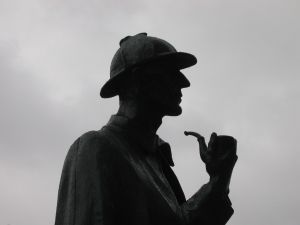
Holmes Statue at Baker Street

Lestrade has established a valid argument. The argument in a more structured form could be stated as follows:

hypothesis If the clothes were found by the river then the body must be in the river
observation The clothes were found by the river
conclusion Therefore the body must be in the river

Lestrade also thought it was a sound (or at least a highly probable argument)  based on his actions. He has found the clothes by the river. Based on this evidence (or observation), Lestrade started dragging the Serpentine River looking for a body because of his working assumption that his hypothesis (see table) was true.

However, Holmes frustrates the detective by pointing out (though the argument is valid and the conclusion is probable) there is a faulty  assumption Lestrade is making.

Holmes argument could be stated in a more structured form as follows:

premise A person is always found near their clothes
premise their clothes (or most of them) are in their closet
conclusion Therefore the person is in the closet

Lestrade assumes that the clothes being found by the river would be an indicator that the body would also be found nearby.  While not committing any formal fallacy, Lestrade is close to committing the fallacy of the converse accident by forming his hypothesis as a general rule that will be true in all circumstances, rather than one of several possibilities. His generalization, even if based on his actual experiences as a detective, will turn out to be incorrect.

If the hypothesis Lestrade accepted was correct, then he would have a more probable chance of success in finding the missing bride by looking in her closet.

This is a good illustration reminding all of us that a valid argument can turn out to be false. While it can be argued that it is probable that the body was in the river, the clothes could also have been placed by the river for a variety of reasons that do not include the body being in the river as the rest of the story shows to be the case.

Where the clothes are the person must also be: another lesson in logic

We balance probabilities and choose the most likely. – Holmes

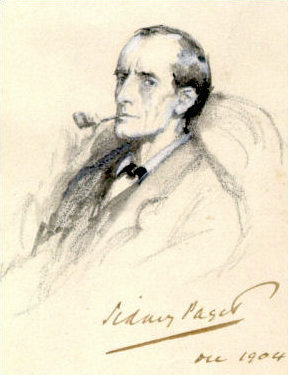
Sherlock Holmes (Wikipedia)

As pat of the Senior Seminar, we discussed the reality that people don’t write out there arguments in logical form. Part of the brilliance of the Socratic Method was the use of questions to explore and probe a person’s view to expose the underlying assumptions, gaps, and contradictions that may exist.  Having looked at the hypothetical form of  a philosophical argument, let’s use The Adventure of the Noble Bachelor to practice identifying these arguments within a story.

The official detective was attired in a pea-jacket and cravat, which gave him a decidedly nautical appearance, and he carried a black canvas bag in his hand. With a short greeting he seated himself and lit the cigar which had been offered to him.

“What’s up, then?” asked Holmes with a twinkle in his eye. “You look dissatisfied.”

“And I feel dissatisfied. It is this infernal St. Simon marriage case. I can make neither head nor tail of the business.”

“Really! You surprise me.”

“Who ever heard of such a mixed affair? Every clue seems to slip through my fingers. I have been at work upon it all day.”

“And very wet it seems to have made you,” said Holmes laying his hand upon the arm of the pea-jacket.

“Yes, I have been dragging the Serpentine.”

“In heaven’s name, what for?”

“In search of the body of Lady St. Simon.”

Sherlock Holmes leaned back in his chair and laughed heartily. “Have you dragged the basin of Trafalgar Square fountain?” he asked.

“Why? What do you mean?”

“Because you have just as good a chance of finding this lady in the one as in the other.”

Lestrade shot an angry glance at my companion. “I suppose you know all about it,” he snarled.

“Well, I have only just heard the facts, but my mind is made up.”

“Oh, indeed! Then you think that the Serpentine plays no part in the matter?”

“I think it very unlikely.”

“Then perhaps you will kindly explain how it is that we found this in it?” He opened his bag as he spoke, and tumbled onto the floor a wedding-dress of watered silk, a pair of white satin shoes and a bride’s wreath and veil, all discoloured and soaked in water. “There,” said he, putting a new wedding-ring upon the top of the pile. “There is a little nut for you to crack, Master Holmes.”

“Oh, indeed!” said my friend, blowing blue rings into the air. “You dragged them from the Serpentine?”

“No. They were found floating near the margin by a park-keeper. They have been identified as her clothes, and it seemed to me that if the clothes were there the body would not be far off.”

“By the same brilliant reasoning, every man’s body is to be found in the neighbourhood of his wardrobe.”

Since most people don’t write out there arguments in logical form (which is not saying the argument is illogical), it is good practice to examine a portion of a narrative and write out the argument being made. Can you write the two arguments made in this portion of the story?

Lestrade:

hypothesis
observation
conclusion

Holmes points out that there is an unstated assumption Lestrade is making.

Holmes: restating Lestrade’s argument (in categorical form)

premise
premise
conclusion

Is Lestrade’s argument valid? Is it sound?

The hypothetical barking dog: a lesson in logic

Sherlock Holmes (wikipedia)


This month our church is hosting a Senior Seminar. In this seminar we invite graduating seniors to join us as we attempt to give them a crash course in the big choices they will face as they head off to college or the work force. One of these areas we explore in the seminar is worldviews and philosophy.

Honoring the fact that the Presidential election has gone to the dogs (a sad commentary on political discourse), this post uses dogs to examine the basic hypothetical form of a philosophical argument. To set up the scenario we are going to use the barking dog hypothesis found in the Sherlock Holmes adventure – Silver Blaze.

Colonel Ross still wore an expression which showed the poor opinion which he had formed of my companion’s ability, but I say by the inspector’s face that his attention had been keenly aroused.

“You consider that to be important?” he asked.

“Exceedingly so.”

“Is there any point to which you would wish to draw my attention?”

“To the curious incident of the dog in the night-time.”

“The dog did nothing in the night-time.”

“That was the curious incident,” remarked Sherlock Holmes.

“Before deciding that question I had grasped the significance of the silence of the dog, for one true inference invariably suggests others. The Simpson incident had shown me that a dog was kept in the stables, and yet, though someone had been in and had fetched out a horse, he had not barked enough to arouse the two lads in the loft. Obviously the midnight visitor was someone whom the dog knew well.”

That basis of Holmes argument starts with the hypothesis that when a dog detects an intruder it will bark.

Writing this out as a premise in an argument would look like this:

If (a dog detects an intruder) then (the dog will bark)

This seems like a premise that that has a high degree of probability of being true most of the time. Of course there are unstated assumptions like the dog is healthy and can see, smell, and hear, is not drugged, and can actually bark. Holmes assumes this hypothesis is reliable, having the testimony that dog is used as a guard dog along with the lads to make sure the horse is not stolen.

In a hypothetical form of a philosophical argument the concept of a dog detecting an intruder is called the antecedent. It represents a cause and is often represented by a P.

The concept of the dog barking is called the consequent. It represents an effect and is often represented by a Q.

Using this as a starting point, we can look at the hypothesis and 4 different ways to arrive at a conclusion based on what the second premise in the argument attempts to either confirm or deny.

Note the hypothetical stays the same in all 4 cases, in which we have asserted that P is a cause of the effect Q. We are also assuming that this hypothesis is true. We are only attempting to verify the conclusion that each argument is making. If this hypothesis is false then the conclusion of each argument would also be false (or at least unproven by the argument).

Modus Ponens: Affirming the Antecedent

hypothetical If (a dog detects an intruder) then (the dog will bark)
premise The dog detects an intruder
conclusion Therefore the dog barks
  • If P is really a cause of Q and the premise that the dog detected an intruder is true (P is true), it will be true that the dog barked (Q is true).

Modus Tollens: Denying the Consequent

hypothetical If (a dog detects an intruder) then (the dog will bark)
premise The dog did not bark
conclusion Therefore the dog did not detect an intruder
  • If P is really a cause of Q and the premise that the dog did not bark is true (not Q), it will be true that the dog did not detect an intruder (not P).
    • The dog did not bark so the cause was missing, which was how Holmes arrived at the conclusion that the person who took the horse could not have been a stranger to the dog.

Fallacy: Denying the Antecedent

hypothetical If (a dog detects an intruder) then (the dog will bark)
premise The dog did not detect an intruder
conclusion Therefore the dog did not bark
  • If P is really a cause of Q and the premise that the dog did not detect an intruder is true (not P), it will not necessarily be true that the dog did not bark (not Q).
    • This is a fallacy because Q may occur for other reasons
    • The dog may have barked because it was hungry or playing etc.

Fallacy: Affirming the Consequent

hypothetical If (a dog detects an intruder) then (the dog will bark)
premise The dog barks
conclusion Therefore the dog detects an intruder
  • If P is really a cause of Q and the premise that the dog barks is true (Q), it will not necessarily be true that the dog detected an intruder (P).
    • This is a fallacy because Q may occur for other reasons
    • The dog may not have barked because of an intruder, but because it was hungry or playing etc.

Once we have established these valid and invalid forms of an argument we can apply them to more interesting cases.

Give this one a try:

hypothetical If (humans and chimps have a common ancestor) then (humans and chimps have similar genetic makeup)
premise humans and chimps have similar genetic makeup
conclusion Therefore humans and chimps have a common ancestor

Is this a valid argument?

Israel and the Inspiration of Scripture (Scripture and the Authority of God by N.T. Wright)

This is part 3  of the series blogging through the book Scripture and the Authority of God by N.T. Wright. You might want to start with part 1. 

Having laid out a thesis (see part 1) and presenting the problems with how scripture is used as authoritative today (see part 2), Wright sets out to examine the use of scripture across different periods of time.

In chapter 2,Wright looks at Israel’s use of scripture and touches on the idea that these writings were inspired by God.

“Inspiration” is a shorthand way of talking about the belief that by his Spirit God guided the very different writers and editors, so that the books they produced were the books God intended his people to have. This is not the subject of the present book, but we should note that some kind of divine inspiration of scripture was taken for granted in most of the ancient Israelite scriptures themselves, as well as in the beliefs of the early Christians.

While it would be difficult to fully understand Wright’s view of inspiration since he leaves that term packed in a suitcase, it would appear that Wright holds to God being actively involved in the writing and editing process of the scriptures. The result of this process was the creation of the books that God intended Israel (and by extension us) to have today. I am not sure why Wright felt that the topic of inspiration did not require a more in depth treatment in a book that deals with the authority of scripture since the two ideas are related.

A small opening in the suitcase packed with Wright’s ideas on inspiration can found in the lecture/essay, published in Vox Evangelica. In this essay God is shown to exercise His authority by delegating it to prophets who carried forth His message and through whom God was able to work and accomplish His purposes.

That is how God brought his authority to bear on Israel: not by revealing to them a set of timeless truths, but by delegating his authority to obedient men through whose words he brought judgment and salvation to Israel and the world.

The example given for this idea is Micaiah, a prophet who foretells Ahab’s doom (1 Kings 22). Wright goes on to explain that Jesus, to Whom all authority has been given, has delegated this authority to the prophets and their writings:

Thus it is that through the spoken and written authority of anointed human beings God brings his authority to bear on his people and his world. Thus far, we have looked at what the Bible says about how God exercises his judging and saving authority. And it includes (the point with which in fact we began) the delegation of his authority, in some sense, to certain writings.

Moving back to the book, since scripture is comprised of the books God intended for us to have and in some way have been delegated authority, Wright explains the purpose of these books.

When full allowance is made for the striking differences of genre and emphasis within scripture, we may propose that Israels sacred writings were the place where, and the mean by which, Israel discovered again and again who the true God was, and how his Kingdom-purposes were being taken forward.

The two key points here are that Israel was able to discover who the true God is apart from the false gods and idols that surrounded them and could learn how to live in expectation of the Kingdom purposes that were unfolding. For Wright these purposes are God’s dealing with the problem of evil and the renewal of creation.

Wright then explains that the “Word of God” is not just a synonym for the written words but also refers to an “elusive, but powerful idea” that God is present and working through the scriptures. This idea is called speech-acts, a term left undeveloped in the book. We get a glimpse of what this might mean looking back to chapter 1:

God does indeed speak through scripture. But we cannot either reduce God’s speech to scripture alone, or for that matter ignore the fact … that “speech” must itself be thought of in terms of “speech-acts“, the deeds are performed by the fact of speaking at all, in particular saying certain types of things

The study of speech-acts focuses on what is said, what was meant, and the actions that are the result of the words that were spoken or written. An example from About.com:

“We use the term speech act to describe actions such as ‘requesting,’ ‘commanding,’ ‘questioning,’ or ‘informing.’ We can define a speech act as the action performed by a speaker with an utterance. If you say, I’ll be there at six, you are not just speaking, you seem to be performing the speech act of ‘promising.’

The point that Wright is making, at least the point I think he is trying to make, is that scripture is more than the written words or timeless truths that they contain but the intent and implications of the one who utters them. Thus at the heart of scripture is, not only words on a page, but the fact that God is acting and transforming and renewing us (Rom 12:2; 2 Cor 5:17).

For someone noted as being a clear and articulate writer and theologian, I have found Wright elusive and difficult to understand regarding exactly how he views authority and inspiration.What does Wright mean when he says that God’s Spirit guided and produced the books that God intended? How does this view differ with the evangelical understanding of this idea (or does it)? And how could this happen without implying some amount of infallibility to the books (which is not dealt with in the book)? However, while Wright’s views regarding inspiration may not fully align with the Chicago statement on inerrancy, we can conclude that Wright holds to the view that scripture was written with the aid of the Holy Spirit and has been delegated authority from God.

While I may go further than Wright in my views on inspiration I agree with much of what he has outlined so far.

  • God guided men in the writing and editing process of creating the written scriptures that He intended.
  • God delegates His authority to these writings.
  • God works through these writings to make Himself known, to transform His people, and to equip His people to accomplish His purposes.

What do you make of Wright’s view of inspiration? Does it imply some degree of infallibility?

If you reject Wright’s view of inspiration, in what way do you see scripture having authority and how do you think we are to discover who the true God is?

Do you know of anything Wright has written that expands and explains his views on these topics?

Rachel Held Evans is also blogging through this book. In her post this week, the entry centered on inspiration and the term the “Word of God”. I encourage you to check out the post and following discussion.

ASIDE: If you have not seen this yet, you should check out the satire, Tom Wright reads Humpty Dumpty.

[Continue reading through the series: part 4]

What is Scripture? (Scripture and the Authority of God by N.T. Wright)

This is part 2  of the series blogging through the book Scripture and the Authority of God by N.T. Wright. You might want to start with part 1. 

When the question is asked – what is Scripture? – what is the first thing that pops into your head?

Was it the revelation of God, 66 infallible books, or Basic Instructions Before Leaving Earth? Whatever your answer was, this is the question raised by Wright in the closing pages of chapter one. He is not asking the question regarding how many books, which books, or these kinds of questions we might have when posed with that idea. Nor has he grappled with views on inspiration or inerrancy.

Rather his aim is to explore the question what does Scripture contain that makes it authoritative? In the closing pages of chapter 1 under the section Transcending Revelation, Wright says that scripture is more than simply “conveying information” or a “record of revelation”. His goal is to help us grapple with the idea that scripture should be understood as more than “merely conveying true religious, theological, or ethical information” but as the story of God’s mission to renew creation.

Initially I struggled with what Wright really meant by this section. This book is based on the lecture and subsequent essay, How can the Bible be Authoritative (pdf), which was originally published in Vox Evangelica back in 1991. Even though the book is supposed to be a more lengthy treatment on this topic, the essay gives a more clear picture of what Wright seems to be asserting here. At least it did for me.

He lists three methods that ‘belittle the Bible’ as they attempt to make use of the scriptures in an authoritative way. These three methods are treating the Bible as a ‘repository of timeless truths’, a ‘witness to primary events’, and/or as having a ‘timeless function to perform’.

The problem with seeing the scriptures as a authoritative because they are a repository of timeless truth, according to Wright,  is that the reader can lose sight of the fact that each book of the Bible was written at a specific point in history within the context of a particular culture.

There are some senses in which that is true. But the sense in which it is normally meant is certainly not true. The whole Bible from Genesis to Revelation is culturally conditioned. It is all written in the language of particular times, and evokes the cultures in which it came to birth. It seems, when we get close up to it, as though, if we grant for a moment that in some sense or other God has indeed inspired this book, he has not wanted to give us an abstract set of truths unrelated to space and time. He has wanted to give us something rather different, which is not (in our post-enlightenment world) nearly so easy to handle as such a set of truths might seem to be.

This is a good precaution and reminder that we need to wrestle and work through what the text says and what that meant within its historical setting and literary form. However I am not sure why this prevents us from digging out truths and principles that are timeless and authoritative (more on this later).

The problem with understanding scriptures as a authoritative because they are a witness to primary events, according to Wright, is that we shift authority  away from Scripture and onto the historical event.

[Taking scripture as a witness to primary events] has the merit of taking seriously the historical setting, the literal sense of the text. The problem about that, however, can be seen quite easily. Supposing we actually dug up Pilate’s court records, and supposing we were able to agree that they gave a fair transcript of Jesus’ trial. Would they be authoritative in any of the normal senses in which Christians have claimed that the Bible is authoritative? I think not. … authority has shifted from the Bible itself to the historically reconstructed event or experience. We are not really talking about the authority of the Bible at all.

Wright’s problem with understanding scriptures as authoritative because of the timeless function they perform is the most unclear to me, given the direction Wright is going. The book is highlighting the need to view scriptures as a meta-story which has the function (which I assume is timeless) of calling people to take part in that story. Yet he claims that this idea does not do justice to the Bible.

For Bultmann, the New Testament functioned (among other things) as issuing the timeless call to decision. For Ignatius and those who have taught Jesuit spirituality, it can be used in a timeless sense within pastoral practice. Now, this is not a million miles from certain things which I shall be suggesting later on in this lecture as appropriate uses of scripture. But at the level of theory it is vital that we say, once more, that such uses in and of themselves are not what is primarily meant when we say that the Bible is authoritative: or, if they are, that they thereby belittle the Bible, and fail to do justice to the book as we actually have it.

The problem in a nutshell:

Once again, it is not really the Bible that is being regarded as the “real” authority. It is something else.

Basically [these methods] imply … that God has, after all, given us the wrong sort of book and it is our job to turn it into the right sort of book by engaging in these hermeneutical moves, translation procedures or whatever.

I don’t think Wright is denying that scripture contains timeless truth, is a witness to primary events, or lacks timeless purposes, although that impression can be left on the reader. He rather is stating that these do not make the scripture authoritative because they shift that authority elsewhere. However, what is still unclear at this point in the book is how his solution to this problem differs from these other methods. Lastly, I am not sure how treating scriptures as a narrative will not require its own “hermeneutical moves” that will involve all of the methods above.

[Continue reading through the series: part 3]