Clear and Present Danger

Clear and Present Danger is not just a good book and later movie but got its start in the Supreme Court of the U.S. (SCOTUS) way back in 1919. Justice Oliver Wendell Holmes Jr., writing the unanimous opinion for the SCOTUS in the case Schenck v. United States, gave us the clear and present danger test. It states in essence that there are times when the 1st Amendment right to free speech may be restricted. The test was actually refined through additional cases as a means to protect speech unless the immediate threat of illegal activity was present.

The question in every case is whether the words used are used in such circumstances and are of such a nature as to create a clear and present danger that they will bring about the substantive evils that Congress has a right to prevent. It is a question of proximity and degree.  (emphasis added)

Martin Luther (Lucas Cranach the Elder 1526)

In Luther’s introduction to his commentary on Galatians, he articulates his own test for clear and present danger when it comes to matters of theology.

I have taken in hand, in the name of the Lord, once again to expound this Epistle of St. Paul to the Galatians: not because I desire to teach new things, or such as you have not heard before, but because we have to fear, as the greatest and nearest danger, that Satan take from us the pure doctrine of faith and bring into the Church again the doctrine of works and men’s traditions.  (emphasis added)

There are areas where people can have theological differences, but whenever the gospel itself is being compromised then we must rise up to define and defend it. Why?

If this doctrine is lost, then is also the whole knowledge of truth, life and salvation lost.

Consider the danger that is present when someone teaches that people are right before God on the basis of the “works of the law” (active righteousness).

There is a danger to:

  • the one teaching “another gospel” whom Paul tells to ‘go to hell’ (Gal 1:8-9)
  • the people who are led astray by this false teaching and find themselves without Christ (Gal 5:4)
  • the preservation of the gospel itself (2:5)

In order to understand and defend the gospel, according to Luther, we have to know the difference between two types of righteousness. That which is active and that which is passive.

An active righteousness, as defined by Luther, is one that is achieved through our natural strength and abilities. It is earned through work and effort and is contrary to grace.

A passive righteousness is one that is not worked for. It is achieved by the strength and abilities of another and we receive it by grace through faith. This righteousness is contrary to works.

In contrasting these two forms of righteousness Luther asks a question and then emphatically answers it:

Do we then do nothing? Do we do nothing at all for the obtaining of this righteousness?

I answer, Nothing at all.

If we do nothing then is passive righteousness received by all? Though it is available to all, sadly, not all receive it. In order to receive this righteousness, nothing is done. However there must be an apprehending of this righteousness through faith. Is faith a work, thus making passive righteousness a form of active righteousness? No. Not according to Paul.

Now to the one who works, his pay is not credited due to grace but due to obligation. But to the one who does not work, but believes in the one who declares the ungodly righteous,his faith is credited as righteousness. … For this reason it is by faith so that it may be by grace (Rom 4:4-5, 16 NET)

Notice that work and grace are contrasted and considered incompatible. One can’t work for something and say it is by grace. Yet, “not working”, grace, and faith are all shown to be similar and in agreement with each other. No matter what we may think about faith, it is clearly not a “work” or activity that is in conflict with grace.

If we do nothing but have faith then are good works contrary to this form of righteousness? May it never be! One who has accepted passive righteousness should show love and goodness ‘how and wheresoever the occasion arise’. For it is good works that are the “true religion” and are how a follower of Jesus is going to be identified (James 1:27; John 13:35; 1 John 4:8). These good works, which are the expected result of having received passive righteousness, should not be mistaken as the means to earning or keeping what was provided by grace.

Yet we know that no one is justified by the works of the law but by the faithfulness of Jesus Christ.  And we have come to believe in Christ Jesus, so that we may be justified by the faithfulness of Christ and not by the works of the law, because by the works of the law no one will be justified. (Gal 2:16, NET)

The next post will examine Paul’s defense of the gospel in Galatians.

I seek not active or working righteousness, for if I had it, I could not trust it, neither dare I set it against the judgment of God. Then I abandon myself from all active righteousness, both of my own and of God’s law, and embrace only that passive righteousness, which is the righteousness of grace, mercy, and forgiveness of sins. – Luther

[Continue reading through the series: part 3]

Some thoughts on Theological Debate from Galatians

I will be studying and teaching through the book of Galatians during the summer. As I work through the book I plan to share observations and thoughts.

Paul, an apostle— not from men nor through man, but through Jesus Christ and God the Father, who raised him from the dead—and all the brothers who are with me,

To the churches of Galatia (Gal 1:1-2 ESV)

Apostle Paul (painting by Andrei Rublev)

Apostle Paul (painting by Andrei Rublev)

Paul wrote the letter to the Galatians in order to deal with some teachers who arrived some time after he left. These teachers were distorting the gospel that Paul had preached and had introduced the churches to the idea that “real” Christians must be circumcised and follow the Mosaic Law. Their teaching had persuaded many in the church to adopt this view.

There is some debate as to whether the letter to the Galatians was directed to churches in the north or the south of Asia Minor (modern day Turkey). The information available points to the probability that the latter (Southern Galatia) is correct. This would mean the recipients of the letter were the churches that Paul planted on his first missionary journey (1MJ).

The letter was likely written from the city Antioch around 48-49 AD. Antioch was Paul’s home church. It was where he taught and ministered before and after the 1MJ. It was this church that confirmed his role as a missionary to regions beyond Judea and Samaria (Acts 13:1-3).

Prior to Paul writing the letter, teachers arrived in Antioch bringing with them their case for following the Mosaic Law, which was  the same issue that confronted the churches of Galatia. Paul was a man of action and great conviction and engaged these teachers in what must have been heated theological debate.

Now some men came down from Judea and began to teach the brothers [in Antioch], “Unless you are circumcised according to the custom of Moses, you cannot be saved.” When Paul and Barnabas had a major argument and debate with them, the church appointed Paul and Barnabas and some others from among them to go up to meet with the apostles and elders in Jerusalem about this point of disagreement. (Acts 15:1-2 NET)

This issue over whether following the Mosaic Law was required to be saved was also prevalent in the city of Jerusalem, even within the communities of the apostles (Acts 15:4-5). Surveying a map, that would mean that this teaching regarding circumcision and the law was not a localized problem (in Galatia) but had spread throughout the entire region where the gospel of Christ was preached. And it was causing disunity and dissension in the churches.

The teachers, were not denying that Jesus was the Messiah of Israel or that He had died and been raised from the dead. If they had it would be unlikely that Luke would have called them ‘brothers’ (Acts 15:5) or that they would have had much influence within the churches. However they were contradicting the gospel that those at Antioch had brought with them when they fled Jerusalem amid the Jewish persecution of Christians. Ironically this persecution was directed by Paul who was then called Saul (Acts 8:1; Gal 1:13).

As Paul was engaging in this debate and watching the unity that Antioch enjoyed be shred apart he was (probably) informed that the problem had spread to the fledgling churches in Galatia as well. Paul knew that these new churches did not have mature and capable leaders, like he and Barnabas, to confront the arguments of these teachers and sat down to write the letter.

In the dealing with the theological issues of the day, Paul exhibited the famous quote ‘in essentials, unity; in non-essentials, liberty; in all things, charity’. Here are 4 observations on theological debate that we can learn from Paul.

Take time to understand the alternate point of view

Paul probably listened and understand the point of view of those he disagreed with. After all Paul was Jewish, schooled as a Pharisee, and known as an expert in the Law so he was able to grasp the nuances of their theological view (Gal 1:14).

This enabled him to effectively debate the teachers and deal with the issues caused by what these teachers taught (Acts 15:1-4; Gal 2:15-4:7). If Paul had built a straw-man out of their teaching and then dismantled this rather than deal with the actual content he might have drawn some cheers from those who agreed with him, but he would not have been as effective at helping those who were struggling to determine which point of view was correct. Nor would he be able to help these teachers understand where they went astray so they might repent (2 Timothy 2:24-26).

Be willing to turn from our currently held positions to adopt another view

Paul strongly defended the gospel against distortions without yielding for a moment (Gal 2:5). But we must also remember that Paul was a Pharisee who studied under Gamaliel (Acts 22:3; Gal 1:14 ; Phil 3:4-6) and was zealous for God and the Law. He was a persecutor of the Way (Acts 22:4-5 ;Gal 1:13). However, when Paul was confronted with Jesus and the truth he had a choice to make. He could remain entrenched in his position regarding the Messiah or accept Jesus and follow Him.

Not many will have the convincing proof of a personal visit from Jesus the risen Lord to help correct a wrongly held theological position, but the principle is one we can still learn from. We must be humble enough to examine the positions we hold and give them up when another position is more probable and defensible as being correct.

Fight for unity but not at the cost of essentials

We are called to live in peace and unity with each other (Ephesians 4:1-4; Phil 1:27). In order to do that we must accept the fact that we will have differences of opinion on various theological matters (Romans 14:1). When we have differences over non-essentials we must work hard to preserve unity and not cause stumbling blocks. However we are also called to ‘contend for the faith’ (Jude 1:3; 1 Tim 1:18-19;6:3-5) when the essentials – like the gospel – are being distorted.

Of course wresting with what is essential and what is a non-essential is tough. I highly recommend this post from the Parchment and Pen blog to help evaluate where different issues might fit.

Compassion for the lost and immature

As Paul returned to Antioch after the 1MJ he must have been optimistic and excited about the new churches that were planted in the area of Southern Galatia and the new believers that made up these communities. Just a few years later, as he writes the letter to Galatians those feelings have been replaced by angst and confusion.

Paul is not concerned with winning the argument as much as he is with winning souls and helping people grow in Christ. Paul is surprised at the way the Galatians have adopted ‘another gospel’ and abandoned Jesus and he pleads with them throughout the letter to seriously consider what he has to say and to adopt the gospel they received during the 1MJ. The concern, emotion, and even frustration all come through as one reads the letter since Paul understands what is at stake when the gospel is distorted and corrupted.

What else might we learn from Paul on how to handle theological debates?

[Continue reading through the series: part 2]

The Five Act Hermenuetic (Scripture and the Authority of God by N.T. Wright)

This is part 6  of the series blogging through the book Scripture and the Authority of God by N.T. Wright. You might want to start with part 1 and work your way through the series.

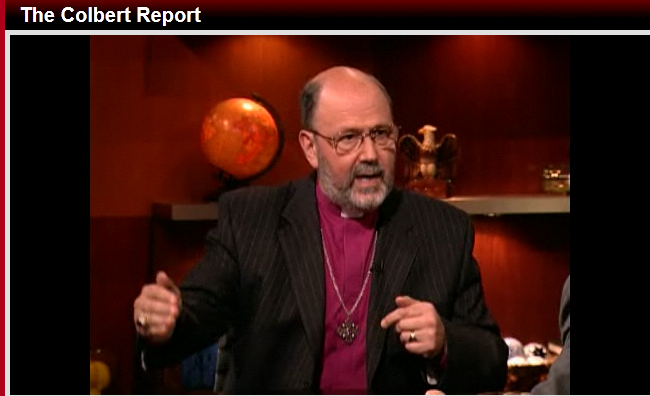
N.T. Wright on Colbert Report

Wright (and this series) started off posing the following questions:

  • If Jesus has authority, what do we mean by authority?
  • How does Jesus exercise His authority through the Bible?
  • Since the Bible is mostly narrative, how can a story be authoritative?

Wright also posed the problem that whenever we go to the scriptures to dig out ‘timeless truths’ rather than the ‘story’ we run the risk of letting something else possess the “real” authority. As he chronicles the various hermeneutic approaches throughout church history (chapters 3 through 6) he unpacks what that something else is:

This is where we see a tension developing between authority and interpretation: How far can a reinterpretation of the text go before it ceases to carry the authority which was the point of interpreting it in the first place? At what point in this process are we forced to conclude that what is reallyauthoritative” within such an operation is the system of theology or devotion already embraced on other grounds, which is then “discovered” in the text by the interpretative method being used? … The question must always be asked, whether scripture is being used to serve an existing theology or vice versa. (page 67, 71)

These are excellent questions. Whenever we are wrestling with a text and its meaning we come with lots of assumptions, cultural baggage, philosophical views, and theological commitments. Wright offers strategies for reading scripture which include reading in light of total context (surrounding passages, theme of the book, historical, and cultural settings), reading all of scripture (not just the parts we like), and using scholarship to provide insight and information on the history, culture, and language.

Wright also stresses that we need to be attempting to get the real “literal” meaning. This real literal meaning is defined as the intended meaning of the original author and not the “literal” reading of the words (112,135) . This allows for an interpretation to be more literal by using allegory or metaphor since that was how the author intended the text to be understood. Wright is correct, our goal is to understand the “original intent and message” of the text taking into account language, idioms, literary genre, and the history and culture at the time it was written.

The 5 Act Hermeneutic

The hermeneutic (a fancy word for framework) that Wright advocates focuses on the story line that runs through the pages of scripture from Genesis to Revelation and finds its climax in the hero of the story Jesus. The authority of scripture then is found in the telling of the story.

Somehow, the authority which God has invested in this book is an authority that is wielded and exercised through the people of God telling and retelling their story as the story of the world, telling the covenant story as the true story of creation. Somehow, it is wielded (it seems) in particular through God’s telling the story of Jesus. (essay on How can the Bible be Authoritative (pdf))

Wright outlines the story as five acts in a play, acknowledging that not everyone will see the acts the same way.

  1. Creation
  2. Fall
  3. Israel
  4. Jesus
  5. Church

There are three keys to this model that pop out throughout the book. First, the story consists of different acts in which each act has both some “continuity and discontinuity” with the act that preceded it and the act that follows it. Second, we must remember that we are living in the 5th act and are free to improvise within the story. Third, the major task for the improv actors in the 5th act is to tell and act out the story.

The major theme of continuity throughout these acts is that God’s creation was good and God has promised to deal with evil and restore creation. A key break (discontinuity) is found between the OT and the NT.

God was fulfilling the covenant promises to Abraham by creating a single multi-ethnic family, those regulations in the Mosaic law which explicitly marked out Jews from their non-Jewish neighbors were not to be set aside, not because they were not good, or not given by God, but because they had been given for a temporary purpose which was now complete (54).

Seeing the authority of scripture within the model of a story has some advantages that should be considered during reading and studying the scriptures.

  • Jesus is the one who possesses authority and is the hero of the story.
  • keeps the Kingdom (and restoration of creation) in focus.
  • scripture is taken as an integrated whole.
  • acknowledges that much of scripture is primarily written in a narrative form.
  • can remove the tendency to “proof text” or see the Bible as a “rule-book”.
  • reminds us we are to live out scripture not just “know stuff”.

The improvisation is not the part of the model that is problematic. Not many people would deny that each person is called to live out their life as a follower of Christ in a dynamic way that is different from others. The exciting and scary part of life is evaluating the way God is gifting and guiding us to fulfill the great commission. However, as Wright cautions in the book we need to make sure we don’t turn “something” else into the authority. In this approach we need to make sure that we don’t make the “real” authority our ability to improvise and end up writing our own version of the story instead taking part in God’s story. We also can’t be so focused on the openness of the story that we lose sight of the principles that we are called to live by in scripture and forget that with this freedom to improvise comes responsibility.

There will always be debate and varying views on what an author meant by a particular passage, what language and cultural factors are involved, and how a passage should be applied today. This model does not solve that problem. It just adds to the debate, how a passage fits into the storyline. That is not a bad thing, but we should not assume that this model will allow there to be unity in how passages are interpreted. Wright seems to know this. He asks lots of questions throughout this book, an important one (found on page 81) reminds us that we will always be contending with the problem of whose view of what the original author meant will count?

An aside on Act 1 and 2

Wright posted excerpts from the essay, which preceded the book, on the BioLogos site. BioLogos is a group that promotes theistic evolution. There are a variety of views within  theistic evolution regarding creation, Adam/Eve, and what the fall was, but most see Genesis 1-3 as a non-historical story. The denial is not that God created the heavens and earth, but that the “details” in these chapters are not historically accurate. The story and intended meaning of Genesis 1-3 is not to tell us “the how” of creation (or the fall) but to convey the truth that God is the good Creator and man is his creation.

Wright adopts this view, yet in his model he proposes the first two acts as a creation and fall. And the whole meta-story and his view of authority rests on the idea of a Kingdom that will come and will result in restoring a creation in need of redemption. He also roots his argument (chapter 9) that the Sabbath rest was a sign that God will redeem creation on God’s 7th day of rest in Genesis. How does one, particularly Wright, reconcile the issues raised in the story with a theistic evolutionary model? At what point did God rest and enjoy His creation in the theistic evolution view if there is no day 7? If creation was created good, but now is “cursed” and in need of restoration then how and when did the “curse” happen? How all this works out in Wright’s model is another suitcase that he left packed tight. Yet it seems critical to the story and the 5 act model.

More signs you may be a Zombie

Featured

You have the reputation of being alive, but you are dead. – Jesus

The zombies are not just in Sardis, but apparently Ephesus has been affected as well. Based on the information from that location here are a few more warning signs that you may be a zombie. Be sure to examine yourself. If you are new to the land of the undead you may want to check out these signs before progressing any further.

Plants v Zombies

Plants v Zombies (PopCap)

  • Mindless Wandering

Zombies are known for their mindless lumbering through the streets and lands seeking their next victim. They have no direction in life except to satisfy their own passions and desires for brains. As they wander about there is no consideration or compassion for others. There clearly is an outbreak in Ephesus according to this report from Paul (Eph 4:18-19).

They are darkened in their understanding, alienated from the life of God because of the ignorance that is in them, due to their hardness of heart. They have become callous and have given themselves up to sensuality, greedy to practice every kind of impurity

If you are into mindless wandering you are likely to exhibit this other sign.

  • Craving things which harm others

We are called to love one another and serve one another. However, zombies take this passage a little to literal – loving to eat others and serve them to other zombies during meal time. Zombies have an insatiable craving and desire for brains. And Paul warns us to beware of being caught up in a zombie feeding frenzy (Gal 5:15):

But if you bite and devour one another, watch out that you are not consumed by one another.

Not a pretty sight! And let’s face it eating the brain is not something that is helpful, edifying, or focusing on the needs of that person. Yet neither is adultery, stealing, or coveting (Rom 13:9).

“You shall not commit adultery, You shall not murder, You shall not steal, You shall not covet,” and any other commandment, are summed up in this word: “You shall love your neighbor as yourself.”

And giving into to these temptations and cravings is a sure sign you are a zombie. As Paul warned Timothy in Ephesus (1 Tim 5:6), before breaking Zombie Land Rule #29 the Buddy System and leaving him behind:

But [the one] who lives for pleasure is dead even while [they] live.

If we want to avoid being a zombie (or just avoid becoming part of a zombie happy meal) we must remember Zombie Land Rule #7 Travel Light and the unofficial yet related rule No Attachments. As in no attachments to the things of this world and being content. It is the coveting of all those things that we think will give us happiness that can weigh us down and devour and consume us. Paul reminds Timothy that unhealthy craving for controversy and wealth among other harmful desires are the root of poor choices that lead to ruin and and loss of faith (1 Tim 6).

  • Hard to Kill

Zombies are notoriously hard to kill. They may be slow and mindless but they are tough. You can cut off their hands, tear off their feet, and pluck out eyes, but they just keep coming.They are relentless in their pursuit of what gives them pleasure. Jesus also reminded us about how hard it was to stop craving the things that tempt us and harm others (Matt 18:8-9; 5:27-30):

And if your hand or your foot causes you to sin, cut it off and throw it away. It is better for you to enter life crippled or lame than with two hands or two feet to be thrown into the eternal fire. And if your eye causes you to sin, tear it out and throw it away. It is better for you to enter life with one eye than with two eyes to be thrown into the hell of fire. – Jesus

Whether it is brains or something else that tempts you to sin, these cravings can be just as hard to kill as a zombie. You can start hacking away but it will not stop you from desiring those things. The only thing you will manage to do is become a blind, one handed sinner with a limp. There is no point in cutting off extremities when only a blow to the head will work.

We need to take Zombie Land Rule #2 double-tap to heart. The first shot to the head is so we stop being undead. We might look like we are alive, but we are dead without Jesus (Eph 2:4-5):

But God, being rich in mercy, because of the great love with which he loved us, even when we were dead in our trespasses, made us alive together with Christ— by grace you have been saved

While being made alive is all about what Christ has done, it can’t stop us from living like zombies unless we take that second head shot (Eph 4:17; 5:2).

Now this I say and testify in the Lord, that you must no longer walk as the Gentiles do, in the futility of their minds.

[But] walk in love, as Christ loved us and gave himself up for us, a fragrant offering and sacrifice to God.

We need to be following Jesus so that we can be transformed in our minds and filled with His Spirit. There will be little lasting change without these.

What other signs may indicate we are becoming a zombie?

Signs you may be a Zombie

An article in Immerse Journal by Ben Kerns reminds us that using things that are popular and well understood to explain spiritual truth is important.

As our cultural context becomes increasingly post Christian, we too must become cross-cultural missionaries and find relevant translations and applications to help our students understand the spiritual realities presented in Scripture.

Even Jesus used parables to help bridge the gap between where his students were and the truth He was trying to explain. The article in Immerse Journal mentions using zombies, which I thought was a great idea and jotted it down as a future blogging idea. Why? The undead are not just for students. Zombies are a popular topic at the office and many colleagues have a copy of one the graphic novel volumes – “The Walking Dead” on their desk.


Zombies are the rage, having infested the popular culture. These undead have mindlessly shuffled into the mainstream as they seek to fulfill an insatiable appetite for their favorite snack – human brains. Likely getting their pop status start in George Romero’s 1968 horror movie Night of the Living Dead, these ghouls have taken over with movies, books, video games,  a hit series The Walking Dead, and even a mud run that bills itself as a “Zombie infested 5K Obstacle Course Race”.  Even the CDC has got in on the action, using the popularity of zombies in a campaign for emergency preparedness:

If you're    ready for a zombie apocalypse, then you're ready for any emergency.    emergency.cdc.gov

There are all kinds of emergencies out there that we can prepare for. Take a zombie apocalypse for example. That’s right, I said z-o-m-b-i-e a-p-o-c-a-l-y-p-s-e. You may laugh now, but when it happens you’ll be happy you read this, and hey, maybe you’ll even learn a thing or two about how to prepare for a real emergency.

What’s up with Zombies? I am not sure what makes them so popular – but I have to say they made reading Jane Austen’s Pride and Prejudice a lot more entertaining. And Wikipedia revealed the interesting fact that zombies are not just popular today, apparently they go way back to some of the earliest literature available (Epic of Gilgamesh Tablet 6):

I will knock down the Gates of the Netherworld,
I will smash the door posts, and leave the doors flat down,
and will let the dead go up to eat the living!
And the dead will outnumber the living!

Plants vs. Zombies (Pop Cap)

So, how does someone identify a zombie? Here are some tell-tale signs.

Signs you may be a Zombie

  • You are undead

One sure fire way to know if you are a zombie is to check and see if you are undead. Zombies are known for being undead. Jesus warned the church at Sardis (Rev 3:1) that they were “undead”:

You have the reputation of being alive, but you are dead. – Jesus

Like zombies, you might look alive because you move around and eat stuff but in reality you are dead. You have no real life in you and you need to wake up! Wake up and do what? Remember. Remember what? How about Zombie Land Rule #22 – when in doubt, know your way out.

If you are feeling a bit undead and want to know the way out then I recommend – the Few, the Humble, the Reborn.  Of course knowing your way out doesn’t do much good if you don’t actually use it.

  • You are following the Horde instead of the Hero

Jesus warns the faithful who are in the church at Sardis that they are out-numbered by the “undead” that surround them.

Yet you have still a few names in Sardis, people who have not soiled their garments, and they will walk with me in white, for they are worthy.

Remember, it is no fun being in the middle of a zombie horde, but survival chances are better if you keep Zombie Land Rule #8 in mind. Get a *great* partner. The One who will always be with you and has conquered death and claimed victory over it sounds like a good choice to me.

  • Just a bite and you could have a serious problem.

One generally becomes a zombie as the result of being infected from a plague. And it does not take much to become a zombie, usually just a bite. So one must be on guard. Get too close and you may find yourself with a limited vocabulary (as in “braaaiiinzz”).

If you think you can hang out with a zombie horde and not get infected you better think again. Had Paul been warning us of the dangers of hanging with the wrong crowd using zombies instead of baking as an example, he might of said a little bite infects the whole body instead of ‘a little leaven leavens the whole lump” (Galatians 5:9). Consider also this warning (1 Cor 15:33)

Do not be deceived: “Bad company ruins good morals.

Best advice here is to avoid them.

  • Stay Alert!

For those who are running well and are among the faithful few in Sardis here is one more tip -  the (unofficial) Zombie Land Rule – it’s a marathon, not a sprint. Unless it is a sprint, then sprint. Remember zombies are slow, so no need to waste energy living life like its the 100 yard dash. Most of the time you just have to stay alert and run life like a marathon- with endurance and the right focus. However there are those times when you just gotta run like your life depended on it!

What other signs may indicate we are becoming a zombie?