
In part one we explored the concepts of existence and identity. This entry will take these concepts and apply them to the person as well as to particular persons.
Clark Pinnock, an advocate for CI, argues that “the traditional view of the nature of hell” is based on “the assumption that souls are naturally immortal.”1 A view that he notes goes back to Plato.2
If souls are naturally immortal, they must necessarily spend a conscious eternity somewhere and, if there is a Gehenna of fire, they would have to spend it alive in fiery torment.
… ‘Once [the human soul] exists, it cannot disappear; it will necessarily exist forever and endure without end.’ This has influenced theology for a long, long time … 3
In this post we will examine some of the major theories about the human soul that have influenced theology. We will rely on the preceding post, as it will draw on what it means to exist, as well as the essence and identity as they relate to the person.
In the prior post, existence was defined as being actual rather than merely conceivable or possible. It tells us that an entity is. The essence, or nature tells us what an entity is. The essence can then ground the identity of a particular (a specific statue of Zeus) as well as the larger category (statues).
To attain any
assured
knowledge
about the soul
is one of
the most
difficult things
in the world.
– Aristotle 4
The body and the soul
As a starting point for examining the soul, we will note that everything that has existed, is in existence, or that will exist in the future is something that is created and sustained by God.
[The Son] is the image of the invisible God, the firstborn over all creation, for all things in heaven and on earth were created in him—all things, whether visible or invisible, whether thrones or dominions, whether principalities or powers—all things were created through him and for him. He himself is before all things and all things are held together in him. 5
The idea that a human, created in the image of God, is comprised of both dust (an earthly, perishable body) and a soul which animates it can be found in the creation account of Genesis.
The Lord God formed the man from the soil of the ground and breathed into his nostrils the breath of life, and the man became a living being. 6
In the New Testament Jesus affirms that a human is composed of both body and soul (Matt 10:28).
That the human being is a composite comprised of soul and body is a widely shared conviction among major influential thinkers on this topic including Plato, Aristotle, Augustine, and Aquinas.7 Nevertheless, these thinkers diverge on the question of personal identity. For example Plato locates the essence of the person primarily in the soul. This allows the soul without the body to remain the self in the afterlife. Aristotle, Augustine and Aquinas would identify the human person with the composite of the soul and body. Augustine and Aquinas will argue that the soul can subsist when separated from the body and anchor identity but would be considered incomplete without the body.
Plato and Augustine: The body and the soul
The idea that the human person is in some sense comprised of a soul and a body was present in ancient Greek thought when Socrates began his project on the examined life.
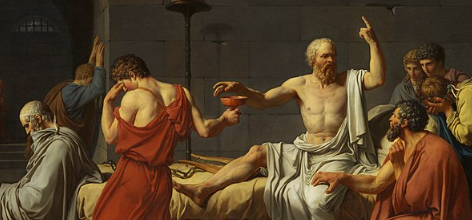
In Phaedo, Plato presents Socrates as he is about to be executed by drinking hemlock. He presents him as prepared to accept his death and uses the occasion to explore the soul.
When Plato is writing, there is then, as there is now, the prevailing view that when a person dies they cease to exist.
[men] fear that when [the soul] leaves the body her place may be nowhere, and that on that very day of death she may be destroyed and perish … issuing forth like smoke or air and vanishing away into nothingness. 8
Plato refutes this idea and sought to show “that when a man is dead the soul still exists and has power and intelligence.” For him the soul was the primary, incorporeal entity that carries personal identity and is capable of knowledge and rationality. It “renders the body alive” and “rational”.
the soul is in the very likeness of the divine, and immortal, and intelligible, and uniform and indissoluble, and unchangeable 9
Plato would further argue that the soul is naturally immortal, having the essential property life.
“What is [it] which will render the body alive?”
“The soul”
…
“What do we call principle which does not admit of death?”
“Immortal”, he said.
“And does the soul admit of death?”
“No”
“Then the soul is immortal?”
“Yes” 10
Plato defines death as the separation of the body and the soul. 11Those souls that were “true disciples of philosophy” would be rewarded with bliss and the reward of remaining separate from the body. Others would be “dragged down again into the visible world.”12
The Platonic view was very influential with how Jewish and Christian thinkers thought about the soul. His ideas were particularly influential with Augustine.13 While fitting Plato’s arguments to Christian theology, Augustine would affirm, like Plato, that the soul was an incorporeal intellect and naturally immortal.14 15
But [the philosophers] who have held its substance to be some kind of life the reverse of corporeal, since they have found it to be a life that animates and quickens every living body, have by consequence striven also, according as each was able, to prove it immortal, since life cannot be without life.16
Augustine would also affirm that “the soul cannot exist without being alive”, which implies, as does Plato, that life is an essential property of the soul. 17
Augustine saw greatness in the soul which animated the body and was the seat of intellect, rationality, memories and life. Augustine thus saw in the soul those properties associated with personal identity. However, Augustine also rejected the Platonic view that the “soul is to be placed in eternal happiness without a body.” 18 Instead he argues that our complete identity is in “the whole man [which] consists of soul and body”. 19
for man is not a body alone, nor a soul alone, but a being composed of both. This, indeed, is true, that the soul is not the whole man, but the better part of man; the body not the whole, but the inferior part of man; and that then, when both are joined, they receive the name of man 20
Aristotle and Aquinas: The body and the soul
Aristotle disagreed with Plato, suggesting that the soul is not a separate entity from the body. His own ideas about existence and identity are grounded in matter and form (see the prior post). His hylomorphic theory guides how he understood the soul.21 Specifically, Aristotle understood a person to be the composite of body (matter) and soul (form).
If we remember, bronze has the potential to be a statue of Zeus. The form “statue of Zeus” actualizes that potential. It is only together (form + matter) that we have a particular statue of Zeus that exists. In a similar way the soul is the form or essence of a living, rational person. It tells us what a person is. It actualizes the potential in physical matter (what is a person made of) organizing it and bringing it life and rationality. It is only together (form + matter) that a particular person exists and has an identity.
the soul is the first grade of actuality of a natural body having life potentially in it.22
It is important to note that despite the similarities between the bronze statue and the living person, for Aristotle there is a key difference. The soul is a principle, not a substance added to a preexisting body. It is only when taken as a composite that a person is said to exist. When a person dies, despite the remaining corpse, Aristotle would say the person no longer exists.
For Aristotle, the soul is not a thing that has life. It is a principle by which anything may be said to be alive.
what has soul in it differs from what has not, in that the former displays life. … Living, that is, may mean thinking or perception or local movement and rest, or movement in the sense of nutrition, decay and growth.23
Aquinas will adopt Aristotle’s theory, and like Augustine’s use of Plato, fit it into Christianity.
whether it be called the intellect or the intellectual soul, [it] is the form of the body. This is the demonstration of Aristotle 24
Like Aristotle and Augustine, Aquinas holds that a person is the composite of body and soul. In the Summa (1.75.4) he commends Augustine’s view that man is “both body and soul” while rejecting Plato’s view that man was “a soul making use of the body.” 25 The soul, as the form, is “the first principle of life in those things which live.” 26
As Aquinas works out his understanding of the human soul he concludes:
that the human soul, which is called the intellect or the mind, is something incorporeal and subsistent.27
He was also assert that the “human soul is incorruptible.”28
Aquinas sees the human soul as intellect and thus of a higher order than animal souls. The latter would cease to exist when the composite animal, also consisting of a body and soul, dies. However, the human soul, as intellect is able to subsist, which is to say it continues to exist even when separated from the body at death. And “it is impossible for a subsistent form to cease to exist.” 29
some powers belong to the soul alone as their subject, as the intelligence and the will. These powers must remain in the soul after the destruction of the body. … Wherefore the composite being destroyed, such [accidental] powers do not remain actually30
When a person dies the soul continues but is incomplete. The substantial properties continue. However, the accidental properties, including sensation, perception, decay and growth, would not survive separation from the body.31 In addition the soul, and its intellectual and volitional aspects, would technically not carry the full identity of the person, which is found only in the composite.
For Aquinas, the soul is considered incorruptible being both intellect and incorporeal. What this means, by way of analogy, is that it does not experience entropy. It does not undergo a state of decay or move toward disorganization on its own. It is a process of corruption or entropy that would result in a substance no longer existing. This is what undergirds Aquinas’ claim that a soul is naturally immortal.
Aquinas argues that there is an abode for the soul when it is separated from its body that is assigned according to how it will be judged at Christ’s return.32 He then, rightly, asserts that every soul will be reunited to the body to be judged.
Hence no soul will remain for ever separated from the body. Therefore it is necessary for all, as well as for one, to rise again.32
Aquinas, noting he agrees with Augustine, will argue that the “identical man will rise again” when the soul is joined to the same body. 33 Since the identity of the person is the composite, it is essential for Aquinas that it be the same body.
it is necessary for the selfsame man to rise again; and this is effected by the selfsame soul being united to the selfsame body. For otherwise there would be no resurrection properly speaking, if the same man were not reformed. 34
Summary
This post has sought to trace the major thinkers that have influenced Christian thinkers about how to understand the soul. Plato and Aristotle are widely recognized as having shaped both Augustine and Aquinas who are themselves influential in how Christianity has understood the soul.
If we generalize things we find that Augustine and Aquinas would affirm:
- The person is a composite of body and soul
- The soul cannot exist without being alive
- The soul is what actualizes a person as a living being
- The soul is incorporeal (not composed of physical matter)
- The soul separates from the body at death
- The soul is subsistent, as it can exist independently, in principle, when separated from the body
- The soul is naturally immortal, not undergoing a process of decay nor death
- The soul is reunited to the same body to face judgment as a living person with the same identity
If one accepts all of these premises, then the argument suggested by Pinnock at the start of this entry flows naturally to its conclusion. The naturally immortal soul, rejoined to the body, must continue to exist as a living being. Those that are wicked would then “live forever” in conscious torment.
In the next entry we will consider alternative understandings of the soul for consideration.
- Pinnock, Clark, Conditional Immortality, in Four Views on Hell: First Edition (p 474-475) Zondervan. Note: this is packaged with the second edition. ↩︎
- Ibid (p 475) ↩︎
- Ibid (p 475) ↩︎
- Aristotle, On the Soul Book I, Part 1
https://classics.mit.edu/Aristotle/soul.1.i.html ↩︎ - Colossians 1:15-17 (NET) ↩︎
- Genesis 2:7 (NET) ↩︎
- This is not to discount other philosophers that have considered the topic of the soul, but rather to focus on those that have (arguably) had the greatest impact on how Christians have thought about it. Two other major thinkers would be Origen and Tertullian. Origen speculates on the soul in First Principles. Tertullian does so in his Treatise on the Soul.
Origen is a much maligned theologian whose speculative proposals suggested that souls were pre-existing rational, volitional intellects with personal identities before embodiment. He also proposed a postmortem healing. These views would stand out and separate him from most other Christian thinkers.
In Book II, chapter 9 of First Principles, Origen notes that the soul is created and endures as God allows: “But since those rational natures, which we have said above were made in the beginning, were created when they did not previously exist, … whatever power was in their substance was not in it by nature, but was the result of the goodness of their Maker. What they are, therefore, is neither their own nor endures for ever, but is bestowed by God. For it did not always exist; and everything which is a gift may also be taken away, and disappear.”
Tertullian would argue that the soul is corporal as well as immortal. In Treatise on the Soul chapter 5, Tertullian will “call on the Stoics also to help” in his arguments against various Greek philosophers as he lays out his own views. This would have him using a different philosophical foundation than Augustine and Aquinas.
In chapter 22 he will summarize his understanding of the soul as follows:
“The soul, then, we define to be sprung from the breath of God, immortal, possessing body, having form, simple in its substance, intelligent in its own nature, developing its power in various ways, free in its determinations, subject to be changes of accident, in its faculties mutable, rational, supreme, endued with an instinct of presentiment, evolved out of one (archetypal soul).“
In chapter 51 he will affirm that “the operation of death is plain and obvious: it is the separation of body and soul” and in chapter 55 that “we have established the position that every soul is detained in safe keeping in Hades until the day of the Lord.”
↩︎ - Plato, Phaedo
Plato: Six Great Dialogues (p 46) Dover
also
https://www.perseus.tufts.edu/hopper/text?doc=Perseus%3Atext%3A1999.01.0170%3Atext%3DPhaedo%3Asection%3D70a ↩︎ - Ibid (p 58) ↩︎
- Ibid (p 81-82) ↩︎
- Ibid (p 41) ↩︎
- Ibid (p 58-59) ↩︎
- In the City of God Book X, Augustine explores the views of Plato and other Platonists such as Plotinus and Porphyry.
In chapter 17 he notes that “philosophers, and especially the Platonists, are with justice esteemed wiser than other men” while also noting that he is just in “emending Plato” citing other Platonists that have also expanded and updated what Plato held.
Chapter 30
“And if this is just, here is a Platonist emending Plato, here is a man who saw what Plato did not see, and who did not shrink from correcting so illustrious a master, but preferred truth to Plato.” ↩︎ - Augustine would note the following in On the Trinity Book XIV chapter 4
“but we must find in the soul of man, i.e., the rational or intellectual soul, that image of the Creator which is immortally implanted in its immortality. … it is therefore called immortal, because it never ceases to live with some life or other, even when it is most miserable.
… yet the human soul is never anything save rational or intellectual; and hence, if it is made after the image of God in respect to this, that it is able to use reason and intellect in order to understand and behold God” ↩︎ - Augustine of Hippo, Stanford Encyclopedia of Philosophy (https://plato.stanford.edu/entries/augustine/#AnthGodSoulSoulBody)
(accessed December 23, 2025) ↩︎ - Augustine, On the Trinity Book X chapter 7
https://www.newadvent.org/fathers/130110.htm
cmp also Book XIII chapter 9, where Augustine applauds the philosophers who arrived at the conclusion that the soul is immortal:
“Assuredly, of those who endeavor to discover it from human reasonings, scarcely a few, and they endued with great abilities, and abounding in leisure, and learned with the most subtle learning, have been able to attain to the investigation of the immortality of the soul alone. ↩︎ - Augustine, City of God Book XIII chapter 24 ↩︎
- Augustine, On the Trinity Book XIII chapter 9 ↩︎
- Ibid. ↩︎
- Augustine, City of God Book XIII chapter 24 ↩︎
- Ancient Theories of Soul, Stanford Encyclopedia of Philosophy
(https://plato.stanford.edu/entries/ancient-soul/#4) ↩︎ - Aristotle, On the Soul Book II part 1
https://classics.mit.edu/Aristotle/soul.2.ii.html ↩︎ - Ibid ↩︎
- Kreeft, Peter. Summa of the Summa: The Essential Philosophical Passages of the Summa Theologica (p. 230). Ignatius Press
Summa 1.76.1 ↩︎ - Ibid (p. 225-226).
Summa 1.75.4 ↩︎ - Ibid (223)
Summa 1.75.1 ↩︎ - Ibid (p 224)
Summa 1.75.2 ↩︎ - Ibid (p 227)
Summa 1.75.6 ↩︎ - Ibid (p 228)
Summa 1.75.6 ↩︎ - Ibid (p 238-239)
Summa 1.77.8 ↩︎ - Ibid (p 235)
Summa 1.75.4
Aquinas explains that the “operation of the sensitive soul” is not proper to a person “apart from the body”. Rather “sensation is not the operation of the soul only. Since then sensation is an operation of man, but not proper to him, it is clear that man is not a soul only. ↩︎ - Summa supplement Q 69 in articles 1 and 2
https://www.newadvent.org/summa/5069.htm ↩︎ - Summa supplement Q 75.2 ↩︎
- Summa supplement Q 79.2 ↩︎
- Summa supplement Q 79.2 ↩︎
 Dead Heroes Don't Save
