
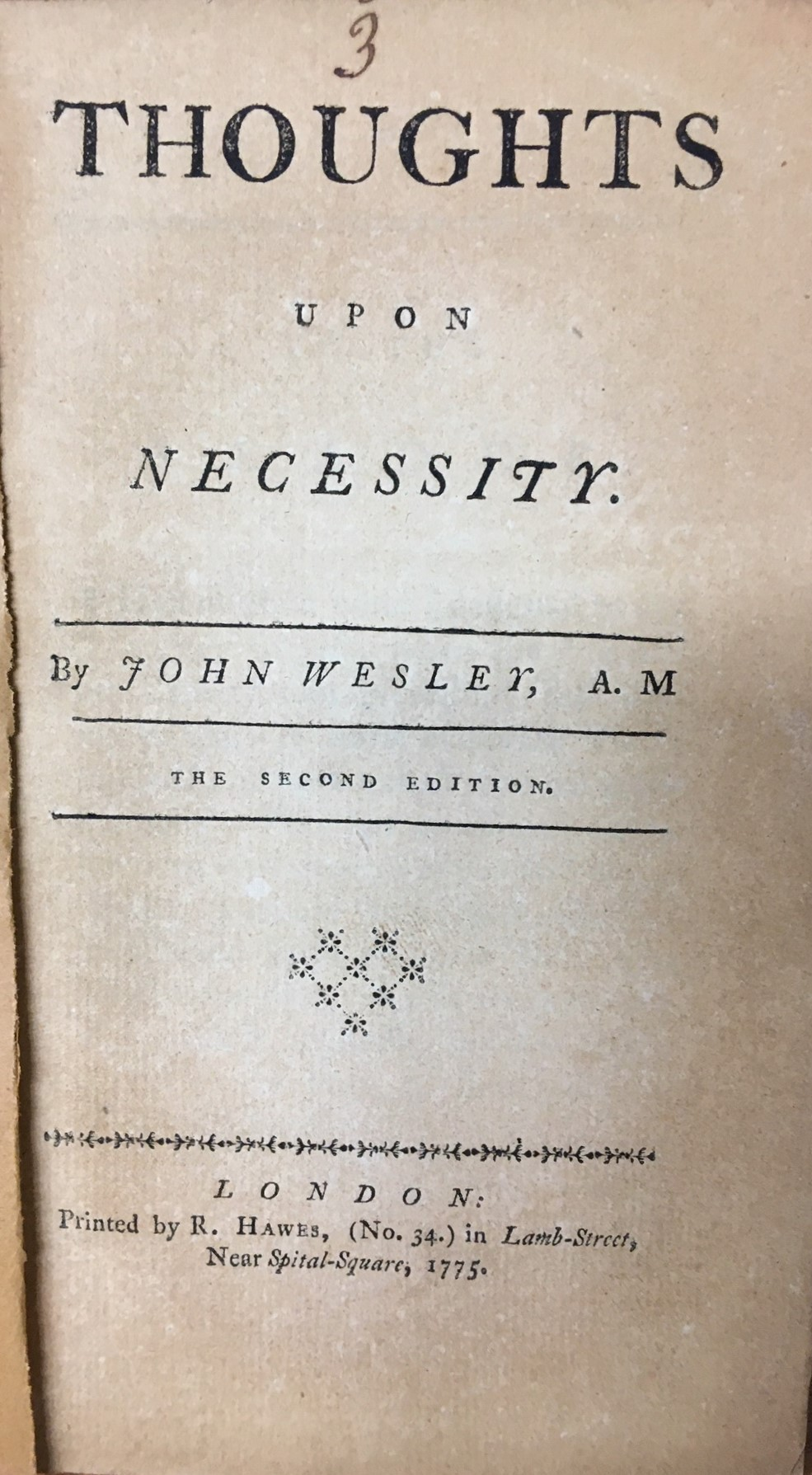
In 1774, Wesley wrote an essay titled “Thoughts Upon Necessity“.1 This essay dealt with arguments put forth by contemporary authors regarding what we would label determinism.

The opening paragraph states clearly the questions that Wesley will explore in the essay.
Is Man a Free-Agent, or is he not?
Are his Actions free or necessary?
Is he Self-determined in Acting; or is he determined by some other Being?
Is the principle which determines him to act, in himself or in another?
This is the question which I want to consider.
The work will critique and challenge the deterministic view that our actions are rendered certain by a causal chain.
[It has been] affirmed with one mouth that from the beginning of the world, if not rather from all eternity, there was an indissoluble chain of causes and effects, which included all human Actions. And that these were by fate so connected together, that not one link of the chain could be broken.
A fair part of the essay is dedicated to dealing with Dr. Hartley’s Observations on Man, His Frame, His Duty, and His Expectations. In Two Parts published in 1749. In this work Dr. Hartley argues that the “vibrating fibres in the brain”, which are fixt by God; renders our actions necessary for He “has thereby laid [all Human Actions] under an invincible necessity, of acting thus, and in no other manner.” Another sizable portion of the essay is spent examining the published opinions of Lord Kames. This post will focus primarily on the latter.
The clockwork universe
Lord Kames, born Henry Home, was a Scottish judge and philosopher. Though obscure to us today, he was an influential thinker during the Scottish Enlightenment as well as a patron to David Hume and Adam Smith.
In Sermon 1062, Wesley had this to say about Lord Kames:
The lowest sort of faith if it be any faith at all, is that of a Materialist, a man who, like the late Lord Kames, believes there is nothing but matter in the universe. I say, if it be any faith at all: for properly speaking, it is not.
In his essay Wesley, introduces him as “The Author of an Essay on Liberty and Necessity, published some years since at Edinburgh”. This essay appears as part of Lord Kames’ larger collection titled Essays on the Principles of Morality and Natural Religion: In Two Parts, published in 1751.3
Lord Kames defined the moral world in a similar way to how the material world works. It consists of a causal chain that renders each and every human action necessary.
In the Moral World, whatever is a cause with regard to its proper effect, is an effect with regard to some prior cause, and so backward without end. Events therefore being a train of causes and effects, are necessary and fixt. Every one must be, and cannot be other ways than it is
– Lord Kames as quoted by Wesley
This causal chain described above is then attributed to God the First Cause who has decreed all events and placed each person in the circumstances that they find themselves.
The Deity is the First Cause of all things. He formed the plan on which all things were to be governed, and put in execution by establishing both in the Natural and Moral world, certain Laws that are fixt and immutable. By virtue of these all things proceed in a regular train of causes and effects, bringing about the events contained in the original plan, and admitting the possibility of no other. This Universe is a vast Machine winded up and set a-going. The several springs and wheels act unerringly one upon another. The hand advances and the clock strikes, precisely as the Artist determined. In this plan, Man, a rational creature, was to fulfill certain ends. He was to appear as an Actor
– Lord Kames as quoted by Wesley
To this Wesley notes in his introduction to the reader that “I cannot believe the noblest creature in the visible world to be only a fine piece of Clock-work.”
Throughout the essay Wesley weaves back and forth between a series of quotes and his comments on them. As he does so he is building his argument against Lord Kames position.
In doing so, it should be noted that Wesley is taking full advantage of the rather interesting position Lord Kames takes in regard to our “appearing as an Actor”. For Lord Kames admits that we have “the feeling of Liberty, [which] does not agree with the real fact [of necessity].”4 This “feeling of liberty which I now scruple not to call deceitful, is so interwoven with our nature, that it has an equal effect in action, as if we were real.”5
This illusory feeling of liberty is something required for without it we could not fulfill our role as moral agents. Therefore this “feeling” is provided by God for our benefit. For “it appears then most fit and wise that we should be endued with a sense of liberty; without which, man must have been ill qualified for acting his present part.” 6
In all which, tho man is really actuated by laws of necessary influence, yet he seems to move himself: and whilst the universal system is gradually carried on to perfection by the first mover; that powerful hand, which winds up and directs the great machine, is never brought into sight.
…
[Virtue] could not otherways be brought about, but by means of the deceitful feeling of liberty, which therefore is a greater honour to virtue, a higher recommendation of it, than if our conceptions were, in every particular, correspondent to the truth of things7
No wonder Wesley exclaims: “Is [he] not fairly giving up the whole cause.”
Wesley’s argument built on Lord Kames assertions
Using a series of quotes, we can present in summary how Wesley understood Lord Kames and built his critique and refutation of his necessitarian position.
- (1) [God did] certainly decree, that those events should fall out, and that men should act just as they do … it is certainly impossible, that any man should act otherwise than he does 8
- (2) The Deity … formed the plan on which all things were to be governed [and] all things proceed in a regular train of causes and effects, bringing about the events contained in the original plan, and admitting the possibility of no other 9
- (3) We cannot conceive any Moral Obligation, without supposing a power in the agent over his own action 10
- (4) If Good and Evil [actions are] Necessary and unavoidable there would be no more place for praise or blame (ie Moral Obligation) 11
- (5) Man is no longer a moral agent, nor the subject of praise or blame for what he does.12
From these premises Wesley argues that these strike at the very foundation of Scripture:
- (6) It follows, if there be no such thing as virture or vice, as moral Good or Evil, if there be nothing rewardable or punishable (ie Moral Obligation), then there can be no Judgment to come and no future Rewards and Punishments 13
- (7) upon this supposition … what can we think of that book, which so frequently and solemnly affirms [a Judgment to come]? We can no longer maintain, That all Scripture was given by inspiration of God 14
- (8) The [necessity] of all human Actions … strikes hereby at the very foundation of Scripture, which must stand or fall with them
[Continuing Thoughts Upon Necessity]
- A version can be found in archive.org
https://archive.org/details/bim_eighteenth-century_thoughts-upon-necessity_wesley-john_1774 ↩︎ - On Faith (Sermon 106)
https://wesley.nnu.edu/john-wesley/the-sermons-of-john-wesley-1872-edition/sermon-106-on-faith/ ↩︎ - A version can be found in archive.org
https://archive.org/details/bim_eighteenth-century_essays-on-the-principles_kames-henry-home-lord_1751 ↩︎ - Lord Kames p200 ↩︎
- Lord Kames p204 ↩︎
- Lord Kames p206 ↩︎
- Lord Kames p207-211 ↩︎
- a mashup of two quotes by Lord Kames as cited by Wesley p12-13
cmp w/ Lord Kames essay p 180-181, 187-191, ↩︎ - partial quote of Lord Kames as cited by Wesley p12
cmp w/ Lord Kames essay p187 ↩︎ - partial quote of Lord Kames as cited by Wesley p20
cmp w/ Lord Kames essay p206
Interestingly Lord Kames suggests that the power of contingency is an illusion given to us to motivate us to moral actions noting that “it appears then most fit and wise that we should be endued with a sense of liberty; without which, man must have been ill qualified for acting his present part. That artificial light, in which the feeling of liberty presents the moral world to our view, answers all the good purposes of making the actions of man entirely dependent upon himself. His happiness and misery appear to be in his own power”
Despite arguing how important the illusion of such a power is in supporting moral responsibility (praise and blame), Kames will ultimately argue that we are, in fact, still responsible even if all human actions are necessary ↩︎ - partial quote of Lord Kames as cited by Wesley p19-20
cmp w/ Lord Kames essay p205 ↩︎ - partial quote of Lord Kames as cited by Wesley p18
cmp w/ Lord Kames essay p195
Here Wesley takes what Kames wrote describing the difficulty of reconciling necessity with moral responsibility. Kames presents it but does not agree with it. In his essay he works to argue we are responsible for our actions even if they are necessary ↩︎ - Wesley p16 ↩︎
- Wesley p21 ↩︎
 Dead Heroes Don't Save