
When Abraham’s son Isaac becomes a father, it is over twin boys. The older boy is named Esau, who was a skilled hunter and outdoorsman. Jacob, the younger boy, was a herdsman. 1 These two sons would not only be very different in their temperaments and skillsets but also in the roles they would play within the story of the nation of Israel. A story that is told throughout the books of the Old Testament.
Jacob, who will later be given the name Israel, is the one through whom God often identifies Himself.
The Lord [is] the God of Abraham, the God of Isaac, and the God of Jacob2
It is through the line of Jacob that the nation of Israel would be established and the physical lineage of the Messiah would be traced.3
But what happened to Esau? Did the man who traded away his birthright, was cheated out of his blessing and founded the nation of Edom also end up unrepentant and eternally lost as many suppose? After all we find God telling us it was “Jacob I loved but Esau I hated.” 4
To answer that question we must start at the beginning. Isaac’s wife Rebekah is pregnant. And before the twins were born God tells her that:
Two nations are in your womb,
and two peoples will be separated from within you.
One people will be stronger than the other,
and the older will serve the younger5
This is widely understood as God informing Rebekah about the larger destinies of her two children and the nations that they will found.
Part of this prophetic word encompasses the promise God made to Abraham telling him that he would be “the father of a multitude of nations.” 6 This promise would primarily be centered on the nation of Israel though the line of Jacob 7. But it also includes the nation(s) founded by Ishmael, his older son through Hagar, and the nation of Edom founded by Esau, the older son of Isaac.8
Not only is God telling Rebekah that each of her sons will found a separate nation. It is also commonly understood that the Lord is also disclosing to her that it is through Jacob, not Esau, that He will fulfill the promises made to Abraham.9 It is the nation of Israel that will be the “apple of his eye” and His special possession. 10 Paul reminds us that this decision was made “before they were born or had done anything good or bad.”11
The birthright
As the narrative unfolds we find the clever and crafty Jacob taking advantage of his brother Esau over several interactions. In the first, Esau has been out working in the fields and returned home exhausted and hungry.12 Jacob has been home cooking lentil stew and Esau exclaims: ‘Feed me red stuff, red stuff there’. Jacob, knowing his brother to be impetuous and prone to immediate action, took advantage of the situation. Rather than show love and kindness to his brother and offer him a meal, he instead offers him a deal. ‘Sell me your birthright.’ Esau, thinking only of his immediate exhaustion and hunger, swears an oath and sells his birthright for some bread and stew. He seemingly gets up without any regret thus earning the nickname “red” (or Edom). In satisfying his immediate need he forfeited something of far greater value in the future. It is in this way, the narrator informs us, that Esau despised his birthright.
In this short episode the word bᵊḵôrâ (birthright) is used four times. Esau’s dismissive attitude, in which he so easily parted with it, was described as despising (bāzâ) it. In Malachi, written some 1500 years later, we find the prophet reminding the people that the Lord showed love to Jacob and hated Esau having destroyed the latter nation for its wickedness. In the same chapter the prophet notes that Israel despises (bāzâ) the Lord’s name and His table because they treat the sacrifices with such disregard and offer Him blind and sick animals.13 No doubt this would remind the people that they are showing the same indifference and casualness towards God that Esau displayed towards his birthright.
But just what is it that Esau has sold? The birthright would consist of the firstborn’s right to a double portion of the inheritance.14 It would also consist of a place of higher honor within the family and among the other siblings.15 The firstborn would be the one to assume the authority and responsibilities of the father when they died. Several commentaries note that included in the selling of his birthright was the transfer of the right to the land promised to Abraham as well as the right to be the founder of the nation Israel.16
Various have been the opinions what this birthright was which Esau sold, but the most probable is, that, together with the right of sacrificing, and being the priest of the family, it included the peculiar blessing promised to the seed of Abraham, that of being the progenitor of the Messiah, and the heir of the special promises of God, respecting Christ’s kingdom.17
The narrative, however, does not make it clear whether the right to be the heir to the promises of Abraham was considered part of the sale of the birthright. A careful reading of the narratives in Genesis show us that there are three distinct blessings that are involved in the story of Esau and Jacob.
- The blessing of the birthright
- The blessing of the patriarch
- The blessing of Abraham
The blessing of the patriarch
The birthright (bᵊḵôrâ) is a separate blessing from that of the blessing (bᵊrāḵâ) given by the patriarch Isaac. This can readily be supported when we look at the narrative involving Jacob’s deceit over Isaac to take Esau’s blessing. Interestingly, a meal is involved again. Isaac is an old man who knows that he is close to death. He is prepared to pronounce a blessing on his firstborn son Esau.18 It was customary for the patriarch, though not required, to reserve a blessing consisting of greater power, position and prosperity for the firstborn.19 Before he does, Isaac wants Esau to hunt some game so that he might enjoy his favorite meal. While Esau is out hunting, Rebekah conspires with Jacob to deceive her husband so that he will bless the younger son instead of the older. The plan works and Isaac does indeed bless Jacob thinking it was actually Esau.
After Esau finds out that Jacob has been blessed by Isaac and that this blessing will stand he is angry and bitter. In his frustration Esau readily admits that he sold his birthright while lamenting the additional loss of the patriarchal blessing.
Esau exclaimed, “Jacob is the right name for him! He has tripped me up two times! He took away my birthright (bᵊḵôrâ), and now, look, he has taken away my blessing! (bᵊrāḵâ)” Then he asked, “Have you not kept back a blessing (bᵊrāḵâ) for me?”20
In Esau’s response we find several ideas that clarify the idea that this blessing was not the same as the birthright
- A different word is used for the blessing (bᵊrāḵâ) than the birthright (bᵊḵôrâ)
- Isaac is planning to bless Esau, despite knowing that the birthright was sold, which would indicate they are two separate things
- Rebekah and Jacob deceive Isaac into blessing Jacob, despite knowing that the birthright was sold, which would indicate they are two separate things. Why else would they seek what Jacob already possesses.
- When Isaac finds out what Jacob has done he reacts with “excessive trembling” noting that Jacob was deceitful and did take away the blessing
- Esau understands them as two different things, acknowledging that he sold his birthright and now has had his blessing taken
Esau may have despised his birthright but has apparently placed a great value on the blessing.
What is it that Jacob has taken? The blessing that Isaac invokes over Jacob involves three things. The first is prosperity found in the “richness of the earth”. The second is power and prestige found in both nations and brothers bowing down before him. 21 The third is for protection such that any that would seek to curse or cause harm would themselves be cursed while any that blessed him would in turn be blessed.22
Some commentators see the patriarchal blessing as inclusive of identifying the one through whom the Abrahamic covenant would be fulfilled.
[He called Esau] with a view to declare him his heir. The promise of the Messiah, and the land of Canaan, was a great trust, first committed to Abraham, inclusive and typical of spiritual and eternal blessings; this, by divine direction, he transmitted to Isaac. Isaac, either not knowing, or not duly considering the divine oracle concerning his two sons, that the elder should serve the younger, resolves to entail all the honour and power that was wrapped up in the promise upon Esau his eldest son. 23
It is only the final part of the blessing that carries with it a resemblance to the promises made to Abraham.
May those who curse you be cursed,
and those who bless you be blessed24
However, this part of the blessing need not be understood as referring to the Abrahamic covenant. It is probably better to understand it as a more general pronouncement of protection since none of the primary promises such as the land, the multitude of descendants nor the transfer of the oaths sworn to Abraham are mentioned. 25 Furthermore, given the distinctness of the birthright and the patriarchal blessing, to understand the patriarchal blessing as inclusive of the Abrahamic blessing would seem to dismiss or conflict with the idea that Esau has already sold the birthright. These same commentators having already argued that it was the birthright that was inclusive of the Abrahamic blessing.
There is some overlap in what Isaac gives as a blessing and what was included in the sale of the birthright when he says “you will be lord over your brothers”. The prominence of the position in the family is typically associated with the right of being firstborn. However, the blessings of prosperity need not be seen as overriding the sale of the “double portion” nor a transfer of the prosperity promised to Abraham, only a desire to see his son prosper.
One might see a conflict with the original prophecy given to Rebekah as well if the statement that the “younger shall serve the older” is taken as involving the relationship between the individuals rather than just as a preference for the nation Israel founded by Jacob over the nation Edom founded by Esau. It should be noted that the Genesis account does not give a clear narrative of Jacob being served by his brother Esau. In fact, it is Jacob that returns from Paddan Aram and bows before Esau calling him lord. 26
Blessing of Abraham
When studying the interactions between Jacob and Esau we find that there is a third blessing involved. After Isaac has given Jacob a patriarchal blessing, thinking it was Esau, we find him calling Jacob to his side. Isaac cautions Jacob about taking a wife and then gives him the “blessing of Abraham”. Here we find the transfer of the promises made to Abraham being explicitly given to Jacob with the full realization that it was indeed Jacob.27
This included:
- the promises to make you fruitful and give you a multitude of descendants (cmp Gen 17:6)
- the blessings of Abraham are for you and your descendants (cmp Gen 17:7)
- the promise that you may possess the land God gave to Abraham (cmp Gen 17:8)
If these promises were already transferred in either of the other two interactions, it would seem that the additional granting of the blessing of Abraham given by Isaac would not have been needed. Yet Isaac, in full recognition that he is talking to Jacob, transfers the blessing of Abraham to him. It seems reasonable to conclude that this blessing was not included in the one given to the person Isaac believed to be Esau. This transfer of the Abrahamic covenant is later confirmed by God with the inclusion that “in you and your offspring shall all the families of the earth be blessed.”28
The reunion of Jacob and Esau
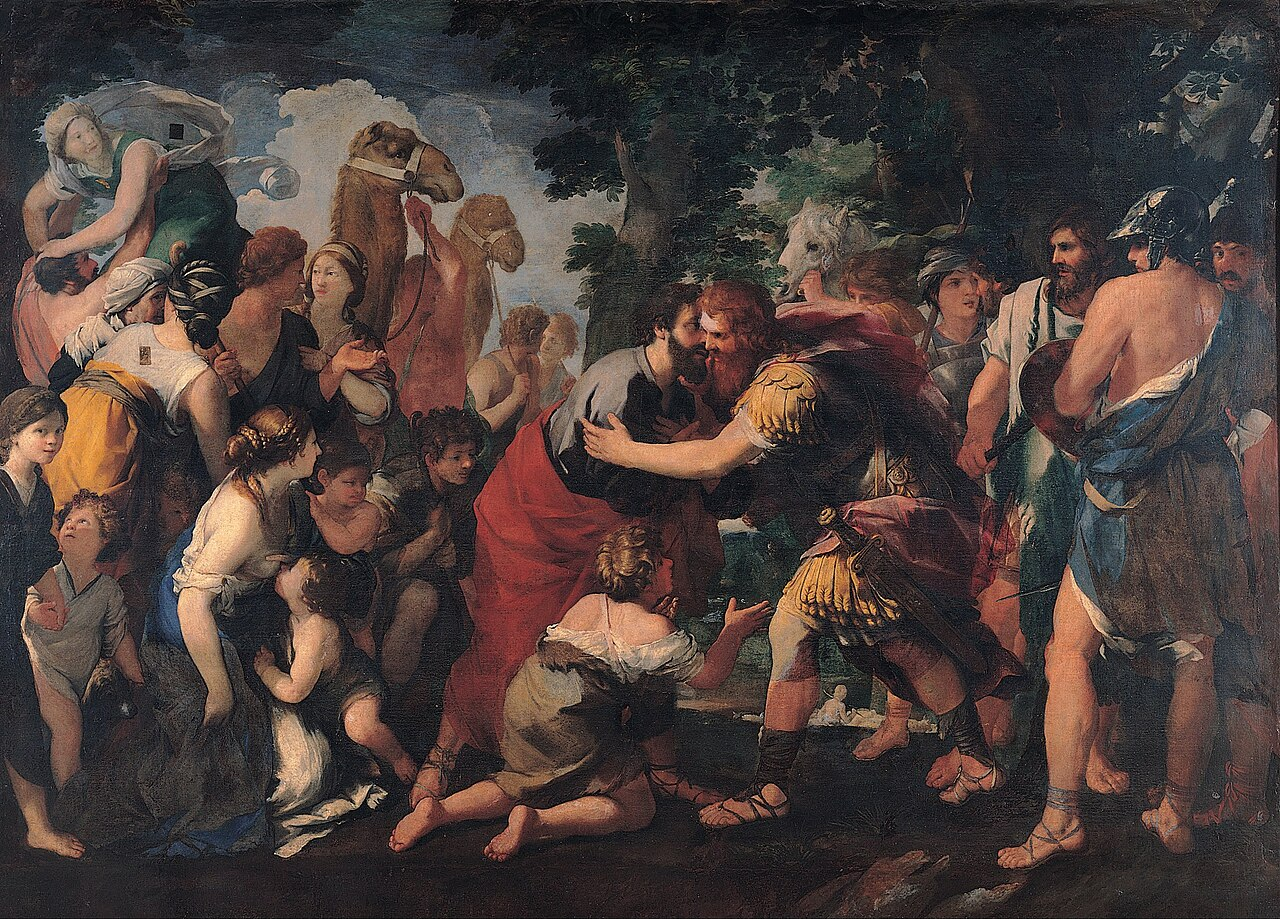
In reading through the Genesis account, it seems best to understand the birthright, the blessing of the patriarch and the blessings of Abraham as three distinct blessings. In the end, it was Jacob that received all of them. Two by taking advantage of his brother Esau and the third by the sovereign choice of God who would use him to found His chosen nation Israel.
Throughout the rest of the story of Jacob we find a man who was himself taken advantage of by his uncle Laban. When Jacob returns from Paddan Aram to his country he is fearful of his encounter with Esau, no doubt remembering the threats of being killed. In light of these threats Jacob recalls the promises made to Abraham and Isaac and asks God for protection. Then, desiring another blessing, he wrestles with God resulting in a limp, a blessing and a new name.29
In the reunion with Esau we find a fearful Jacob:
- bow before his brother as he approached him (33:3)
- call his brother ‘lord’ (32:4-5,18; 33:8, 15)
- send a gift of numerous animals (32:13-18)
Esau is quick to embrace his brother and accept him, having released his bitterness and forgiven him. He is also reluctant to take his gifts, being content with what he has.
In all of this it is possible to see Jacob, himself a changed man, returning to Esau the stolen patriarchal blessings of prosperity, power and prestige. As Esau returns to Seir and Jacob to the land of Canaan it seems that both Jacob and Esau have also accepted their roles in God’s plan to found different nations through them.
In considering the birthright and patriarchal blessing and whether they were inclusive of the Abrahamic promises we should keep something in mind. God rejected the attempt of Abraham and Sarah to fulfill the promise He made to them when they sought to accomplish having a son “in the flesh” through Hagar rather than wait. Despite these actions it was Isaac and not Ishmael that would receive the promises of Abraham from God.30 Knowing that customarily the younger would serve the older firstborn, should the interactions between Jacob and Esau be understood as God accepting Jacob’s deceitful attempts to secure his place as heir to the Abrahamic covenant, as was told to his mother Rebekah, in a similar worldly fashion? It is clear Rebekah and Jacob placed a great value on the birthright and the patriarchal blessing but went about getting them using less than honorable methods. However, nothing in the narrative seems to require that we understand that as the means by which the transfer of the Abrahamic covenant was achieved.
The poor example of Esau in Hebrews
In Hebrews, we find the author use Esau as an example of someone to be avoided. Interestingly it comes as a warning after urging the recipients of the letter to pursue peace and to be sure that one does not allow a root of bitterness to take hold. The narratives in Genesis seem to portray Esau as an example of one that was angry and bitter, to the point of wanting to kill his brother Jacob, but did not let that take hold as he allowed his brother to return in peace.
The author instead seems to be making a separate warning from that admonition warning us to avoid being someone that is “sexually immoral and godless” like Esau. The author uses the example of the selling of the birthright to underscore the point.
The description of Esau here is understood differently among commentators. Some hold that πόρνος, from which we get our word pornography, refers to sexual sins committed by Esau. Others, noting that Genesis does not describe Esau as committing sexual sin, nor does the selling of the birthright have any connotation of sexual sin, understand it differently. They understand the word as a metaphor for rejecting God. This is rooted in the Old Testament use of sexual and martial metaphors that describe Israel as “whoring” after other gods and being an unfaithful wife.
The other designator for Esau was βέβηλος which carries with it the idea of being common, worldly or profane. 31 Some commentators take the two descriptors as a hendiadys, a figure of speech in which two words are used to express a single concept. They understand that Hebrews is describing Esau as one who treats the sacred and spiritual as something common or as having no value. That idea aligns well with the Genesis narrator’s assessment that Esau despised his birthright. It also correlates with the way Malachi, drawing on Jacob and Esau, describes Israel despising sacred and spiritual things.
… Esau, who sold his own birthright for a single meal. For you know that later when he wanted to inherit the blessing, he was rejected, for he found no opportunity for repentance, although he sought the blessing with tears.32
From this statement, as well as the noted description, some commentators conclude that Esau has no “objective possibility for repentance granted by God” and was eternally rejected by God. 33 While one should never confuse the Hebrew author with describing Esau in any way that can be understood as positive, we should not be to hasty in sending Esau to hell. In this passage the author of Hebrews has conflated two stories in making his point. Esau did sell his birthright but it was the patriarchal blessing that he sought with tears. It should be clear from the Genesis account that Esau is seeking an opportunity for Isaac to change his mind (μετάνοια) and give him the blessing that was taken by Jacob. Something that Isaac refused to do. One need not interpret the repentance (μετάνοια) as referring to Esau’s permanent spiritual condition.
There is a great lesson in Esau. His folly and sin in seeking immediate gratification and satisfying an earthly appetite by giving up something of far greater value and spiritual significance is one to be avoided. To treat something of great value with such disregard is no small thing. The author of Hebrews, drawing on particular moments in Esau’s story, is making the point that such a cavalier attitude can be dangerous if one takes the same posture with Christ. That need not mean that the individual Esau never repented over his foolish actions nor was eternally rejected for them. The narratives in Genesis, nor the use in Hebrews, do not offer us enough information to conclude that either way.
- Jacob is described as “one who dwells in tents”. The phrase indicates one who is a shepherd or herdsman according to several commentaries (cmp also Gen 4:20)
Ellicott’s Commentary notes: “Esau equally had a tent for his abode, but Jacob stayed at home, following domestic occupations, and busied about the flocks and cattle.”(https://biblehub.com/commentaries/ellicott/genesis/25.htm)
Cambridge Bible for Schools and Colleges notes: “The life of Jacob, the herdsman and the shepherd, is contrasted with that of the fierce and roving huntsman.” (https://biblehub.com/commentaries/cambridge/genesis/25.htm) ↩︎ - Exodus 3:15 (NET) ↩︎
- Romans 9:4-5 ↩︎
- Romains 9:10-12; Malachi 1:2-3 ↩︎
- Genesis 25:23 (NET) ↩︎
- Genesis 17:5 ↩︎
- God promised land to Abraham, Isaac, and Jacob and to make them a holy nation (Gen 12:1-3, 7; Gen 17:8; Gen 28:3-4; Exodus 6:8; 19:5-6 (NET)) ↩︎
- Gen 17:20; 36:8-9 (NET) ↩︎
- Romans 9:10-13 (NET) ↩︎
- Deut 32:10 ↩︎
- Romans 9:11 ↩︎
- Genesis 25:27-34 ↩︎
- Malachi 1:6-14 ↩︎
- Deut 21:17; 2 Chronicles 21:3 ↩︎
- Genesis 43:33 ↩︎
- Matthew Henry notes that the birthright “includeth the future possession of the land of Canaan by his children’s children, and the covenant made with Abraham as to Christ the promised Seed. Believing Jacob valued these above all things; unbelieving Esau despised them.”
The Pulpit Commentary affirms that the blessings of the Abrahamic covenant are included.
(https://biblehub.com/commentaries/genesis/25-31.htm)
↩︎ - Benson Commentary
(https://biblehub.com/commentaries/benson/genesis/25.htm) ↩︎ - Genesis 27 (entire chapter) ↩︎
- cmp to Joseph’s response when Jacob gives a greater blessing to the younger son Ephraim instead of the firstborn Manasseh (Gen 48:8-22). Note also that the firstborn Reuben received a rebuke within the blessings given by Jacob for defiling his bed (Genesis 49:3-4) ↩︎
- Genesis 27:36 (NET) ↩︎
- Isaac seems to confirm this telling Esau that he has made Jacob ‘lord over you’ and sustained him with grain and wine (Gen 27:37) ↩︎
- Genesis 27:27-29 ↩︎
- Benson Commentary
(https://biblehub.com/commentaries/benson/genesis/27.htm)
Matthew Henry notes that Rebekah “had, no doubt, treasured the prophecy of Jacob’s ultimate superiority, and now it seemed as if the father would reverse it. Had her faith been pure and exalted, she would have known that God would fulfil His word without her help; but all alike act from unworthy motives, and all have their need of punishment. But here the fault began with Isaac, and Rebekah probably considered that she was preventing a grievous wrong Rebekah knew that the blessing was intended for Jacob, and expected he would have it. But she wronged Isaac by putting a cheat on him; she wronged Jacob by tempting him to wickedness. She put a stumbling-block in Esau’s way, and gave him a pretext for hatred to Jacob and to religion. All were to be blamed. It was one of those crooked measures often adopted to further the Divine promises; as if the end would justify, or excuse wrong means.
The Pulpit commentary notes that Jacob in seeking the blessing of Isaac that “It was the blessing of the Abrahamic covenant he craved.” Later, assuming the blessing Isaac was about to give included the Abrahamic covenant notes that “Isaac must either have forgotten the heavenly oracle which announced the destinies of his sons at their birth, and distinctly accorded the precedence to Jacob, or he must not have attached the same importance to it as Rebekah, or he may have thought that it did not affect the transmission of the covenant blessing, or that it did not concern his sons no much as their descendants.”
(https://biblehub.com/commentaries/pulpit/genesis/27.htm) ↩︎ - Genesis 27:29 (cmp Gen 12:3) ↩︎
- cmp that to the transfer of the Abrahamic covenant to Isaac (Gen 26:3-5) ↩︎
- Genesis 33:1-11 ↩︎
- Genesis 28:1-5 ↩︎
- Genesis 28:13-15 (also Gen 35:11-13) ↩︎
- Genesis 32:9-12; 26 ↩︎
- Genesis 26:1-6 ↩︎
- cmp that to “worldly fables” used in 1 Tim 4:7 or “worldly empty chatter” in 1 Tim 6:20 and 2 Tim 2:16. It is also used in 1 Sam 21:4 (LXX) to refer to “common bread” ↩︎
- Hebrews 12:16-17 (NET)
a translation note tells us that “it” can refer to ” referring “either to the repentance or the blessing. But the account in Gen 27:34-41 (which the author appeals to here) makes it clear that the blessing is what Esau sought. Thus in the translation the referent (the blessing) is specified for clarity.” ↩︎ - O’Brien, Peter T. The Letter to the Hebrews (Pillar New Testament Commentary) (p. 476) ↩︎

