
Michael Horton on Justin Martyr
Michael Horton, in his book Putting Amazing Back into Grace, writes the following in the appendix (link):
Not only does Scripture speak definitively in proclaiming God’s electing grace; the historic, catholic, apostolic church affirms these truths as the truly orthodox position of the church of Jesus Christ. To substantiate this claim, I have also prepared an abbreviated historical sketch from church fathers to the present, including church creeds, that clearly affirms the doctrines of grace.
Horton, unlike other Reformers, does not see in the early church the confusion and lack of certainty on this subject, but rather a “definitive affirmation” of the doctrines of grace (aka TULIP and meticulous sovereignty).
Unfortunately, the quotes Horton uses from the early church to substantiate his claim do not contain citations making them difficult to find and read within their full context. Far worse is the fact that many of the quotes have been shown to be spurious. One should check out Jack Cottrell’s assessment of this appendix, which he calls “extremely poor scholarship”, for more details (link).
Since we are focusing on Justin Martyr, let’s examine one of Horton’s quotes attributed to him. The intent of the author is to show readers that Justin affirmed total depravity and irresistible grace.
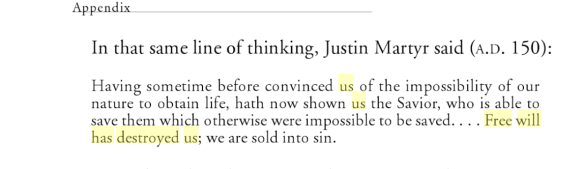 Yet, if one were to search Justin’s works for the text “Free will has destroyed us” it can’t be found. Nor for that matter can the rest of this quote. However, as noted in Norman Geisler’s Chosen But Free, we find that it was actually written by Tatian (and can be read in its context here).
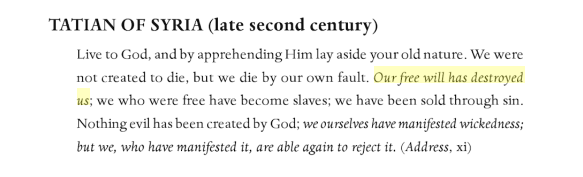 Reading this passage in context, it is clear that Tatian was not rejecting free will, as Horton would have us believe. In fact it is teaching the opposite. Tatian is explaining, to the Greeks he is addressing, that because we have free will and abuse it, choosing to do evil instead of good, that we will perish. People have the ability to both choose evil and to reject it (ie choose good). He even writes the following in an earlier chapter:
the power of the Logos, having in itself a faculty to foresee future events, not as fated, but as taking place by the choice of free agents, foretold from time to time the issues of things to come; … (chapter 7)
This quote further establishes that Tatian both rejected determinism and understood foreknowledge as God knowing ahead of time what the choice of an individual would be in the future. This would seem to weaken any idea that he also affirmed irresistible grace. Taken together this writings do not seem like Calvinism in an “embryonic form”, let alone a definitive declaration of it. What Tatian has written would contradict the view of foreknowledge taught in the Westminster Confession of Faith, which asserts that God knows the future because He has decreed it, not because He has foresight (see chapter 3.2).
John Calvin more clearly affirms what Tatian denies:
he foresees the things which are to happen, simply because he has decreed that they are so to happen, … it is impossible to deny that God foreknew what the end of man was to be before he made him, and foreknew, because he had so ordained by his decree (Institutes Book 3, chap 23)
Let’s return to Justin Martyr and some of Horton’s other claims. In a mashup of two quotes from Dialogue with Trypho, Horton also tries to assert that Justin held to a limited atonement as understood by the Reformers. In this view Jesus did not die for the sins of the whole world, making salvation possible for everyone, but rather died only for those whom God unconditionally elected.
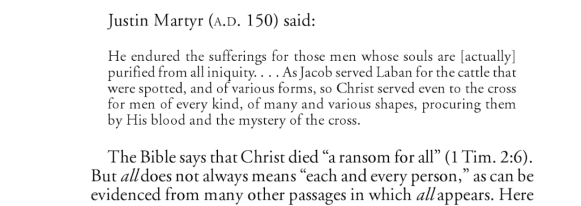
These partial quotes in the appendix are taken from chapters 41 and 134. Needless to say, that is hardly letting context shape meaning. But it gets worse. Chapter 41 (link) is on the celebration of the Lord’s Supper, which is “prescribed in remembrance of the suffering which He endured on behalf of those who are purified from all iniquity.” It is difficult to see how this should be taken as a “definitive affirmation” of an atonement rooted in unconditional election.
In chapter 134 (link), Justin is exploring the idea that Jacob and his wives were types. Leah was a type representing the nation Israel, while Rachel represented the Church. Jacob represents Christ who died on the cross for both groups. While Justin says Christ died “for men of every kind”, it is clear from the context that he is trying to show the reader that Christ died for both Gentiles and the Jewish people. It would be hard to see this as referring to an atonement rooted in unconditional election, unless one comes to the text with that idea in mind and pushes it on the text.
Consider these statements further, in light of what Justin writes in chapter 95 (link), in which he notes that Christ died for “the whole human family”.
For the whole human race will be found to be under a curse. … the Father of all wished His Christ for the whole human family to take upon Him the curses of all, knowing that, after He had been crucified and was dead, He would raise Him up,
… His Father wished Him to suffer this, in order that by His stripes the human race might be healed …
These statements assert that the atonement was for the “whole human family”. Limiting the phrase “whole human family” to only those who are unconditionally elect would be challenging. Justin uses this phrase first to describe those under a curse and then immediately after that to describe those whom God the Father wanted Christ to die for.
 Dead Heroes Don't Save
God, being sovereign determines nothing outside of Himself, by foreknowledge of that which He did not decree. To allege that foreknowledge is God simply knowing something ahead of time – begs the question of Hod knowing something that SOMEONE outside of Himself decreed it, and that God simply knows those decrees. If someone decrees something that is against the Will of God – but that God has foreseen it, knows it will happen, but must allow it because it is related to the god known as “man’s Free Will” then we can obviously see who is on the Sovereign throne – man’s Free Will cannot be elevated to such a height.
What can the author of the universe know, apart from that which He has decreed? The books that are opened in the judgement, those events of history are not books that anyone but God has written. The Book of Life is not described by Jesus as “those that men have given me will come” but instead as “those the Father has given me will come.”
Grace is not Grace if it is earned by “good choices” by then it is a debt, of God, owed and earned by making such “learned decisions arrived at, of course by apt pupils.” Paul adresses the inability of unregenerate men to become regenerate upon hearing a Spiritual message – apart from God, according to the purposes of His (own will influenced by nothing outside of Himself) regenerating those, not of their own choosing but instead by God’s Gracious choice.
This is not of “recent” men inserting theology into the texts, but instead of men articulating more and more clearly what is already there.
Secular case in point: in America WHEN did all men become equal? When was it a universal truth? When was it articulated? When did it become reality?
In Scripture: When was the Triinitarian Godhead become reality? When was it understood as universal truth? When was it articulated? When did the word “Trinity” become part of Christian vocabulary?
Men become more capable of articulable their positions throughout history – it takes longer to articulate Heavenly truths that are often clouded by wolves in sheeps clothing, powers & principalities in dark places, and of course misunderstandings – yet the truths are there and have been before the foundation of the world!
Greg
Welcome to DHDS and thanks for sharing your comment.
I would be happy to debate and discuss the various theological points that comprise the Reformed doctrines of grace. However, the main thrust of this series of posts was to counter the claims that some Reformed theologians make regarding what the early church held.
I would hope that this series makes it clear that the claim that Justin Martyr was a proto-Calvinist is false. He makes several clear statements about what he (and the early church) understood regarding faith, foreknowledge and free will. That said, you are well within your rights to disagree with Justin and other early theologians about how these things work.
I agree with you, that truth doesn’t change. What is true is so, regardless of whether people recognize it as such. However, regarding your assertion that men became “more capable of articulating their positions throughout history”, I think there are some important distinctions that should be made. You cite the Trinity as an example. However as one reads the pre-Nicene theologians it is clear that the church has always held to a Trinitarian view of God even if it was not clearly articulated. That is a very different example of the evolution of an idea, than say the view of predestination and election. The early church clearly rejected the views that Augustine and Calvin would systematize and later be captured in the acrostic TULIP. The early church taught positions that are in conflict with the doctrines of grace and sovereignty. For example Justin clearly saw foreknowledge as foresight, not decrees. Thus, unlike the Trinity, one must explain why the early church was flat out wrong in what they taught. Why should we accept the newer assertions of Augustine over Justin? Further, one must wrestle with why the earlier theologians are wrong when they are much closer to the apostles teaching and know the language and culture in which the NT was written far better than we ever could.
Thanks
Mike
BTW: if you are interested here are some posts diving into the topics of predestination and foreknowledge.
The Providence Problem
3 Characteristics of Predestination
3 Characteristics of Foreknowledge and Free Will
Mike: first thanks for taking the time do research, post the article and respond. Second I apologize for the horrendous grammatical errors of my last post – autocorrect on the go may work great in some areas!but it butchers others.
I think the wrestling can be put to rest with this one thought: agenda and bias. The doctrines of the Catholic Church did not come about by simple men just reading their Bibles, preaching & teaching, and then putting into place what they saw as truth. These men put into place what they knew would prosper them, and their stranglehold on the “keys to the Kingdom.” Frankly they were just new Pharisees.
All the way back to Joseph’s theology of God in Genesis, which resulted in the forgiveness of his brothers, did not seem to be one of “God foresaw a famine, and my brothers’ treachery and came up with a back up plan to fix it all in the nick of time before the famine and Jacob’s death.” Joseph seems to be saying that even though his brothers hatched an evil plan, God hatched it first – their evil intent was only secondary to what God decreed they would do for good. This is the theology of the Bible long before it even became a written scroll.
The agenda of the other theologies is the insistence of men deciding their fates. Men demand that right – trying to wrestle it out of the hands of their creator, that’s the elevation of men to the Throne. The very presence of Israel being a chosen race, is part of reformed theology, it is woven in the fabric of the scripture and the universe. Prevelant early church theologians who disagreed with doctrine are evident even in the Bible itself – the book of Galatians is evidence, but we see they are dead wrong – thank the Lord that Paul was around to crush the movement, though denominations have still created works-based theologies.
You are definitely correct, however to say that it is wrong to ascribe a held theology to a man (Justin) who didn’t hold to it – and while I am not completely sure of Justin’s position, I agree it is improper to make something of it, that wasn’t there.
Greg
Greg
Thanks for coming back and taking the time to engage. Sorry took some time to get back to you. I’ll try to reply to some of your comments.
I am glad that we can both agree that it is wrong for anyone to claim that early church theologians (or anyone else for that matter) hold to a view when they do not. We would also both agree that there are teachers who profess “another gospel” and other false doctrines. From the era of the apostles through to today that has been true (or if you like since the Fall as that would be true as well).
I think where we will start to disagree, is with the idea that the wrestling can be put to rest due to agenda and bias. The problem is we all have an agenda and a bias. The early church theologians did but so do we. Why should we think we are correct and they are wrong? The question for us, particularly when we have differences in doctrines and practices, is to wrestle with what is it that Paul (and the other apostles) taught in the presence of many witnesses and passed on through reliable teachers.
I am not sure what you mean by “doctrines of the Catholic Church”. Do you refer to the Roman Catholic Church? If so, do you mean to imply that any time period before, I presume, the Reformation is Catholic? That would seem to exclude the Eastern Orthodox. It would also be a hasty generalization of church history.
I could be wrong, but it seems you would reject the consensus of the early church on the basis that these teachers were devising ideas and falsehoods that “they knew would prosper them”. And that these men were also not “reading their Bibles”.
However, if one were to read the early church, particularly the first three centuries (but even beyond that), one would find that these men were very familiar with Scripture. We may not agree with all of their ideas or exegetical conclusions, but to claim that they were all just trying to grab a “stranglehold” on the church seems to be both another hasty generalization and unfair. Further, one must consider that the early Christians lived in an era fraught with danger, which often resulted in loss of jobs, family, property, and sometimes even life. I recommend Why on Earth did Anyone Become a Christian by Larry Hurtado for a survey of what that time period was like.
I would also add that these men did not just read their Bibles, but are some of the earliest men (Clement, Ignatius, Justin, Polycarp, Irenaeus etc) in the chain of those who handed down to us both the Scripture and those things that were taught by Paul and others. If none of them handed these teachings on correctly, how do we know we have correctly identified what Paul originally taught? How do we know we aren’t affected by agenda or bias?
Another area where we will disagree is on how to define God’s sovereignty. We probably don’t see it the same way. However, Scripture clearly states that God is light and in Him is no darkness at all. This would certainly make it difficult for God to “hatch the evil plans” of Joseph’s brothers so He could work it for good. Because that would seem to imply that there is darkness in Him and that the ends justify the means.
You mention Reformed doctrine, so I assume you understand the Scriptures as teaching God as decreeing all things without foresight and electing unconditionally men to salvation. I would understand Scripture as teaching God in His sovereignty choosing to first provide the means of salvation (the cross and resurrection), then choosing the means by which it would be available (by grace through faith). God then chose, as it was His right to do, to give people the opportunity to respond to His gift. He in His wisdom chose to offer the gift to any who come in faith (the condition) placing them into the body of Christ (and thus electing them).
Mike
Mike (been awhile). While it would be Gracious of God to provide an “opportunity” for fallen, depraved men to stumble around, as the living-dead zombies we are, being dead in our trespasses & sin, who, in our exercise of ANY free will we possess, love & pursue the dark rather than light & at every opportunity slink into our darkened tomb to revel in our sin, for the pleasure of sin itself & THEN figure out how to suddenly love the light & hate God less.
1 Corinthians 2 teaches that apart from the Spirit we zombie’s couldn’t even understand the Gospel message apart from the Spirit & we can see that Spirit, with ears to hear, eyes to see, & a new heart of flesh placed in us (you don’t do your own heart transplant – & the Bible is clear on Who gives us a new heart) is only bestowed most effectively upon the Elect of God.
People today misunderstand theology and their bias against a Sovereign God (which I once had but praise God, He opened my rebellious eyes) & I am indeed just as prone to bias, though every learning – man’s bias is always toward his own choosing of his destiny. To surrender one’s destiny to God is exactly what depraved men refuse to do.
God SAVES, He does not “try” or “wish” or “hope.” When He decides to “have children” in the “new birth” – the children do not “will themselves to be born” & like the example of the wind, given immediately after, to Nicodemus – the Spirit goes where He wills, we only see evidence of its presence. You have as much decision in your new birth, as you did in your fleshly one. That example says much!
Nicodemus, a VERY learned Pharisee, a Teacher of Israel, misunderstood that concept while speaking with God, Himself in the flesh – but given the entirety of Scripture now, we have the Spirit & a clearer picture. We must abandon our “will” to His & beg for Him to help our unbelief.
Greg (more later).
I’m pressed for time at the moment, and
Looking back over the comments, assuming you are the same Greg, and seeing that it was 2018 when we last engaged, it certainly has been awhile.
I appreciate you coming back to share your views on Reformed theology (RT) but as you can imagine I remain just as unconvinced of the “bias” argument as I did years ago. Not because I don’t think I (or anyone else) don’t have any bias, but because we all do.
You hold a bias toward the Reformed definitions of sovereignty and its interpretations of certain passages. With that bias you see TULIP and determinism in the Scripture where the vast majority of Christians since the first century have not. That does not mean (as I have noted earlier) that the earliest Christians had everything correct, but the misrepresentation of their view certainly does not lead me to the conclusion that in the last 500 years we have a clearer picture of what the Scripture means, but rather to think quite the opposite. If Calvinists are quick to see their view where it clearly isn’t being taught, why would I not conclude they do that with the Scripture passages as well?
Further, in RT, if all I do is ultimately something that God decreed BTFOTW and without the benefit of foresight, then I have no “will” to abandon. My will ultimately originated in the mind of God and is what He willed me to have. Before I was born or did anything good or bad, my fate, my will and my decisions were already decided.
Mike – yes, same Greg. Obviously we are not permitted to apply beliefs to those who did not have them & use those falsely attributed beliefs to make a point validating our arguments. This I believe is the point you were originally making & for which the author was contending.
Bias is something we all have but some bias is wiped out by the Spirit and we are told repeatedly to test the spirits (bias) against The Spirit, to see if it’s true. American bias in the last century has century has changed because in history one of God’s affectionate titles was “Providence” as referenced in various papers of the age. I’ve learned quite a bit more since last engaging but first I will say I was originally of the “free will in all conduct” bent & passed over any reference in Scripture to election, God directing the actions of men etc, and election. However once a more careful study where that verbiage was acknowledged and original languages brought to bear, the argument against God’s sovereignty falls flat. I’ve that we do have a “free will” of sorts but its is bent by our fallen nature. We freely do what we will, but what we will do is chained by our stone-dead hearts, our wicked dead nature which love’s darkness, hates God. Our actions are also limited by God’s Divine plan BTFOTW. Our hearts might plan out our lives but God is the determining factor of results (Proverbs 16:9; James 4:15) – this is God clearly saying “I run your show.”
If you’ve ever prayed for men to behave differently in a situation, or even for their salvation (which we all ought to be doing) then you are praying God act upon their free will (unfairly if you believe it’s improper).
The “new birth” passage in John 3, during the interaction with Nicodemus is rock solid. Jesus is telling Nicodemus that all of his righteous efforts to please God are fruitless & the only thing that will save him is being born from above. The
Another passage is the “No man can come to Me unless the Father who sent Me draws Him” (John 6:44). That “no man can” describes the incapacity of any human being in history coming to Christ apart from meeting the condition following. The condition is the drawing – but the Greek word there is not an invite. Why the word “draws” was used by translators might have been bias, or culture as in “draw water up from a well.” Stand over a well and invite water up & out all day and, like men, given the nature of water & mans’ fallen nature the water will not make its way up out of the well to heed your invite. The Greek word there is ἑλκύω (helkuo) (Strong’s #G1670) and it means to drag by force. This same word is used of Peter fishing (John 21:6). I don’t think they were inviting fish to shore. Trust me – I fish & they don’t respond to my beckoning. Men don’t have the heart to respond to the Gospel apart from God’s supernatural acting upon them with a heart transplant.
The most famous interaction of God upon man, for which His people have celebrated & continue to celebrate down through the ages is all about God demonstration of His power & plan in human history – the Exodus. Nothing about that episode is of free will from beginning to end. Pharaoh was brought to power by God decree through time, for the purpose of God’s glory. Every leader appointed in history is appointed by God despite the impression the free will of men brought it about (Romans 13:1).
I am not offended to be part of God’s plan under His divine ordinance – after all everything that happens in history, despite our inability on this side of Glory to comprehend it – is for the good of God’s people without exception. This isn’t hard to see in Scripture, it’s just hard to take the knee & accept.
Mike, I thank you for indulging me, I enjoy the discussion & our interaction. Such banter brings about clarification & conviction & I’m grateful for what you share.
Greg
You have quite a bit in your comment and I will not have time to address it point by point. It is clear you have adopted Reformed Theology (RT), which I assume includes TULIP and the determinism outlined in the Westminster Confession of Faith (WCF). As you know there is ongoing debate on most of the points as they relate to soteriology and how various passages are interpreted. I reject the major premises and have focused on quite a few of those topics on this blog.
I will share a few things based on what you wrote.
The majority of non-Calvinists do not pass over references to election in Scripture. They do however interpret and understand election as taught in Scripture as meaning something very different than the unconditional election that is argued for in RT.
The majority of non-Calvinists would also openly acknowledge that God can and does act within creation both sustaining it and actively interacting with it. They would also wholeheartedly agree that God can work in ways to direct the actions of men. He may even override their LFW. The most common example would be the judicial hardening of Pharoah’s heart. However, we would not see that as normative, nor indicate that it means in all cases people lack LFW. In fact, the argument would be that God hardened Pharoah’s heart in response to his prior LFW choices.
It is a common misunderstanding made by advocates of RT that those who reject their soteriology are rejecting God as sovereign. Like election, non-Calvinists don’t ignore or reject God’s sovereignty. We do however reject the Calvinist definition of it that requires God to determine ahead of time every choice and act people will make before the foundation of the world. The logical implications regarding God’s relation to evil, despite protests in the WCF to the contrary, are unavoidable. All actions, good and evil, originate in the mind of God and are what He wants to happen.
It is true that the few times this Greek word (ἕλκω) is used in the NT it carries with it the idea of dragging by force – as when Paul and Silas are dragged to court (Acts 16:19). But it would be a mistake to assume that the word is restricted to this meaning. Like English words, Greek words can carry a range of meaning.
In BDAG the following three possibilities are listed:
1. to move an object from one area to another in a pulling motion, draw, with implication that the object being moved is incapable of propelling itself or in the case of pers. is unwilling to do so voluntarily, in either case with implication of exertion on the part of the mover
2. to draw a pers. in the direction of values for inner life, draw, attract, an extended fig. use of mng. 1
3. to appear to be pulled in a certain direction, flow
Thus, we see that attracting is part of the valid range of meaning for the word.
Regarding the translations. Every English translation that I know of (NET, NIV, ESV, NASB, KJV, NKJV etc) translates ἑλκύω as draw. These translations are done by language scholars that represent a broad range of theological views, including RT. The ESV, rightly or wrongly, is even said to even have a bias in their translation towards RT. It seems odd that not a single translation, over the many years in which they were done, has chosen the word drag.
Now consider the implications that result from the word ἑλκύω meaning drag in John 6:44. Scripture would be teaching us that God must force us to be saved against our will just as Paul and Silas were taken to court against their will. That doesn’t seem like the picture painted in the Sermon on the Mount where Jesus says the wise man will hear and heed his words – building on the rock.
Thanks again for stopping by DHDS