
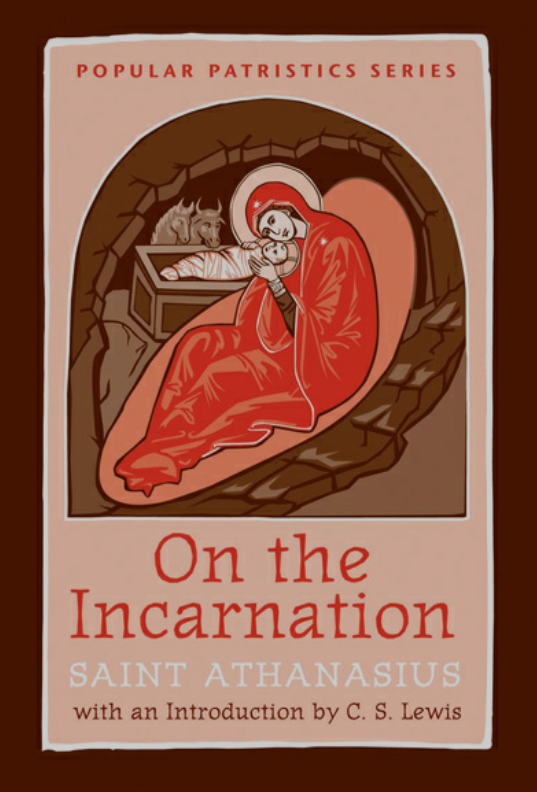
With Christmas coming, I decided to take C.S. Lewis’ advice and read an old book, tackling On the Incarnation by Athanasius during Advent. Up to now I’ve only read excerpts from this work (post), but I plan on reading and blogging through the entire book. I will be using the translation published as part of the Popular Patristics Series. This edition is translated by John Behr and contains the famous preface by C.S. Lewis (see blog post on that here).
Every age has its own outlook. It is specially good at seeing certain truths and specially liable to make certain mistakes. We all, therefore, need the books that will correct the characteristic mistakes of our own period. And that means the old books.
Preface by C.S. Lewis
On the Incarnation
On the Incarnation is considered an apology (or defense) of the cross and is the sequel to an earlier work entitled Against the Gentiles. 1 The dating for On the Incarnation is debated, with some favoring an early date prior to the Council of Nicaea, citing the lack of mentioning Arius. 2 Others suggest it was probably written sometime after the council, given that the author would have been writing at a very young age if it was earlier.3 These provide a range of time for the composition that would fall somewhere between 318 and 337 AD.
that you may be able to know the cause of the manifestation in the body of such and so great Paternal Word, … that, being by nature bodiless and existing as the Word, by the love for humankind and goodness of his own Father he appeared to us in a human body for our salvation.
On the INCARNATION 1
Who was Athanasius?
Athanasius contra mundum
A famous phrase that means: Athanasius against the world. And so it must have seemed at the time, as he was a major figure in the Arian controversy.
Before jumping into the book, I thought it may be worth exploring who Athanasius was. We can start by examining how this man was viewed around 10 years after his passing. It is during the celebration of a feast in Constantinople where we find Gregory of Nazianzus (329-390), a contemporary of Athanasius and the then current Archbishop, calling Athanasius a “pillar of the church”.
Gregory went on to describe the efforts of Athanasius during the Arian controversy before and after the Council of Nicaea. 4
In praising Athanasius, I shall be praising virtue. To speak of him and to praise virtue are identical, because he had, or, to speak more truly, has embraced virtue in its entirety. …
The beginning of this madness was Arius … others, catching the infection, organized an art of impiety, and, confining Deity to the Unbegotten, expelled from Deity not only the Begotten, but also the Proceeding one …
Not so that blessed one, who was indeed a man of God and a mighty trumpet of truth … he both happily preserved the Unity, which belongs to the Godhead, and religiously taught the Trinity, which refers to Personality, neither confounding the Three Persons in the Unity, nor dividing the Substance among the Three Persons, but abiding within the bounds of piety, by avoiding excessive inclination or opposition to either side.
Oration 21
Athanasius (296-373) served as the bishop of Alexandria for over 40 years. He was noted, as we have seen, for his role in defending the Trinity. The city, located in Egypt, over which he had responsibility was founded by Alexander the Great and was noted as a great place of learning. During this period of time it was recognized as one of three major metropolitan areas, with Rome and Antioch, that were given a “place of honor” and governed the churches within their respective geographies. 5
Early in his life, Alexander, then the bishop of Alexandria, took Athanasius on as his secretary. Under his tutelage, Athanasius learned rhetoric, philosophy and theology. Alexander was, himself, a student under Clement of Alexandria (150-215) at the famed Catechetical School of Alexandria. Alexander studied alongside Origen (185 – 253), a prolific writer and theologian, who was also a student at the school at the time. 6 These men would all have a great influence on Athanasius and his theology.
The Arian controversy started around 319 with the Council of Nicaea being convened in 325 to try and settle the matter. There, as noted, Athanasius was a major figure in refuting the teaching of Arius.
And therefore, first in the holy Synod of Nicæa, the gathering of the three hundred and eighteen chosen men, united by the Holy Ghost, as far as in him lay, he stayed the disease [referring to the ‘madness of Arius’]. Though not yet ranked among the Bishops, he held the first rank among the members of the Council, for preference was given to virtue just as much as to office
Oration 21
From our vantage point we may assume that after Nicaea the controversy was over. However, the decisions only encouraged more fighting and debate, which would continue for years. Shortly after the council, in 328, Athanasius was named bishop of Alexandria when his mentor Alexander passed. 7 He was exiled several times during his time of service as bishop due to disputes with Arian supporters led by Eusebius of Nicomedia.8
Besides his role in the Arian controversy, Athanasius is often credited with writing the earliest known list of the NT canon which contained the 27 books that we recognize today. This list appeared in his 39th Festal Letter in 367 AD. There is some debate among scholars as to whether Origen recorded a list with the 27 books of the NT even earlier, around 250 AD. 9 Since both of these highly regarded theologians were in Alexandria and taught within a close knit circle of prominent theologians it would seem that the leaders in this area were instrumental in the identification of the NT canon.
- Athanasius, Saint, Patriarch of Alexandria. On the Incarnation: Saint Athanasius (Popular Patristics Series Book 44) (p. 15). St Vladimir’s Seminary Press. Kindle Edition. ↩︎
- Athanasius, Saint, Patriarch of Alexandria. On the Incarnation: Saint Athanasius (Popular Patristics Series Book 44) (p. 18). St Vladimir’s Seminary Press. Kindle Edition. ↩︎
- Ibid (p. 18) ↩︎
- Oration 21: On the Great Athanasius, Bishop of Alexandria.
https://www.newadvent.org/fathers/310221.htm ↩︎ - Canon 6 from Council of Nicaea
https://www.christian-history.org/council-of-nicea-canons.html#6 ↩︎ - St. Athanatius (entry at CCEL)
https://www.ccel.org/ccel/athanasius ↩︎ - St. Athanasius (entry in Britannica)
https://www.britannica.com/biography/Saint-Athanasius ↩︎ - Eusebius of Nicomedia
https://www.newadvent.org/cathen/05623b.htm ↩︎ - Kruger, Michael. 10 Misconceptions about the NT Canon: #10: “Athanasius’ Festal Letter (367 A.D.) is the First Complete List of New Testament Books
https://michaeljkruger.5mt.site/10-misconceptions-about-the-nt-canon-10-athanasius-festal-letter-367-a-d-is-the-first-complete-list-of-new-testament-books/ ↩︎
 Dead Heroes Don't Save