
The earlier posts in this series (part 1) explored the early evidence that a person named Mark is the author of the book we call the Gospel of Mark.
The testimony was largely in agreement about the following information:
- Mark was the author.
- Mark was not a disciple of Jesus (while Jesus was alive).
- Mark wrote down what Peter was teaching and proclaiming.
- The book was written at the request of believers in Rome.
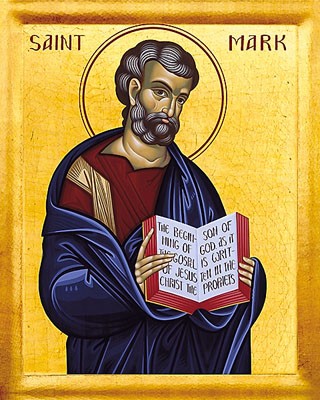
The testimony of the early church also notes that Mark was in Alexandria, Egypt planting churches.
Who is this person named Mark?
The extant testimony of the early church is unanimous that it was written by Mark, a person taken to be John Mark, the associate of Barnabas and Paul on the 1MJ.
One factor in favor of this being correct, notes Daniel Wallace, is that Mark is “by no means a major player in the New Testament.”1
The author identified as Mark is widely accepted as the person named John Mark that we find referenced throughout the NT.
In The New Testament in Its World, affirms that no alterative person has ever been suggested as the author.
Certainty is impossible, but John Mark is probably the best candidate, not least because his name, as a younger and less well-known early Christian, would not naturally occur to second-century Christians when seeking to name the book. No alternative figure has ever warranted consideration. 2
Wallace further notes that “[t]here is not much evidence within either Mark or the rest of the NT to connect [John Mark] with this gospel. Still, there is nothing against this supposition. And further, there is some evidence of Mark’s connection with Peter.”3
The Life and Times of John Mark
The connection Mark has with Peter starts with the first time he is mentioned in the NT (Acts 12:12). He is identified as “John who was also called Mark” and the son of Mary who owns a house in Jerusalem where the church gathers. Luke introduces us to him as he narrates several events including the warning of a famine, the execution of James the brother of John and the imprisonment of Peter (Acts 11:27-30; Acts 12:1-5). 4
After Peter’s divine rescue, from prison and impending death, the first place he goes is to Mary’s home, suggesting that this was a place where the church regularly met. It is easy to infer that Peter would know her son John Mark for some number of years as he ministered there. Around this time Paul and Barnabas are also in Jerusalem, and when they return to Antioch they take John Mark with them (Acts 12:25).
Mary may have sent her son John Mark to Antioch to get away from the unrest in Jerusalem that was taking place at the time. Whatever her reasons, she has sent him away with his cousin Barnabas (Col 4:10). Despite John Mark not being a “major player”, we can infer that Luke makes mention of him because in a few chapters he will be the catalyst for Paul and Barnabas parting ways before the 2MJ.
When Paul and Barnabas set out on the 1MJ they do bring Mark, referred to at this point only as John (Acts 13:5). For undisclosed reasons “John left them and returned to Jerusalem” (Acts 13:13). It seems reasonable to conclude that John Mark returns to his mother’s home in Jerusalem. He would again have an opportunity to spend time under Peter’s teaching. It appears that Mark was in Jerusalem for several years seeing first hand the continuing debates regarding the inclusion of the Gentiles.
The Jerusalem Council, which would occur some time around 49-50 AD, sought to settle the questions regarding the Jewish & Gentile groups being joined together and the dissention it was causing. It is likely these disturbances were what led to the Jews being expelled from Rome around this time. 5 This council brought Paul and Barnabas back to Jerusalem (Acts 15:2). At the conclusion of the council they return to Antioch and from there decide to visit the churches they planted on the 1MJ (15:36). When Barnabas insists on bringing John Mark the team splits up. Barnabas and his cousin head to Cyprus (15:37-39). We don’t know anything about this missionary journey but it would give John Mark great experiences that would help him plant churches in Alexandria, Egypt.
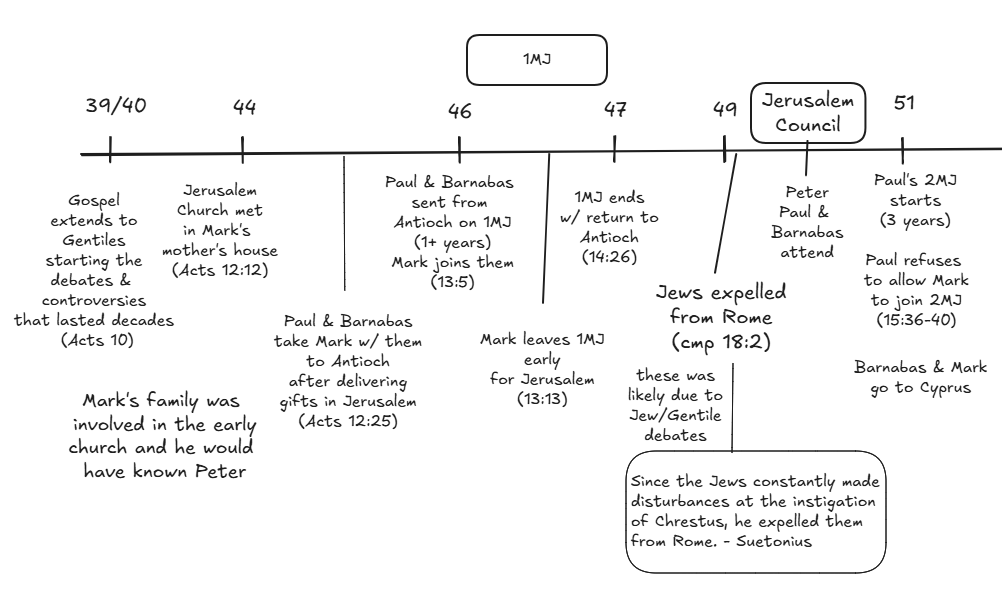
It is around this time that we find a decade or so gap in what we can know for certain about John Mark and his activities. As a relatively unknown character best known for splitting up Paul and Barnabas, Luke does not tell us anything more.
Numerous theories are proposed as to when Peter went to Rome and whether he took Mark with him. Additional theories, that favor a very early dating of the Gospel of Mark, suggest that perhaps Mark wrote the gospel during this period based on what Peter had been teaching in Jerusalem.
Any theory that tries to propose what Mark was doing rests on a set of events that themselves are dated with uncertainty. The major anchor points are the following:
- Claudius dies and is succeeded by Nero in 54 AD
- Paul sent a letter to Rome, likely from Corinth, around 56-57 AD 6
- Despite tradition claiming the church at Rome was founded by Peter this seems unlikely, as does his being in Rome during this time. 7
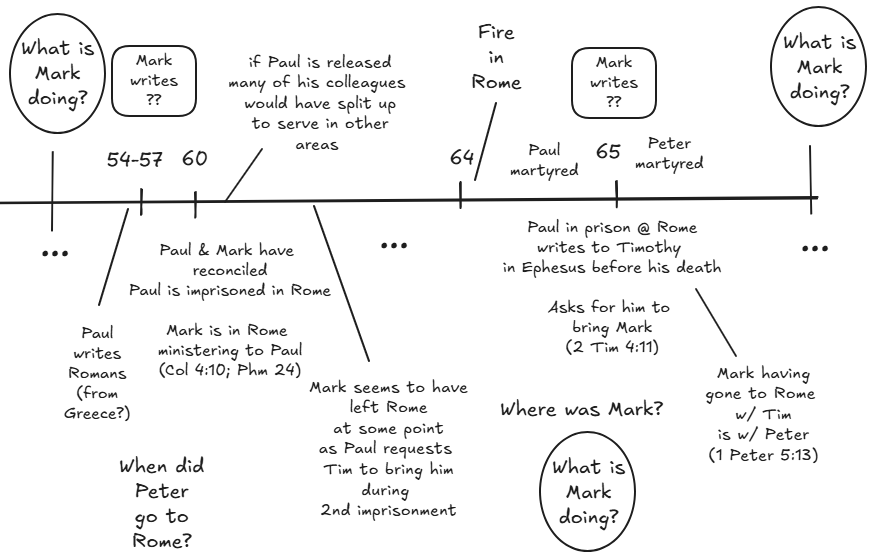
- After the 3MJ Paul is imprisoned and taken to Rome, around 60 AD (Acts 28:14) 8
- While in Rome Paul writes Colossians and Philemon, both of which mention Mark is with him (Col 4:10; Philemon 1:24).
After a decade where the actions and whereabouts of Mark can not be readily known, we find Mark in Rome with Paul. We also find that Paul is making preparations for Mark to be well received in Colossae. It is unclear when Paul and John Mark reconciled. Perhaps it was some time after the reports of a successful missionary journey with Barnabas. It is also unclear how long Mark stayed in Rome. Nor can we be sure whether Peter was in Rome around this time or whether he arrived some time later, though Paul’s lack of mentioning Peter suggests he was not.
These Pauline letters are the brief bit of information we get about Mark. The next time we have something indicating his activities it is in another Pauline letter. This is written to Timothy in Ephesus before Paul, in jail at Rome, is about to be executed. In this letter, probably around 64-65 AD, Paul asks Timothy to bring Mark with him (2 Tim 4:11).
This suggests that Mark is not in Rome at this time and had left, potentially when Paul was released between 60 and 62 AD, to pursue other ministries. The earliest dating of the Gospel of Mark, in the 50s, would have it already completed at this point.
The last bit of information in the New Testament is found in Peter’s first epistle. Peter notes that Mark, referred to as his son, sends his greeting to the churches in Asia Minor where the letter will be sent (1 Peter 5:13). Here we have to assume that Peter does refer to John Mark, who would be like a son and would know and be known by many in the churches of Asia Minor. The dating of Peter’s letter varies, between 60 and 63 AD. The location from which the letter was written is contested, with some advocating it was from Rome, which was referred to as Babylon in the letter.
Despite it being difficult to know much about the circumstances regarding 1 Peter, it would show that Mark and Peter got back together in the 60’s. The letter could also place them in Rome lining up with some of the claims in tradition. However, the earlier dating of the letter seems to place them in Rome around the time of Paul’s first imprisonment (60-62) where there is scant evidence Peter was there.
It is unclear when Mark went to Alexandria to plant and minister to churches. The Coptic Church, also known as the Coptic Church of Alexandria, assigns this to sometime after 60 AD. Their tradition has Mark ministering there until he returns to Rome to minister to Paul and then Peter in 64-65 AD. Coptic tradition then suggests Mark, upon his return to Alexandria, was executed by being dragged to death in 68 AD. 9
When was the book written?
Given the life and times of John Mark, it can be difficult to determine when he wrote the Gospel of Mark. Grant Osborne lays out three major ranges to consider for when Mark was written.10
- in the 50s since Mark was written before Matthew and Luke who relied on it when writing their own accounts
- in the late 60s after the death of Peter
- in the 70s after the destruction of the Temple and Jerusalem
Hurtado accepts that Mark could have been written over a period of 25 years. He notes that given the numerous factors that are involved and the tentative dating of various events and other works that must fit together that nothing more certain can be determined.
For our purposes, we shall allow for the writing of Mark any time between A.D. 50 and 75, as I see no compelling basis for being more precise here.11
Most commentators are split between the 50s and late 60s. Lane favors the decade of the 60s. 12 Edwards does as well.13 Wallace favors the 50s as does Osborne. 14
Most commentators accept the association of Peter and John Mark, with the latter capturing the former’s recollections and teachings. There is was some discrepancy in the early tradition as to whether the book was written before or after Peter’s martyrdom. The associate with Rome being the place where the writing was done is also generally accepted. However, not all suggest that Peter was in Rome while Mark was writing.
Arguing for the earlier date range, in the 50s, prioritizes the following pieces of information:
- Luke completed Acts in 62 AD and his Gospel sometime before that.
- Mark was the first gospel written and was used by the authors when composting the other Synoptic Gospel.
- Mark had to have written his gospel prior to 62 AD
Lining up the timelines for when, and sometimes if, Peter was in Rome, aside from his martyrdom, along with the various activities associated with him in Acts makes pushing the writing of the book that early too much of a challenge. It is the opinion of this author that Mark likely wrote this book in the mid-60s after those in Rome requested it and Peter endorsed the effort. It is unclear if the work necessarily was written, at least in its entirety, in Rome.
- Wallace, Daniel. “Mark: Introduction, Argument and Outline” Online. (https://bible.org/seriespage/mark-introduction-argument-and-outline) (accessed August 18, 2025). ↩︎
- Wright, N. T.; Bird, Michael F.. The New Testament in Its World: An Introduction to the History, Literature, and Theology of the First Christians (p. 557). Zondervan Academic. Kindle Edition ↩︎
- Wallace, “Mark: Introduction, Argument and Outline” ↩︎
- The famine that Agabus tells the people of Antioch during the reign of Claudius is also mentioned by Suetonius a Roman historian in The Lives of the Twelve Caesars. This occurs in chapter 18 in the Life of Claudius.
When there was a scarcity of grain because of long-continued droughts, he was once stopped in the middle of the Forum by a mob and so pelted with abuse and at the same time with pieces of bread, that he was barely able to make his escape to the Palace by a back door; and after this experience he resorted to every possible means to bring grain to Rome, even in the winter season.
↩︎ - Suetonius mentions that the Jews were expelled from Rome during the reign of Claudius. It is assumed that “Chrestus” was meant to refer to Christ and that the disturbances were related to either Jews opposing the spread of the claim that Jesus was their Messiah or the Jew/Gentile inclusion debates. At this time most would have considered Christians as another sect within Judaism, similar to Pharisees, Sadducees, and Essenes. This event is often dated around 49 AD and also mentioned in Acts 18:2.
Since the Jews constantly made disturbances at the instigation of Chrestus, he expelled them from Rome
↩︎ - Moo, Douglas J.. The Epistle to the Romans (NICNT). Eerdmans Publishing Company. (p 2-3)
The date at which Romans was written will depend, accordingly, on the dating of Paul’s three month stay in Greece; and this dating, in turn, is depending on the hazardous process of constructing an absolute chronology of the life of Paul. The best alternative is probably AD 57, though leeway of a year or two in either way must be allowed.
↩︎ - Eusebius, a fourth century historian, placed Peter there during the reign of Claudius but given Peter’s activities in Jerusalem and around the time of the Jerusalem Council this seems hard to reconcile
For immediately, during the reign of Claudius, the all-good and gracious Providence, which watches over all things, led Peter, that strongest and greatest of the apostles, and the one who on account of his virtue was the speaker for all the others, to Rome (Ecc Hist 2.14)
Moo (p 2) suggests that
the assessment of the fourth century father Ambrosiaster is probably correct: the Romans ‘have embraced the faith of Christ, albeit according to the Jewish rite, without seeing any sign of mighty works or any of the apostles.’
↩︎ - Eusebius notes that this was Paul’s first imprisonment in Rome and that he was later released. It was also at this time that Luke completed the book of Acts.
Luke, who wrote the Acts of the Apostles, brought his history to a close at this point, after stating that Paul spent two whole years at Rome as a prisoner at large, and preached the word of God without restraint.
Thus after he had made his defense it is said that the apostle was sent again upon the ministry of preaching, and that upon coming to the same city a second time he suffered martyrdom. (Ecc Hist 2.22). ↩︎ - St. Mark the Apostle, the Founder of the Coptic Church (https://copticorthodoxanswers.org/st-mark-founder-of-coptic-church/) (accessed August 20,2025) ↩︎
- Osborne, Grant R.. Mark (Teach the Text Commentary Series) . Baker Publishing Group. Kindle Edition.(Loc 362) ↩︎
- Hurtado, Larry W.. Mark (Understanding the Bible Commentary Series) . Baker Publishing Group. Kindle Edition. (Loc 369) ↩︎
- Lane, William L.. The Gospel of Mark (NICNT) Eerdmans Publishing Company (p 21) ↩︎
- Edwards, James R.. The Gospel according to Mark (Pillar). Eerdmans Publishing Company (p 9) ↩︎
- Osborne (Loc 362) ↩︎
 Dead Heroes Don't Save