
The earlier posts in this series (part 1) explored the early evidence that a person named Mark is the author of the book we call the Gospel of Mark. This author was further identified as John Mark who makes brief appearances throughout the NT (part 6).
There is a prevailing opinion that the Gospels were not written by eyewitnesses and that those who did write them did not consult the eyewitnesses. These authors simply wrote the stories that they had heard.
Even though there may well have been eyewitnesses alive some 35-40 years after Jesus’ death, there is no guarantee – or, I would argue, no reason to think – that any of them were consulted by the authors of the Gospels when writing their accounts. The eyewitnesses would have been Aramaic speaking peasants almost entirely from rural Galilee. Mark was a highly educated, Greek speaking Christian living in an urban area outside of Palestine (Rome?), who never traveled, probably, to Galilee. So the existence of eyewitnesses would not have much if any effect on his Gospel. (emphasis added) 1
– Bart Ehrman
While Mark was not a disciple of Jesus during His earthly ministry the extant evidence affirms that he wrote down what Peter was teaching and proclaiming. Peter was, of course, an eyewitness and one of the three closest disciples to Jesus. We have seen that Mark and Peter would have known each other over a period of decades. This familiarity would give the author of the Gospel of Mark lots of opportunities to talk with him, ask questions and to hear his teaching. In addition, Mark’s mother was hosting meetings where Christians would gather. There would be no reason to think that most of the people that assembled were also eyewitnesses of Jesus’ teaching and healing (Acts 2:22; 12:12). Mark would have met and conversed with them as well. That should counter any idea that eyewitnesses did not have much effect on what was written.
Even today, it is not uncommon for an eyewitness or participant in historical events to rely on another, perhaps more capable, writer to help collect and organize their recollections into a book. That arrangement is how we might think about how the Gospel of Mark came about.
Indeed, I will also make every effort that, after my departure, you have a testimony of these things.
– Peter 2
In capturing the testimony and teaching of Peter, Mark’s book exhibits several literary devices and techniques to present the ministry of Jesus. The book is divided into two halves, with the first exploring Jesus’ Galilean ministry and the latter the journey to Jerusalem. The division is the proclamation that Jesus is the Christ.3
It is my view that the whole book forms a chiasmus. This is a didactic device in which a sequence of ideas are presented and then repeated in reverse order. The gives the overall book a “mirror” effect as the ideas are “reflected” back. It can be used to capture the reader’s (or listener’s) attention and is used to highlight a major theme or point, which can be found in the center.
The book forms a chiastic organization around the theme that Jesus is the Son of God. The identity of Jesus is revealed throughout the first half of the narrative as Mark demonstrates the authority Jesus has and the reactions of those who encounter Him. The pivots occurs when Peter identifies Jesus as the Christ. However, Peter still fails to understand that Jesus must “be rejected by the elders, the chief priests and the teachers of the law, and that he must be killed and after three days rise again.” The second half focuses on Jesus as He sets out for Jerusalem and the cross. This part of the narrative explores the unexpected idea that the promised Davidic King was also the Suffering Servant.
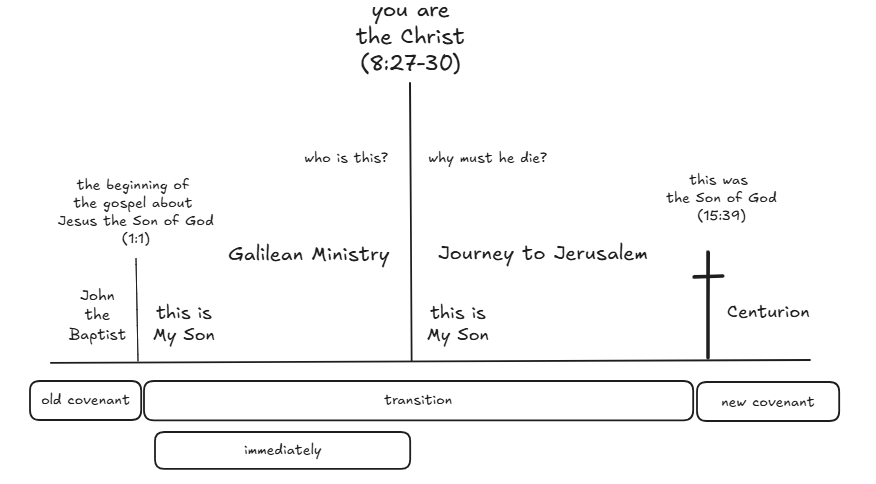
This image can be flattened into this table where each major idea is labeled with a letter. That gives us a basic ABCDCBA structure.
| Level | Section | Reference | Key Phrase or Theme |
|---|---|---|---|
| A | The beginning of the gospel of Jesus Christ, the Son of God | 1:1 | The beginning of the good news of Jesus, the Son of God, starts w/ John the Baptist |
| B | You are My beloved Son | 1:11 | Divine declaration of Jesus as the Son of God at His baptism |
| C | Galilean Ministry | 1:14–8:26 | Jesus grows in popularity as he preaches, heals and casts out demons |
| D | You are the Christ | 8:27–30 | Peter declares Jesus as Messiah but doesn’t comprehend the cross |
| C′ | Journey to Jerusalem | 8:31–16:8 | The road to the cross, death, burial and resurrection |
| B′ | This is My beloved Son | 9:7 | Divine declaration of Jesus as the Son of God at the Transfiguration |
| A′ | Truly this man was the Son of God | 15:39 | The Roman centurion declares Jesus is the Son of God as He dies on the cross |
If we compare the overall structure of the Gospel of Mark with Peter’s presentation of the good news to Cornelius in Acts we find they have a similar outline. 4 This may lend some support to the extant testimony that Mark is writing based on the eyewitness testimony of Peter and his teaching.
Here is how Luke narrates Peter’s visit to Cornelius to share the good news.
Then Peter started speaking: “… You know the message he sent to the people of Israel, proclaiming the good news of peace through Jesus Christ (he is Lord of all)— you know what happened throughout Judea, beginning from Galilee after the baptism that John announced: with respect to Jesus from Nazareth, that God anointed him with the Holy Spirit and with power. He went around doing good and healing all who were oppressed by the devil, because God was with him. We are witnesses of all the things he did both in Judea and in Jerusalem. They killed him by hanging him on a tree, but God raised him up on the third day and caused him to be seen, not by all the people, but by us, the witnesses God had already chosen, who ate and drank with him after he rose from the dead. He commanded us to preach to the people and to warn them that he is the one appointed by God as judge of the living and the dead. About him all the prophets testify, that everyone who believes in him receives forgiveness of sins through his name.”5
It is likely this narrative captures the major elements of the conversation (ipsissima vox) rather than a verbatim exchange (ipsissima verba). But in this narrative Luke captures an outline that matches the overall structure of Mark’s book.
We can match the major outline in Acts with the overall structure of Mark as follows:
| Mark | Reference | Acts | Reference | Note |
|---|---|---|---|---|
| Jesus came from Nazareth in Galilee and was baptized by John in the Jordan River … [with] the Spirit descending on him | 1:9-10 | beginning from Galilee after the baptism that John announced … that God anointed Him w/ Spirit | 10:37 | Jesus’ ministry starts with John the Baptist and the Baptism of Jesus who was anointed with the Spirit |
| Jesus went into Galilee and proclaimed the gospel of God | 1:14-15 | You know the message he sent to the people of Israel, proclaiming the good news of peace | 10:36 | Jesus starts in Galilee to proclaim good news – the kingdom is at hand, which included an expectation of peace |
| So he healed many who were sick with various diseases and drove out many demons. | 1:34; 3:10-11; 6:53-56 | He went around doing good and healing all who were oppressed by the devil, because God was with him | 10:38 | The first half of the book highlights Jesus’ ministry in the region of Galilee centered on His teaching and miraculous works |
| So the Pharisees went out immediately and began plotting with the Herodians, as to how they could assassinate him | 3:6; 11:18; 12:12 | They killed him | 10:39 | Mark shows the increasing hostility and rejection of Jesus by the scribes that would lead to plotting His death |
| You are the Christ | 8:27–30 | Jesus Christ (he is Lord of all) | 10:36 | |
| The Triumphal entry through to the Last Supper and arrest | 11-14 | We are witnesses of all the things he did both in Judea and in Jerusalem | 10:39 | The second half of the book documents Jesus’ travel to Jerusalem and His final week |
| Then they brought Him to the place Golgotha, … And they crucified Him | 15:23-24 | We are witnesses … They killed him by hanging him on a tree, | 10:39 | Jesus is crucified, dies and is buried |
| you are looking for Jesus the Nazarene, who has been crucified. He has risen; He is not here … go, tell His disciples and Peter …there you will see Him | 16:6-7 | God raised him up on the third day and caused him to be seen … by us, the witnesses God had already chosen | 10:40-41 | Jesus has risen and is seen by the disciples |
| As it is written in the prophet Isaiah | 1:1 | About him all the prophets testify | 10:43 | Mark uses numerous references to Isaiah and other OT prophets |
| Truly this man was the Son of God | 15:39 | Peter presents the good news to Cornelius a centurion | 10:1 | Mark highlights the good news is for both Jews and Gentiles by having this proclamation come from a Roman centurion, just as God used Peter and a centurion to make the same point |
The outline of the conversation and proclamation of good news in Jesus that Peter shared with Cornelius is probably one that was used repeatedly as Peter ministered and shepherded the early church. The stories that comprise much of what we have in the Gospel of Mark were almost certainly shared over several decades and were eventually organized and preserved for us by John Mark.
We have good reasons to accept Mark as the author saw Peter the eyewitness, proclaim Jesus and share the stories of what it was like to be His follower. We can rightly think of this book as The Memoirs of Peter on the Life of Jesus, which was written and arranged by Mark .
- Question about Eyewitnesses and the Gospels, The Bart Ehrman Blog (https://ehrmanblog.org/question-about-eyewitnesses-and-the-gospels/) (accessed November 12,2025)
Ehrman will also note that “My sense is that most of the eyewitnesses (and who knows how many there were?! Hundreds? Probably not. Dozens?) had died before the Gospels were written.” However, that would discount what Paul writes when he says that most are still living (1 Cor 15:6) in a letter that was penned around 54 AD. That would be around 10 years before Mark likely wrote. ↩︎ - 2 Peter 1:15 (NET) The NET Bible note for this verse identifies some challenges associated with the idea this passage refers to Peter working to help bring about Mark’s book
“Some have suggested that Mark’s Gospel is in view. The difficulty with this is threefold: (1) Mark is probably to be dated before 2 Peter, (2) early patristic testimony seems to imply that Peter was the unwitting source behind Mark’s Gospel; and (3) “these things” would seem to refer, in the least, to the prophecy about Peter’s death (absent in Mark).”
However, it is clear that Peter, nearing the end of his life, was working to make sure the stories of Jesus were preserved and passed on ↩︎ - Edwards, James R.. The Gospel according to Mark (Pillar) (p 20-21) Eerdmans ↩︎
- Lane, William L. The Gospel according to Mark (NICNT) (p 10-11) Eerdmans ↩︎
- Acts 10:34-43 (NET) ↩︎
 Dead Heroes Don't Save