Where the clothes are the person must also be: another lesson in logic

We balance probabilities and choose the most likely. – Holmes

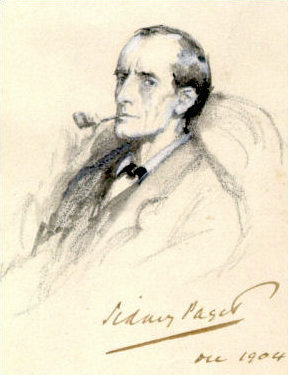
Sherlock Holmes (Wikipedia)

As pat of the Senior Seminar, we discussed the reality that people don’t write out there arguments in logical form. Part of the brilliance of the Socratic Method was the use of questions to explore and probe a person’s view to expose the underlying assumptions, gaps, and contradictions that may exist.  Having looked at the hypothetical form of  a philosophical argument, let’s use The Adventure of the Noble Bachelor to practice identifying these arguments within a story.

The official detective was attired in a pea-jacket and cravat, which gave him a decidedly nautical appearance, and he carried a black canvas bag in his hand. With a short greeting he seated himself and lit the cigar which had been offered to him.

“What’s up, then?” asked Holmes with a twinkle in his eye. “You look dissatisfied.”

“And I feel dissatisfied. It is this infernal St. Simon marriage case. I can make neither head nor tail of the business.”

“Really! You surprise me.”

“Who ever heard of such a mixed affair? Every clue seems to slip through my fingers. I have been at work upon it all day.”

“And very wet it seems to have made you,” said Holmes laying his hand upon the arm of the pea-jacket.

“Yes, I have been dragging the Serpentine.”

“In heaven’s name, what for?”

“In search of the body of Lady St. Simon.”

Sherlock Holmes leaned back in his chair and laughed heartily. “Have you dragged the basin of Trafalgar Square fountain?” he asked.

“Why? What do you mean?”

“Because you have just as good a chance of finding this lady in the one as in the other.”

Lestrade shot an angry glance at my companion. “I suppose you know all about it,” he snarled.

“Well, I have only just heard the facts, but my mind is made up.”

“Oh, indeed! Then you think that the Serpentine plays no part in the matter?”

“I think it very unlikely.”

“Then perhaps you will kindly explain how it is that we found this in it?” He opened his bag as he spoke, and tumbled onto the floor a wedding-dress of watered silk, a pair of white satin shoes and a bride’s wreath and veil, all discoloured and soaked in water. “There,” said he, putting a new wedding-ring upon the top of the pile. “There is a little nut for you to crack, Master Holmes.”

“Oh, indeed!” said my friend, blowing blue rings into the air. “You dragged them from the Serpentine?”

“No. They were found floating near the margin by a park-keeper. They have been identified as her clothes, and it seemed to me that if the clothes were there the body would not be far off.”

“By the same brilliant reasoning, every man’s body is to be found in the neighbourhood of his wardrobe.”

Since most people don’t write out there arguments in logical form (which is not saying the argument is illogical), it is good practice to examine a portion of a narrative and write out the argument being made. Can you write the two arguments made in this portion of the story?

Lestrade:

hypothesis
observation
conclusion

Holmes points out that there is an unstated assumption Lestrade is making.

Holmes: restating Lestrade’s argument (in categorical form)

premise
premise
conclusion

Is Lestrade’s argument valid? Is it sound?
The hypothetical barking dog: a lesson in logic

Sherlock Holmes (wikipedia)


This month our church is hosting a Senior Seminar. In this seminar we invite graduating seniors to join us as we attempt to give them a crash course in the big choices they will face as they head off to college or the work force. One of these areas we explore in the seminar is worldviews and philosophy.

Honoring the fact that the Presidential election has gone to the dogs (a sad commentary on political discourse), this post uses dogs to examine the basic hypothetical form of a philosophical argument. To set up the scenario we are going to use the barking dog hypothesis found in the Sherlock Holmes adventure – Silver Blaze.

Colonel Ross still wore an expression which showed the poor opinion which he had formed of my companion’s ability, but I say by the inspector’s face that his attention had been keenly aroused.

“You consider that to be important?” he asked.

“Exceedingly so.”

“Is there any point to which you would wish to draw my attention?”

“To the curious incident of the dog in the night-time.”

“The dog did nothing in the night-time.”

“That was the curious incident,” remarked Sherlock Holmes.

“Before deciding that question I had grasped the significance of the silence of the dog, for one true inference invariably suggests others. The Simpson incident had shown me that a dog was kept in the stables, and yet, though someone had been in and had fetched out a horse, he had not barked enough to arouse the two lads in the loft. Obviously the midnight visitor was someone whom the dog knew well.”

That basis of Holmes argument starts with the hypothesis that when a dog detects an intruder it will bark.

Writing this out as a premise in an argument would look like this:

If (a dog detects an intruder) then (the dog will bark)

This seems like a premise that that has a high degree of probability of being true most of the time. Of course there are unstated assumptions like the dog is healthy and can see, smell, and hear, is not drugged, and can actually bark. Holmes assumes this hypothesis is reliable, having the testimony that dog is used as a guard dog along with the lads to make sure the horse is not stolen.

In a hypothetical form of a philosophical argument the concept of a dog detecting an intruder is called the antecedent. It represents a cause and is often represented by a P.

The concept of the dog barking is called the consequent. It represents an effect and is often represented by a Q.

Using this as a starting point, we can look at the hypothesis and 4 different ways to arrive at a conclusion based on what the second premise in the argument attempts to either confirm or deny.

Note the hypothetical stays the same in all 4 cases, in which we have asserted that P is a cause of the effect Q. We are also assuming that this hypothesis is true. We are only attempting to verify the conclusion that each argument is making. If this hypothesis is false then the conclusion of each argument would also be false (or at least unproven by the argument).

Modus Ponens: Affirming the Antecedent

hypothetical If (a dog detects an intruder) then (the dog will bark)
premise The dog detects an intruder
conclusion Therefore the dog barks
  • If P is really a cause of Q and the premise that the dog detected an intruder is true (P is true), it will be true that the dog barked (Q is true).

Modus Tollens: Denying the Consequent

hypothetical If (a dog detects an intruder) then (the dog will bark)
premise The dog did not bark
conclusion Therefore the dog did not detect an intruder
  • If P is really a cause of Q and the premise that the dog did not bark is true (not Q), it will be true that the dog did not detect an intruder (not P).
    • The dog did not bark so the cause was missing, which was how Holmes arrived at the conclusion that the person who took the horse could not have been a stranger to the dog.

Fallacy: Denying the Antecedent

hypothetical If (a dog detects an intruder) then (the dog will bark)
premise The dog did not detect an intruder
conclusion Therefore the dog did not bark
  • If P is really a cause of Q and the premise that the dog did not detect an intruder is true (not P), it will not necessarily be true that the dog did not bark (not Q).
    • This is a fallacy because Q may occur for other reasons
    • The dog may have barked because it was hungry or playing etc.

Fallacy: Affirming the Consequent

hypothetical If (a dog detects an intruder) then (the dog will bark)
premise The dog barks
conclusion Therefore the dog detects an intruder
  • If P is really a cause of Q and the premise that the dog barks is true (Q), it will not necessarily be true that the dog detected an intruder (P).
    • This is a fallacy because Q may occur for other reasons
    • The dog may not have barked because of an intruder, but because it was hungry or playing etc.

Once we have established these valid and invalid forms of an argument we can apply them to more interesting cases.

Give this one a try:

hypothetical If (humans and chimps have a common ancestor) then (humans and chimps have similar genetic makeup)
premise humans and chimps have similar genetic makeup
conclusion Therefore humans and chimps have a common ancestor

Is this a valid argument?