The Adventure of the Elected Man (or Holmes meets Spurgeon)

As I look back upon my life it is with great pleasure that I think about the good fortune I had being acquainted with one Sherlock Holmes. Not only because he was probably the greatest detective who ever lived but because he was among my dearest of friends. Life was never boring. We worked together on many cases and shared many adventures. Many of which you no doubt might be very familiar with, as I have taken up the task of writing up the more interesting of these paying attention to those that challenged Holmes great analytical skills and power of observation. However as I sit back and reflect I can’t help but recount some of the conversations and visitors we had in our apartment on Baker Street that did not make it into these various accounts.

Vanity Fair: Charles SpurgeonNot all our visitors came seeking Holmes involvement in solving some crime or predicament which they often brought with them. Some came just to talk.

One of the more interesting visits came early in our friendship when we had just met and started sharing an apartment. Our guest on that day was none other than Charles Spurgeon. Yes, the Charles Spurgeon, the very popular preacher at the Metropolitan Tabernacle, a large church in South London near the river Thames. It was approximately 10 km from our flat on Baker Street.

Do you find it surprising that Sherlock would entertain the Prince of Preachers. While not the most active of church-goers, Holmes was no stranger to God. Remember the account about the Blue Carbuncle when he sought to help Mr. Ryder remarking that he likely “saved his soul” by letting him go rather then letting him rot in prison. Continue reading
Where the clothes are the person must also be (answer)

This post contains the answer to the question posed in the post where the clothes are the person must also be.

I encourage you to try and solve the questions posed in the prior post before reading the answer.


Crime is common. Logic is rare. Therefore it is upon the logic rather than upon the crime that you should dwell. – Holmes

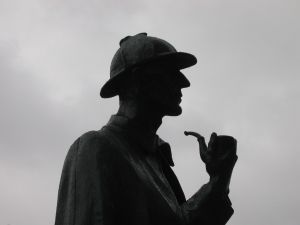
Holmes Statue at Baker Street

Lestrade has established a valid argument. The argument in a more structured form could be stated as follows:

hypothesis If the clothes were found by the river then the body must be in the river
observation The clothes were found by the river
conclusion Therefore the body must be in the river

Lestrade also thought it was a sound (or at least a highly probable argument)  based on his actions. He has found the clothes by the river. Based on this evidence (or observation), Lestrade started dragging the Serpentine River looking for a body because of his working assumption that his hypothesis (see table) was true.

However, Holmes frustrates the detective by pointing out (though the argument is valid and the conclusion is probable) there is a faulty  assumption Lestrade is making.

Holmes argument could be stated in a more structured form as follows:

premise A person is always found near their clothes
premise their clothes (or most of them) are in their closet
conclusion Therefore the person is in the closet

Lestrade assumes that the clothes being found by the river would be an indicator that the body would also be found nearby.  While not committing any formal fallacy, Lestrade is close to committing the fallacy of the converse accident by forming his hypothesis as a general rule that will be true in all circumstances, rather than one of several possibilities. His generalization, even if based on his actual experiences as a detective, will turn out to be incorrect.

If the hypothesis Lestrade accepted was correct, then he would have a more probable chance of success in finding the missing bride by looking in her closet.

This is a good illustration reminding all of us that a valid argument can turn out to be false. While it can be argued that it is probable that the body was in the river, the clothes could also have been placed by the river for a variety of reasons that do not include the body being in the river as the rest of the story shows to be the case.

Where the clothes are the person must also be: another lesson in logic

We balance probabilities and choose the most likely. – Holmes

Sherlock Holmes (Wikipedia)

As pat of the Senior Seminar, we discussed the reality that people don’t write out there arguments in logical form. Part of the brilliance of the Socratic Method was the use of questions to explore and probe a person’s view to expose the underlying assumptions, gaps, and contradictions that may exist.  Having looked at the hypothetical form of  a philosophical argument, let’s use The Adventure of the Noble Bachelor to practice identifying these arguments within a story.

The official detective was attired in a pea-jacket and cravat, which gave him a decidedly nautical appearance, and he carried a black canvas bag in his hand. With a short greeting he seated himself and lit the cigar which had been offered to him.

“What’s up, then?” asked Holmes with a twinkle in his eye. “You look dissatisfied.”

“And I feel dissatisfied. It is this infernal St. Simon marriage case. I can make neither head nor tail of the business.”

“Really! You surprise me.”

“Who ever heard of such a mixed affair? Every clue seems to slip through my fingers. I have been at work upon it all day.”

“And very wet it seems to have made you,” said Holmes laying his hand upon the arm of the pea-jacket.

“Yes, I have been dragging the Serpentine.”

“In heaven’s name, what for?”

“In search of the body of Lady St. Simon.”

Sherlock Holmes leaned back in his chair and laughed heartily. “Have you dragged the basin of Trafalgar Square fountain?” he asked.

“Why? What do you mean?”

“Because you have just as good a chance of finding this lady in the one as in the other.”

Lestrade shot an angry glance at my companion. “I suppose you know all about it,” he snarled.

“Well, I have only just heard the facts, but my mind is made up.”

“Oh, indeed! Then you think that the Serpentine plays no part in the matter?”

“I think it very unlikely.”

“Then perhaps you will kindly explain how it is that we found this in it?” He opened his bag as he spoke, and tumbled onto the floor a wedding-dress of watered silk, a pair of white satin shoes and a bride’s wreath and veil, all discoloured and soaked in water. “There,” said he, putting a new wedding-ring upon the top of the pile. “There is a little nut for you to crack, Master Holmes.”

“Oh, indeed!” said my friend, blowing blue rings into the air. “You dragged them from the Serpentine?”

“No. They were found floating near the margin by a park-keeper. They have been identified as her clothes, and it seemed to me that if the clothes were there the body would not be far off.”

“By the same brilliant reasoning, every man’s body is to be found in the neighbourhood of his wardrobe.”

Since most people don’t write out there arguments in logical form (which is not saying the argument is illogical), it is good practice to examine a portion of a narrative and write out the argument being made. Can you write the two arguments made in this portion of the story?

Lestrade:

hypothesis
observation
conclusion

Holmes points out that there is an unstated assumption Lestrade is making.

Holmes: restating Lestrade’s argument (in categorical form)

premise
premise
conclusion

Is Lestrade’s argument valid? Is it sound?