
This is part 5 of the series blogging through the book On the Incarnation by Athanasius. You might want to start with part 1 and work your way through the series.
In this post we are going to jump right in, picking up where we left off in part 4. We will be looking at the second major argument Athanasius presents in Against the Gentiles related to how creation points to a Creator. And yes, we will eventually get back to On the Incarnation.
Why do we find a Universe that has Order and Harmony?
In the second major argument advanced by Athanasius, we find him making a teleological argument. A teleological argument is one that makes an appeal to what is known of the universe and then moves to argue that it shows evidence of design and purpose. It then asserts that this is evidence for a Designer.
The Fine-Tuning Argument
A popular and modern version of a teleological argument would be the fine tuning argument.
The laws of physics, the shape of the universe and the values of numerous constants appear to be so finely tuned that a slight change in any one of them could radically change how the universe looks and whether it could support life.1 These observations leave physicists, and all of us, to grapple with whether our universe was designed to support life or whether it was something else that brought about the circumstances in which we find ourselves.
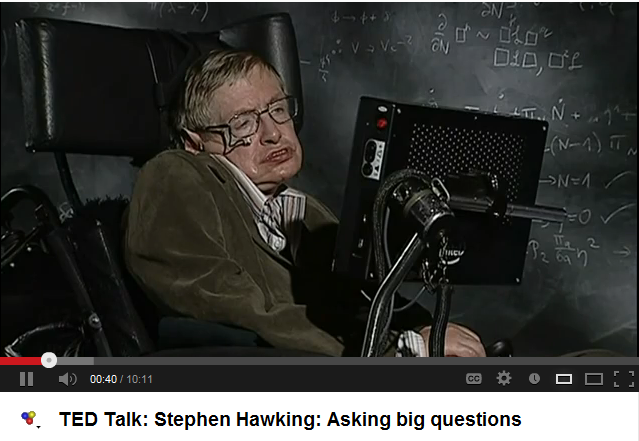
In A Brief History of Time, the famous physicist Stephen Hawking writes:
The laws of science, as we know them at present, contain many fundamental numbers, like the size of the electric charge of the electron and the ratio of the masses of the proton and the electron. We cannot, at the moment at least, predict the values of these numbers from theory – we have to find them by observation. It may be that one day we shall discover a complete unified theory that predicts them all, but it is also possible that some or all of them vary from universe to universe or within a single universe. The remarkable fact is that the values of these numbers seem to have been very finely adjusted to make possible the development of life. … it seems clear that there are relatively few ranges of values for the numbers that would allow the development of any form of intelligent life. Most sets of values would give rise to universes, that, although they might be very beautiful, would contain no one able to wonder at that beauty. One can take this either as evidence of a divine purpose in Creation and the choice of the laws of science or as support for the strong anthropic principle. (emphasis added) 2
The alternative to a Designer is the “anthropic principle”.3 The dictionary definition states that “conditions that are observed in the universe must allow the observer to exist” because we are here to observe it.4
Physicist Leonard Susskind defines this principle as follows:
In particular what determines the fact that the temperature of our planet is between freezing and boiling? The answer is that nothing does. There are environments with temperatures ranging from almost absolute zero to trillions of degrees. Nothing, determines the nature of our environment—except for the fact that we are here to ask the question! The temperature is between freezing and boiling because life (at least our kind) requires liquid water. That’s it. That’s all. There is no other explanation.
This rather pedestrian, common sense logic is sometimes called “The Anthropic Principle.”(emphasis added) 5
As an alternative to a Designer, modern physicists propose a multiverse. The multiverse is generally understood as the “entire ensemble of innumerable regions of disconnected space-time” that have different laws of physics.6 The majority of these other universes would not be able to support life. The proposal attempts to blunt the “astronomically low” odds that our universe would be fine tuned as it is.7
By analogy, if there are enough universes, with enough variation in the numbers in their physics, then it becomes statistically likely that one will happen to have the right numbers for life. 8
There is frustration and debate among physicists about whether the anthropic principle or the multiverse ideas are “good science”.9 My goal here is not to dive into that debate. I will leave that for the reader (or perhaps a future blog post). The intent, for the moment, is for us to recognize that Athanasius was involved in a debate similar to this one, 1700 years ago.
Athanasius’ Teleological Argument
I want to stress the word similar, as not only was Athanasius’ understanding of the universe very different than ours. Most of his opponents in the debate held a different alternate view; they were advocating for multiple gods, not naturalism.
Athanasius and his contemporaries both generally accepted a similar cosmology and understanding of the universe (see part 4). From that common ground, Athanasius appeals to the order and harmony found in nature. Since we don’t find chaos and dissolution we should understand that is only possible if there is a Designer purposefully managing things to achieve this end.
Interestingly, the multiverse is not a new concept to the debate. In the fourth century, Athanasius argued that if there are a plurality of gods it would suggest there should be a plurality of universes.
For the fact that there is one Universe only and not more is a conclusive proof that its Maker is one. For if there were a plurality of gods, there would necessarily be also more universes than one. (ch 39) 10
He considered it a “fact” that “there is one Universe” and thus offered it as “conclusive proof that its Maker is one.” I am not sure if anyone was arguing for a multiverse in the fourth century. Athanasius is relying on the common understanding that there is one universe to advance his argument. His point seems to be, we all admit that there is one universe so there cannot be a plurality of gods. If there were multiple gods and one universe they would all be weak, needing each other’s combined effort and skills to bring about the universe. Further since these gods are often at odds with each other, then surely the universe “would be diverse and inconsistent” rather than harmonious and orderly as it is found. Today, that argument is flipped, as there is no longer agreement that there is “one Universe”. Those that reject a Designer, singular or plural, now argue for a plurality of universes.
The basic form of the argument is that God, being invisible, made Himself known through an orderly Creation.
For God, being good and loving to mankind, and caring for the souls made by Him … for this cause God by His own Word gave the Universe the Order it has, in order that since He is by nature invisible, men might be enabled to know Him at any rate by His works. For often the artist even when not seen is known by his works. (ch 35)
He points out such things as the movement of the sun, moon and stars and the diversity of the elements and seasons which can all be found working together.
[Without a single Maker] we should consequently see not an ordered universe, but disorder, not arrangement but anarchy, not a system, but everything out of system, not proportion but disproportion. For in the general strife and conflict either all things would be destroyed, or the prevailing principle alone would appear. (ch 37)
Athanasius then advances the argument. Without the order and harmony of the various elements and entities in the universe (ie fine tuning), how could there be life?
For what sort of an universe would it be, if only the sun appeared, or only the moon went her course, or there were only night, or always day? Or what sort of harmony would it be, again, if the heaven existed alone without the stars, or the stars without the heaven? Or what benefit would there be if there were only sea, or if the earth were there alone without waters and without the other parts of creation? Or how could man, or any animal, have appeared upon earth, if the elements were mutually at strife, or if there were one that prevailed, and that one insufficient for the composition of bodies (ch 37)
The order found in the universe is what allows life.
Athanasius will describe then how order is like hearing music coming from a lyre. We recognize the sounds as having design and purpose so that what we hear is beautiful music. Further we assume there is a musician. No one thinks the lyre is playing itself, nor do we conclude that harmonious music was made by accident (or by competing gods).
In the same way we should understand the universe.
For just as though one were to hear from a distance a lyre, composed of many diverse strings, and marvel at the concord of its symphony, in that its sound is composed neither of low notes exclusively, nor high nor intermediate only, but all combine their sounds in equal balance — and would not fail to perceive from this that the lyre was not playing itself, nor even being struck by more persons than one, but that there was one musician, even if he did not see him, who by his skill combined the sound of each string into the tuneful symphony; so, the order of the whole universe being perfectly harmonious, and there being no strife of the higher against the lower or the lower against the higher, and all things making up one order, it is consistent to think that the Ruler and King of all Creation is one and not many, Who by His own light illumines and gives movement to all. (ch 38)
There really is nothing new under the sun.
- Is the Universe Fine-Tuned for Life?
https://www.pbs.org/wgbh/nova/article/is-the-universe-fine-tuned-for-life/ ↩︎ - Hawking, Stephen. A Brief History of Time (p. 120-130). Bantam Book ↩︎
- What Is the Anthropic Principle?
https://www.thoughtco.com/what-is-the-anthropic-principle-2698848 ↩︎ - Merriam Webster dictionary entry for anthropic principle
https://www.merriam-webster.com/dictionary/anthropic%20principle ↩︎ - Smolin Vs. Susskind: The Anthropic Principle
https://www.edge.org/conversation/lee_smolin-leonard_susskind-smolin-vs-susskind-the-anthropic-principle ↩︎ - Confronting the Multiverse: What ‘Infinite Universes’ Would Mean
https://www.space.com/31465-is-our-universe-just-one-of-many-in-a-multiverse.html ↩︎ - Our Improbable Existence Is No Evidence for a Multiverse
https://www.scientificamerican.com/article/our-improbable-existence-is-no-evidence-for-a-multiverse/ ↩︎ - Our Improbable Existence Is No Evidence for a Multiverse
https://www.scientificamerican.com/article/our-improbable-existence-is-no-evidence-for-a-multiverse/ ↩︎ - Smolin Vs. Susskind: The Anthropic Principle
https://www.edge.org/conversation/lee_smolin-leonard_susskind-smolin-vs-susskind-the-anthropic-principle ↩︎ - All quotes from Against the Gentiles from New Advent translation unless otherwise noted.
https://www.newadvent.org/fathers/2801.htm ↩︎
 Dead Heroes Don't Save