
This is part 6 of the series blogging through the book On the Incarnation by Athanasius. You might want to start with part 1 and work your way through the series.
In the opening chapter of On the Incarnation, Athanasius referred to his prequel noting that he had “sufficiently treated a few points regarding the error of the Gentiles concerning idols”. We have been examining those points in the last few posts. These were important because it sets the stage for the more popular work that followed.
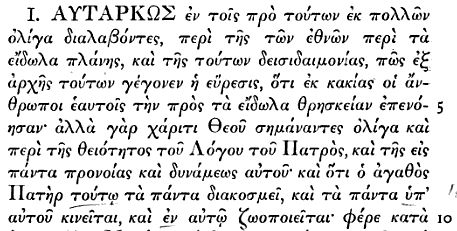
The next thing Athanasius tells us in the introduction is that in the prequel he covered a “few points regarding the divinity of the Word of the Father and his providence and power in all things”. 1
Athanasius goes on to list three things we learn about God’s providence.
- through [the Word] the good Father arranges all things
- by him all things are moved
- and in him are given life
A cursory search from the initial chapter of On the Incarnation, suggests that the Greek word προνοία was used by Athanasius for providence. Please note that I did not have the resources, or the ability, to confirm this was always the case each time the English word appears in the translation. 2
The BDAG entry offers us the following definition of προνοία: thoughtful planning to meet a need, forethought, foresight, providence. The Friberg lexicon offers: be concerned about, plan a way to provide for. The same form of the word from the introduction appears in Acts 24:2
Since we have through you attained much peace, and since by your providence reforms are being carried out for this nation, we acknowledge this in every way and everywhere, most excellent Felix, with all thankfulness. (Acts 24:2-3 NASB95)
Christian writers throughout history have contemplated God’s providence. They have not always agreed on what it entails. At a minimum it entails God’s intentional design and continual governance of the universe.
Expanding on the 3 points from the introduction, here are 5 things we learn about how Athanasius understood providence from the two works under consideration.
God actively and continually sustains the universe
Athanasius wrote that God desires all to exist. Therefore after the initial act of creation, He is actively at work (ie sustaining) to prevent nature from coming apart as it would necessarily do without His involvement. The Creation “by the governance and providence and ordering action of the Word …is helped by Him so as to exist”. Without this work the fate of the universe would be “dissolution”. Athanasius appeals to Colossians 1:15 as support for this.
[God] desires all to exist, as objects for His loving-kindness. Seeing then all created nature, as far as its own laws were concerned, to be fleeting and subject to dissolution, lest it should come to this and lest the Universe should be broken up again into nothingness, for this cause He made all things by His own eternal Word, and gave substantive existence to Creation, and moreover did not leave it to be tossed in a tempest in the course of its own nature, lest it should run the risk of once more dropping out of existence
(Against the Gentiles chap 41) 3
God actively and continually orders the universe
As we saw in part 5, Athanasius recognized that the universe is not in a chaotic state, but rather is orderly. Returning to the illustration of the lyre, Athanasius describes the order of the universe as the seasons, sun, moon and stars are all moving according to the organizing action of God.
For just as though some musician, having tuned a lyre, and by his art adjusted the high notes to the low, and the intermediate notes to the rest, were to produce a single tune as the result, so also the Wisdom of God, handling the Universe as a lyre, and adjusting things in the air to things on the earth, and things in the heaven to things in the air, and combining parts into wholes and moving them all by His beck and will, produces well and fittingly, as the result, the unity of the universe and of its order, Himself remaining unmoved with the Father while He moves all things by His organizing action, as seems good for each to His own Father.
(Against the Gentiles chap 43)
Through God all things live and move
Related to His sustaining and ordering the universe, God is said to give life and movement to all things.
For by a nod and by the power of the Divine Word of the Father that governs and presides over all, the heaven revolves, the stars move, the sun shines, the moon goes her circuit, and the air receives the sun’s light and the æther his heat, and the winds blow: the mountains are reared on high, the sea is rough with waves, and the living things in it grow, the earth abides fixed, and bears fruit, and man is formed and lives and dies again, and all things whatever have their life and movement; …
For as by His own providence bodies grow and the rational soul moves, and possesses life and thought, and this requires little proof, for we see what takes place — so again the same Word of God with one simple nod by His own power moves and holds together both the visible universe and the invisible powers, allotting to each its proper function, so that the divine powers move in a diviner way, while visible things move as they are seen to do.
(Against the Gentiles chap 44)
When Athanasius, in the introduction, writes “by Him all things are moved”, we may wonder what he means in using the word “moved”. The word translated “moved” is κινεῖται from κινέω. A form of this word is found in Matt 23:4 and Acts 17:28. That latter verse is appealed to in chapter 42 of On the Incarnation.
for in Him we live and move and exist, as even some of your own poets have said, ‘For we also are His children.’ (Acts 17:28 NASB95)
In BDAG, the word κινέω conveys the idea to be in motion, move, move around. The lexicon goes on to say it is used as “an expression of being a living being”, citing this passage as an example.
The idea of motion was a major concept within Greek philosophy. When Paul uses the phrase “in Him we live and move and exist”, he is actually quoting from the philosopher Epimenides, who attributes these things to Zeus. 4 5 The concept of motion was a major topic for Aristotle that led him to postulate the Unmoved Mover. Without getting into the various debates that revolve around motion in Aristotle, we find that it refers to change. Particularly the potentiality of an object becoming an actuality.6 7 8 Examples of this include an acorn becoming an oak tree, a student learning and bricks being used to construct a building. Of course, with potentiality comes the idea that something, like a brick or wood, can be used to build any number of things and thus has more than one potential. 9 Other important concepts within this idea of motion include the purpose to which an object is guided by nature. Here an example is a hen’s egg becoming a chicken (it’s telos) and not some other creature. 10 Finally, Aristotle will bring these ideas together to involve the potentiality of an object’s being or non-being. 11
Consider this excerpt from Athanasius.
the Wisdom of God, … Himself remaining unmoved with the Father while He moves all things by His organizing action
(Against the Gentiles chap 43)
Drawing on all of this, we can infer that by movement, Athanasius appears to have in view the fact that each thing in creation is dependent on God for it’s existence and is designed by God. Things will then act in accordance with how they were designed.
The Word is the primary actor that creates and sustains on behalf of the Father
Athanasius makes it clear that all of the work of Providence that he describes is attributed to the Word – Jesus Christ.
But being present with Him as His Wisdom and His Word, looking at the Father He fashioned the Universe, and organized it and gave it order; and, as He is the power of the Father, He gave all things strength to be, as the Saviour says : Whatever things I see the Father doing, I also do in like manner. And His holy disciples teach that all things were made through Him and unto Him
(Against the Gentiles chap 44)
The aim of God’s governance is so that we might know Him
The work of the Word, that is His providence, has as its chief goal making the Father known to all.
So they could, lifting up their sight to the greatness of the heaven and discerning the harmony of creation, know its ruler, the Word of the Father, who by his providence for all things makes known to all the Father, and for this reason moves the universe so that through him all might know God.
(On the Incarnation chap 12) 6
Not only does this echo the ideas in Romans 1 that through creation we can know there is a Creator, but it also brings back into focus that, for Athanasius, the proper state of mankind is to contemplate the Word and through this to know the Father (see part 2).
He is awe-struck as he contemplates [by the power of his mind] that Providence which through the Word extends to the universe.. seeing the Word, it sees in Him also the Father of the Word, taking pleasure in contemplating Him, and gaining renewal by its desire toward Him
(Against the Gentiles chap 2)
- Athanasius, Saint, Patriarch of Alexandria. On the Incarnation: Saint Athanasius (Popular Patristics Series Book 44) (p. 46). St Vladimir’s Seminary Press. Kindle Edition. ↩︎
- St. Athanasius on The incarnation, the Greek text
https://play.google.com/books/reader?id=5sIUAAAAQAAJ&pg=GBS.PR14&hl=en ↩︎ - All quotes from Against the Gentiles from New Advent translation unless otherwise noted.
https://www.newadvent.org/fathers/2801.htm ↩︎ - Paul quotes the Pagans, Supplement to Introducing the New Testament, 2nd ed
http://cdn.bakerpublishinggroup.com/processed/esource-assets/files/1835/original/10.26.Acts_17.27-28__Paul_Quotes_the_Pagans.pdf?1524575512 ↩︎ - The NIV footnote reads “From the Cretan philosopher Epimenides”
https://www.biblegateway.com/passage/?search=acts+17%3A28&version=NIV ↩︎ - Ancient Greek Philosophy (see Physics and Metaphysics under Aristotle), Internet Encyclopedia of Philosophy
https://iep.utm.edu/ancient-greek-philosophy/ ↩︎ - Aristotle: Motion, Internet Encyclopedia of Philosophy
https://iep.utm.edu/aristotle-motion/ ↩︎ - Aristotle’s Metaphysics (Actuality and Potentiality), Stanford Encyclopedia of Philosophy
https://plato.stanford.edu/entries/aristotle-metaphysics/#ActuPote ↩︎ - Ibid ↩︎
- Durant, Will, The Story of Philosophy. (Simon and Shuster 1933) (p. 56-57) ↩︎
- Aristotle’s Metaphysics (Actuality and Potentiality), Stanford Encyclopedia of Philosophy
https://plato.stanford.edu/entries/aristotle-metaphysics/#ActuPote ↩︎ - Athanasius, Saint, Patriarch of Alexandria. On the Incarnation: Saint Athanasius (Popular Patristics Series Book 44) (p. 60). St Vladimir’s Seminary Press. Kindle Edition ↩︎
 Dead Heroes Don't Save