Ancient Theologians weigh in on Genesis: Basil’s reflections on creation (part 5)

This post is part of a series looking at Basil’s views on the creation account in Genesis. If you have not already read it, I recommend starting with part 1.

In the last post we saw Basil defend the beginning of the universe and time. Views that were not broadly accepted until approximately 100 years ago. Prior posts further demonstrated that Basil held the widely accepted idea that the universe was comprised of 4 or 5 elements. These elements are what Basil understood as being created in the beginning.

The opening of the creation account in Genesis, as we have noted, states that the water is already found in existence at the beginning. Furthermore, the account only states that the “heavens and the earth” are created “in the beginning”. These observations caused philosophers to question whether the elements were co-existent with God.

In the beginning, he says God created. [Moses] does not say God worked, God formed, but God created. Among those who have imagined that the world co-existed with God from all eternity, many have denied that it was created by God

– Homily I

Basil, rightly, rejects the idea of the elements co-existing with God. In order to defend his view he seeks to explain why the elements that comprise the universe are not enumerated in the creation account. To understand his explanation we must set aside what we know of the universe today and form a picture of how a fourth century person would view things.
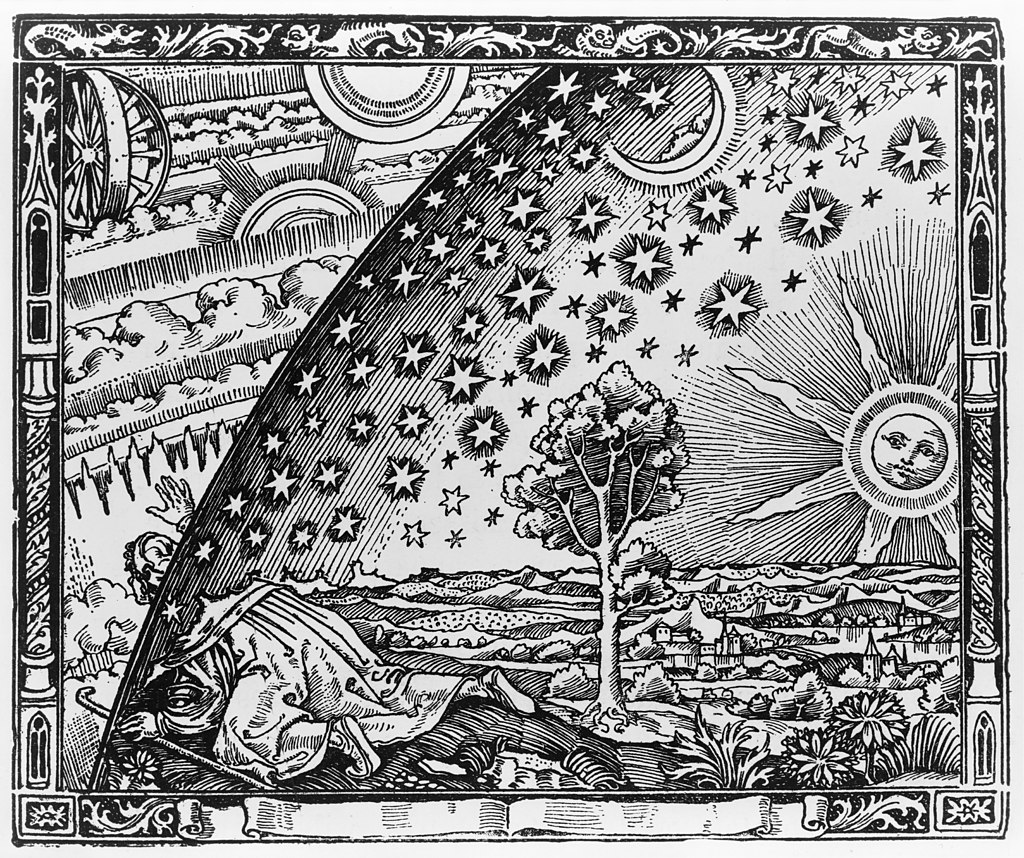
Source: wikipedia

A small geo-centric universe

Basil accepted the prevailing theory of his day that the earth was the center of, what would be to us now, a very small universe. This idea was based on the theories of Aristotle and Ptolemy and it prevailed until the 17th century when a heliocentric model replaced it.

Continue reading

Ancient Theologians weigh in on Genesis: Basil’s reflections on creation (part 4)

This post is part of a series looking at Basil’s views on the creation account in Genesis. If you have not already read it, I recommend starting with part 1.

In the last post we looked at Basil’s homilies as they related to the makeup of the universe. Basil accepted the idea that the cosmos was made up of 5 elements and correlated the heavens, earth and water in the first few verses of the account to them. In this post we will continue to explore how Basil explained the creation account in Genesis with the “science” of his day.

Is the Universe eternal?

One characteristic of the universe that was commonly held during the fourth century was that the universe has always existed and always will exist. Basil describes some philosophers as those “who have imagined that the world co-existed with God from all eternity”. Others he describes as atheists that see the universe as “conceived by chance and without reason”.

Basil rejected any view of the universe that suggested it was eternal or created by chance. He strongly argued that the universe was created by God and thus had a beginning as well as a purpose.

He first establishes a beginning, so that it might not be supposed that the world never had a beginning. … [The Creator] needed only the impulse of His will to bring the immensities of the visible world into being. …

Do not then imagine, O man! That the visible world is without a beginning … do not vainly imagine to yourselves that the world has neither beginning nor end. … In the beginning God made. That which was begun in time is condemned to come to an end in time. If there has been a beginning do not doubt of the end.

Homily I

Basil is careful to elaborate on “the beginning” as referring only to the “visible world” and not the “invisible world”. The former would be the universe in which we dwell and the latter is the abode of angels which is “outstripping the limits of time” and existed before the “beginning”.

The purpose of the visible world was a place to train the souls of men who were mortal.

To this world (referring to the abode of angels) at last it was necessary to add a new world, both a school and training place where the souls of men should be taught and a home for beings destined to be born and to die.

Basil astutely notes that time, itself, was among the things created “in the beginning”.

In the beginning God created; that is to say, in the beginning of time. 

Thus was created … the succession of time, for ever pressing on and passing away and never stopping in its course. Is not this the nature of time, where the past is no more, the future does not exist, and the present escapes before being recognized?

Continue reading

Ancient Theologians weigh in on Genesis: Basil’s reflections on creation (part 3)

This post is part of a series looking at Basil’s views on the creation account in Genesis. If you have not already read it, I recommend starting with part 1.

The Genesis account according to Basil

To explore this idea of fitting the creation account into the prevailing view of the universe a bit further we will use Basil’s Hexaemeron (The Six Days) as a case study. We introduced Basil in a prior post, but as a quick reminder he was a bishop during the late fourth century. “The Six Days” is a series of homilies written about the Genesis creation account. In the first two posts in this series we learned that Basil rejected allegorical interpretations, instead approaching the creation account as a historical narrative of the events. Through each homily he unpacks each day in the creation account and compares it to the prevailing cosmology of his day. His cosmology is of course rooted in the philosophical and scientific (or pre-scientific if you prefer) ideas that were prevalent during the fourth century. At times he will refute some of the ideas philosopher/scientists offer but throughout much of the work Basil interprets the creation account in line with those theories. Although a fourth century cosmology was much closer to what Moses and the Israelites might have understood about the universe, Basil’s ideas differ from both the ANE myths and modern scientific models.

What we will find is that Basil was generally able to take the cosmology of the fourth century and read that into the creation account. With the benefit of living more than 1600 years later and having the advantage of understanding the universe in much greater detail, especially with the advancements in science over the last 400 years, we can clearly see that some of Basil’s proposals, being rooted in a flawed cosmology, are incorrect. With his failed attempts before us it should help us reconsider how we approach the creation account today. We must ask ourselves, are we not in danger of doing the same thing? Further, if Basil could see the science of his day in the account and was clearly wrong, what makes us think we can do better? We have already seen our own modern failed attempts in the water vapor canopy and gap theories. Lest we are too critical of Basil and his interpretations, his intentions were noble as he sought to help his listeners more fully appreciate the Creator.

I want creation to penetrate you with so much admiration that everywhere, wherever you may be, the least plant may bring to you the clear remembrance of the Creator.

Basil (Homily 5)

What would a fourth century cosmology look like?

If Basil’s understanding of the universe was rooted in fourth century cosmology we would need to ask ourselves what that entails. The primary understanding of the universe during Basil’s time would have been governed by the Ptolemaic system. Built upon Aristotle and others, this system was proposed around 150 AD and benefited from being able to explain the erratic orbits of the celestial bodies around the earth. It prevailed until the late 16th and early 17th centuries when Kepler, building off Copernicus and Brahe, worked out a heliocentric model.

Continue reading