In part one we explored the concepts of existence and identity. That was followed, in part 2, by a look at the major influences that lead to the idea that the soul is immortal. This entry will explore alternative understandings of the soul for consideration.
In the last post we saw that, despite different underlying philosophical foundations, Augustine and Aquinas affirm that the person is a composite of body and soul. They also both affirm that the soul, an incorporeal intellect and the principle of life, is naturally immortal (or incorruptible). In a moment we will see that both theologians will be careful to ground the existence of the soul in God and His will rather then in itself. In doing so, we might, with a degree of irony, call both Augustine and Aquinas advocates of a conditional immortality.
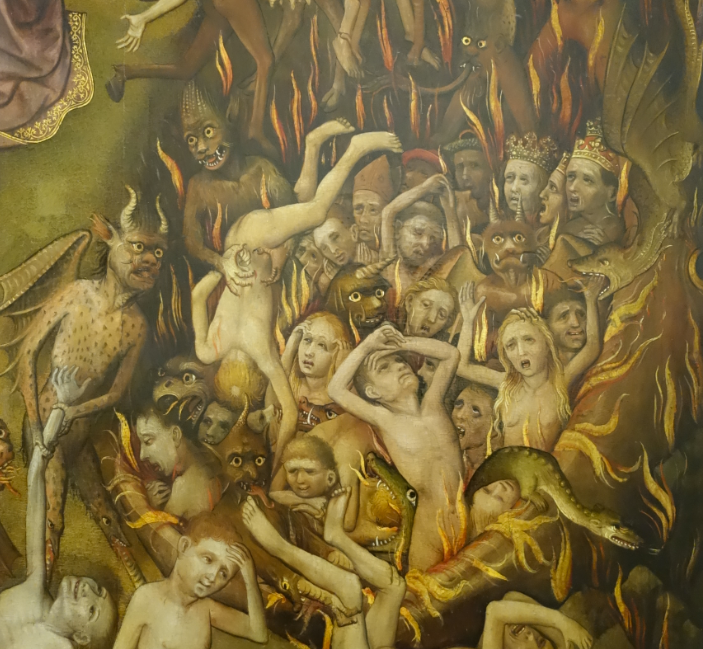
The punishment of the damned will never come to an end Before one scoffs at that and considers it a foolish claim, let me make it abundantly clear that both of these theologians affirm that the wicked will suffer eternal conscious torment (ECT).
pain can exist only in a living subject 1 – Augustine
Augustine notes that in his day there is debate about the fate of the wicked. He spends the greater part of Book XXI of The City of God making the case that “the soul [of the wicked] will neither be able to enjoy God and live, nor to die and escape the pains of the body.” 2
… to say in one and the same sense, life eternal shall be endless, punishment eternal shall come to an end, is the height of absurdity. Wherefore, as the eternal life of the saints shall be endless, so too the eternal punishment of those who are doomed to it shall have no end.3
In the supplement to the Summa Aquinas argues “the damned can prefer ‘not to be’ according to their deliberate reason” which would be to have “relief from a painful life”.4 However “it is inadmissible that the punishment of the damned will ever come to an end.” 5
The disposition of hell will be such as to be adapted to the utmost unhappiness of the damned. Wherefore accordingly both light and darkness are there, in so far as they are most conducive to the unhappiness of the damned. 6
Having established that Augustine and Aquinas were deeply committed to ECT, why might we consider them advocates of conditional immortality?
In part one we explored the concepts of existence and identity. This entry will take these concepts and apply them to the person as well as to particular persons.
Clark Pinnock, an advocate for CI, argues that “the traditional view of the nature of hell” is based on “the assumption that souls are naturally immortal.”1 A view that he notes goes back to Plato.2
If souls are naturally immortal, they must necessarily spend a conscious eternity somewhere and, if there is a Gehenna of fire, they would have to spend it alive in fiery torment. … ‘Once [the human soul] exists, it cannot disappear; it will necessarily exist forever and endure without end.’ This has influenced theology for a long, long time … 3
In this post we will examine some of the major theories about the human soul that have influenced theology. We will rely on the preceding post, as it will draw on what it means to exist, as well as the essence and identity as they relate to the person.
In the prior post, existence was defined as being actual rather than merely conceivable or possible. It tells us that an entity is. The essence, or nature tells us what an entity is. The essence can then ground the identity of a particular (a specific statue of Zeus) as well as the larger category (statues).
To attain any assured knowledge about the soul is one of the most difficult things in the world. – Aristotle 4
The body and the soul As a starting point for examining the soul, we will note that everything that has existed, is in existence, or that will exist in the future is something that is created and sustained by God.
[The Son] is the image of the invisible God, the firstborn over all creation, for all things in heaven and on earth were created in him—all things, whether visible or invisible, whether thrones or dominions, whether principalities or powers—all things were created through him and for him. He himself is before all things and all things are held together in him. 5
The idea that a human, created in the image of God, is comprised of both dust (an earthly, perishable body) and a soul which animates it can be found in the creation account of Genesis.
The Lord God formed the man from the soil of the ground and breathed into his nostrils the breath of life, and the man became a living being. 6
In the New Testament Jesus affirms that a human is composed of both body and soul (Matt 10:28).
That the human being is a composite comprised of soul and body is a widely shared conviction among major influential thinkers on this topic including Plato, Aristotle, Augustine, and Aquinas.7 Nevertheless, these thinkers diverge on the question of personal identity. For example Plato locates the essence of the person primarily in the soul. This allows the soul without the body to remain the self in the afterlife. Aristotle, Augustine and Aquinas would identify the human person with the composite of the soul and body. Augustine and Aquinas will argue that the soul can subsist when separated from the body and anchor identity but would be considered incomplete without the body.
Plato and Augustine: The body and the soul The idea that the human person is in some sense comprised of a soul and a body was present in ancient Greek thought when Socrates began his project on the examined life.
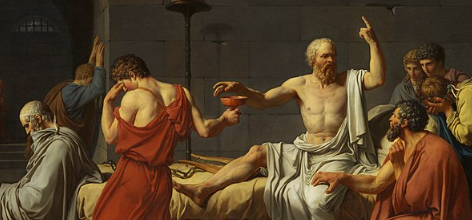
In Phaedo, Plato presents Socrates as he is about to be executed by drinking hemlock. He presents him as prepared to accept his death and uses the occasion to explore the soul.
When Plato is writing, there is then, as there is now, the prevailing view that when a person dies they cease to exist.
[men] fear that when [the soul] leaves the body her place may be nowhere, and that on that very day of death she may be destroyed and perish … issuing forth like smoke or air and vanishing away into nothingness. 8
Plato refutes this idea and sought to show “that when a man is dead the soul still exists and has power and intelligence.” For him the soul was the primary, incorporeal entity that carries personal identity and is capable of knowledge and rationality. It “renders the body alive” and “rational”.
the soul is in the very likeness of the divine, and immortal, and intelligible, and uniform and indissoluble, and unchangeable 9
Plato would further argue that the soul is naturally immortal, having the essential property life.
“What is [it] which will render the body alive?” “The soul” … “What do we call principle which does not admit of death?” “Immortal”, he said. “And does the soul admit of death?” “No” “Then the soul is immortal?” “Yes” 10
Plato defines death as the separation of the body and the soul. 11Those souls that were “true disciples of philosophy” would be rewarded with bliss and the reward of remaining separate from the body. Others would be “dragged down again into the visible world.”12
When Kirk Cameron recently noted that he favored conditional immortality (CI), also known as annihilationism, over eternal conscious torment (ECT) it created a series or reactions and responses across various platforms. This prompted me to take a deeper look at the fate of those who die without Christ. Among the numerous rebuttals that were offered two major themes emerged that are worth exploring.
What do we mean by the terms existence, life and death?
What claims might we make about the soul?
As we delve into these topics we will find that the concept of identity is also important.
Augustine famously quips that he understands “time” until he is asked to explain it.1 That sentiment is just as true when we attempt to define each of the concepts outlined above with any precision. Aristotle starts off his work De Anime (On the Soul) noting that having certainty about the soul is one of the hardest things possible.2 We would be wise to admit that certainty on much of these topics “lies beyond [our] powers” and that there is “darkness in our understanding”. As we pursue these topics my aim, like Augustine, is to do so with a sense of offering the “service of my thinking and my [keyboard]” such that it is “stirring up love for [God] in myself, and in those who read this.” 3
What is existence? When we say that something exists or has existence, what do we mean. We may start with the idea that some entity is instantiated in reality or actuality. This entity has being as opposed to non-being or nothing. In saying an entity exists we are saying that it is instead of that it is not. The notion of existence is related to the identity of the entity, or the description of what it is (its essential properties). How these things are related to each other is something that has been widely debated by philosophers for millennia.4

 Dead Heroes Don't Save
