
This is part of a series of posts exploring each of the views presented in The Incarnation Four Views edited by Andrew Hollingsworth and R.T. Mullins. In part one we explored the Narrow Scope Negation model.
View 2: Divine Preconscious Model
Andrew Loke is an Associate Professor in the Department of Religion and Philosophy at Hong Kong Baptist University. Among his published works is A Kryptic Model of the Incarnation.
In building a model of the Incarnation, Andrew Loke has a different set of starting premises than Timothy Pawl. He isn’t trying to fit classical theism into his model nor does he accept the authority of the councils. One of the major concerns that Pawl raises against this model is its novelty and theological cost.1
Loke makes a valuable observation about any model that is proposed for the Incarnation.
in order to make meaningful statements about Jesus in accordance with the Scriptures and to rebut the charge of incoherence, it would be helpful if the Christian can suggest a possible model to show how concepts like omniscience and apparent limitation in knowledge can be affirmed of Jesus in such a way that no contradiction results. It is not required that the Christian come up with the actual model of the incarnation. Rather, all that is required is that he or she suggests a possible model to show how contradictions do not result. (emphasis in original) 2
C. Stephen Evans, in his critique, agrees with this idea suggesting he would “be happy if it turns out to be the case that there are other models which accomplish the same goal: providing an account of how God might become incarnate that is logically coherent and possible.” 3
There was a consistent observation highlighted in the responses of each contributor about the Divine Preconscious Model (DPM) model. It is very complex and difficult to understand.4 A notion that Loke does not back away from, noting that “On the other hand, “a great level of complexity of the model of the incarnation is only to be expected given the sheer difficulty of the idea that a person could at the same time be a human as well as the Maker of the universe.” 5
What follows is an overview of DPM.
Functional kenotic-kryptic model
Loke’s more complex DPM model rests on the Kenosis theory which relies on the idea that Jesus either limited or gave up some of his divine attributes and powers during the incarnation.
KENOTICISM, from the Gk. kenōsis, meaning (self-) ‘emptying’ (used in Phil. 2:6–7), refers to a number of related Christological theories concerning the status of the divine in the incarnate Christ. … The actual theories varied. 6
The Kenosis theory can be separated into a functional and an ontological kenosis.7 Functional Kenosis states that Christ retains his divine attributes but consciously chooses not to exercise them, at least not very often.8 Ontological Kenosis states that Christ actually gives up or relinquishes His divine attributes. In both views Jesus is understood as limiting Himself and making Himself reliant on the Spirit during His earthly ministry. However, in the former Jesus can choose to access His own divine capabilities whereas in the latter He cannot. 9
Evans, who will defend a Kenotic Christology, notes that the views he and Loke present are very similar since they both agree “that a perfect being is capable of self-limitation.” 10 Loke would rather emphasize the differences in their respective models. Loke argues for a functional rather than an ontological kenosis. In his essay, DPM is described as a “functional-kenotic-kryptic model”. Loke notes that kryptic (from the Greek krypsis) highlights that these divine capabilities are hidden rather than given up.11 He see Evans’ view as holding to an ontological kenosis while criticizing him for not being more precise in identifying which view he holds.12
Divine Preconscious Model (DPM)
Loke, like Pawl, relies on a natures being concrete (refer to part 1). 13 He is clear in his assertion that the divine and human natures are concrete parts that are less than the whole 14
This is important because DPM rests on another similarity to the narrow scope negation (NSN) model that was presented by Pawl. It relies on the narrowing of the negation to a particular concrete nature to avoid contradiction.
The concrete nature view explained above allows for a clear explication of how contradictory properties can be exemplified by Christ in two different respects (“in respect of his divine nature and in respect of his human nature”) without a confusion of the natures.15
Since both NSN and DSM use the “according to a nature” to narrow the predication it should be noted that there is major difference between the models. NSN primarily relies on formal logic for its solution. Narrowing the scope of negation to one nature technically removes the contradiction. However there isn’t any further explanation as to “how” this might work in the person of Christ. This is left open and abstract, which is the gap where Loke’s model steps in. It is also where the complexity begins. The description that follows will rely on both the essay in the book and the article Loke published entitled “The Natures, Minds, and Wills of Christ in Christian Philosophy” to give an overview.16
The DPM model emphasizes the unity of the person. 17 What is a person?
The word ‘person’ is defined as a centre of consciousness, with the property of being a subject who possesses various characteristics such as moral agency, rationality, language, intentionality, self-consciousness, and ability to enter into suitable relationship with other persons 18
That definition differs from the classical definition offered by Boethius. Both seek to describe a person as having volitional agency. For Boethius the person was an individual substance with a rational nature. An individual substance is an objective, concrete entity which is of the type person if it possesses a rational nature. A human person would be a substance possessing a human nature (which can be understood as a more specific type of rational nature or includes it). And divine person would be a substance possessing a divine nature (which either is a more specific type of rational nature or includes it). That can lead to understanding Jesus as being two persons (Nestorianism).
Divine Person + Human Person = 2 Persons
Loke grounds the idea of a person in a “mind that is able to be consciously aware.” 19 An individual substance with a single consciousness is what makes it a person. This removes the difficulty of understanding Jesus as both a divine person and a human person. 20
DPM holds that Jesus as a person has one unified consciousness. This is the key metaphysical move that this model makes.
DPM affirms that Christ has a divine mind and a human mind, and the unity of Christ’s personhood is maintained in virtue of one unified consciousness21
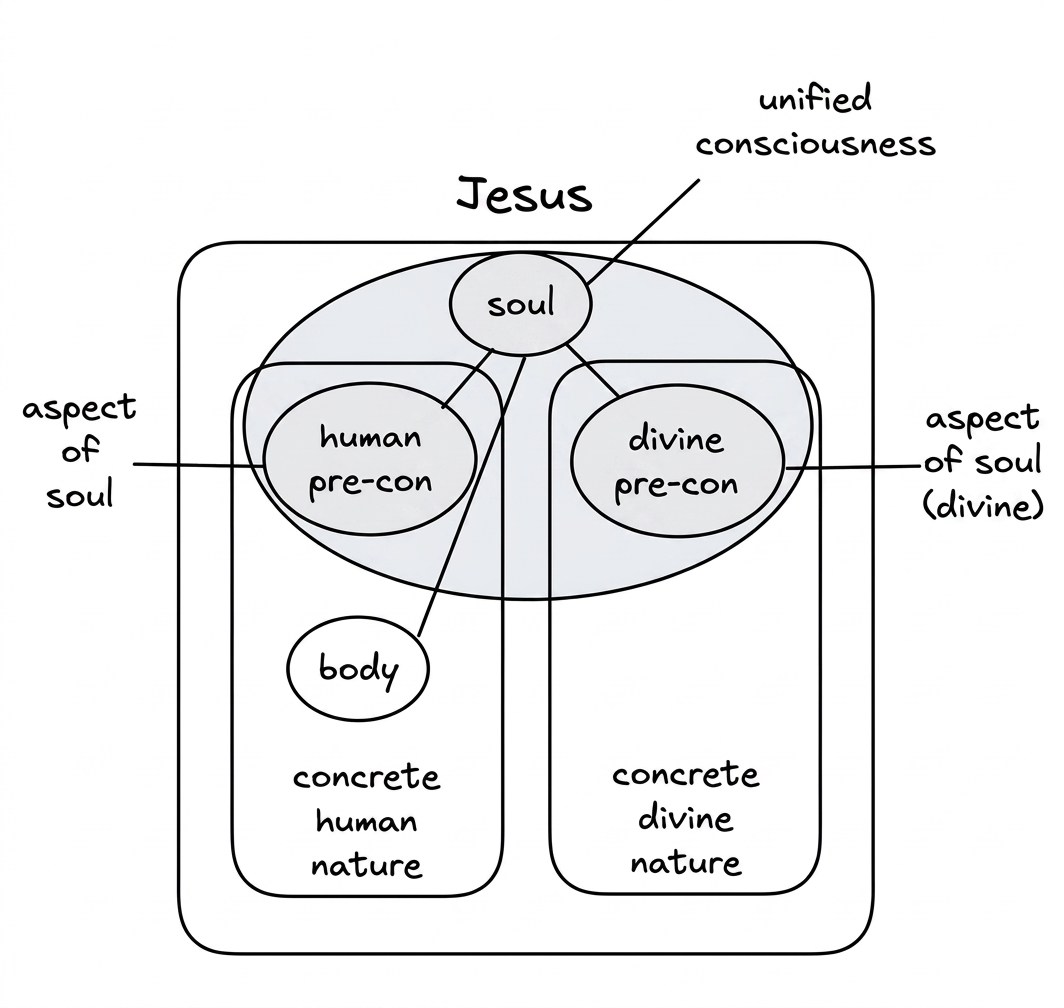
The unified consciousness is a whole entity that has two aspects one that is human and one that is divine. The human and divine aspects are concrete parts of the whole. This allows the one person, defined as a center of consciousness, to be truly divine and truly human. 22
It should be noted that Loke seems to move between referring to this unified consciousness as a “soul” and a “mind” at times.
Loke holds that the pre-incarnate Logos had a mind.23 As part of taking on a human nature, the Logos assumed a consciousness, a divine preconsciousness, a human preconsciousness and a body. 24 Pawl pushed against the unclarity here regarding whether the pre-incarnate Logos lacked a consciousness. 25 An important point if one wants to claim the Logos is a person before the incarnation. That forced Loke to clarify that the mind of the Logos had a consciousness that was aware of all divine mental contents. However the divine mental contents of the consciousness were “relocated” to a divine preconsciousness that was still accessible to the consciousness. 26
Loke defines the preconscious “as mental contents that exist outside of consciousness (but is accessible to consciousness by directing attention to them).” 27 The mental contents of each preconscious would align with its nature. The unified consciousness can access and draw on the human preconscious and all of the mental contents as well as feel and act through the human body. The unified consciousness can also access and draw on the divine preconscious. 28
That allows the following statements:
- Jesus knows the day and hour of his return according to the divine preconscious
- Jesus does not know the day and hour of his return according to the human preconscious
- Jesus is a unified person that could access both the divine and human preconscious
The DPM model in this way offers a way to understand “how” Jesus was a person who was both fully divine and human without contradiction.
The DPM model affirms that Christ has two wills but works to avoid that this appears to make Him two persons by assigning the role of “willer” to the unified consciousness.
to assert that Christ had two wills would imply that Christ had two self-determining faculties. Having two self-determining faculties seems to imply having two selves, which would divide Christ into two persons.
…
[DPM avoids this, noting that] there are two self-determining faculties (the human and divine wills), but only one-self (the ‘willer’). 29
The unified conscious is identified as the “willer” which aligns well with the definition given for a person as a volitional agent.
Christ had one conscious and thus was one ‘willer’. Christ had a human will … [and] had a divine will … Therefore, the one ‘willer’ had a human self-determining faculty (in virtue of his conscious and [the human part of] his preconscious) and a divine self-determining faculty (in virtue of his conscious having access to [the divine part] of his preconscious). Because he was one person, all the acts of Christ were the acts of his whole person. 30
How many “souls” and how many “wills”?
Some contributors argue that DPM suggests, in different ways, that there are three souls in Christ. The unified soul (or consciousness), the human soul and the divine soul. 31 It also suggests there are three wills.
Loke clarifies that Jesus as a person has one soul with two parts.32 Regarding wills, Jesus as a person has one will with two parts. 33 I found it hard to reconcile this statement in his essay in the book with how he avoided calling the willer a will in the additional article. It would seem that the willer is actually a will composed of a two parts (a divine will and a human will) much the way the soul is actually a composite of two parts (a divine soul and a human soul). This composite willer and the composite soul are either to be identified with the unified consciousness or are themselves parts of it.
Given the claims of having one soul and one will would seem to suggest Jesus is a whole person composed of concrete parts much the way a car is with a steering wheel, engine and tires. Setting aside any issues that the classical theist might have here, this would seem to require a significant ontological change in the pre-incarnate Logos. The single complete divine soul and single complete divine will are both part of the divine nature. During the incarnation they both acquire human parts (the human soul and will). The divine soul and divine will were not composite but become so. Overall, this seems to be an area that could use more careful clarifications, particularly as one attempts to avoid uniting or blending the natures, or parts of them like the soul and will, into one which could lead to the charge of Eutychianism.
Just say no to Classical Theism
It is clear that Pawl and Loke have had multiple exchanges debating each of their models. Pawl has the longest response to the DPM model. And much of the space in Loke’s address to his critics is dedicated to points raised by Pawl. Pawl writes that the “theological costs” that must be incurred in Loke’s model, which relies on parts, are just too much to pay.
Loke pushes back:
Pawl claims that my view entails the costs of abandoning [strong divine immutability], impassibility, (essential) atemporality, and simplicity. I don’t see abandoning these as costs, since they are not taught by Scripture and are philosophically unwarranted … Pawl himself notes that “these are historically the most difficult attributes to square with an incarnation.” I agree. Too bad for Pawl that he has failed to address the difficulties adequately. Abandoning them removes the difficulties, which is a gain rather than a cost.34
- Hollingsworth, Mullins, The Incarnation Four Views, Wipf and Stock Publishers Kindle edition (p 141) ↩︎
- Ibid 108 ↩︎
- Ibid 145 ↩︎
- Ibid 132, 145, 148-149 ↩︎
- Ibid 158 ↩︎
- Clark, R. Scott, A Brief History of the Kenosis Theory, The HeidelBlog (source: https://heidelblog.net/2016/08/a-brief-history-of-the-kenosis-theory) ↩︎
- The Incarnation Four Views (p 207) ↩︎
- Ibid 108, 148 ↩︎
- Ibid 110, 186 ↩︎
- Ibid 145 ↩︎
- Ibid 108 ↩︎
- Ibid 207-208 ↩︎
- Ibid 112 ↩︎
- Ibid 112 ↩︎
- Ibid 112 ↩︎
- Loke, Andrew, The Natures, Minds, and Wills of Christ in Christian Philosophy, St. Andrews Encyclopedia of Theology (source: https://www.saet.ac.uk/Christianity/NaturesMindsandWillsofChrist) ↩︎
- The Incarnation Four Views (p 126) ↩︎
- Loke, Natures, Minds and Wills (section 1.1) ↩︎
- Ibid (section 1.1) ↩︎
- Pawl relied on Aquinas’ metaphysic to avoid understanding Jesus as two persons by denying that Christ’s human nature is itself an independent substance (see part 1) ↩︎
- Loke, Natures, Minds and Wills(section 3.3) ↩︎
- The Incarnation Four Views (p 114) ↩︎
- Ibid 110 ↩︎
- Ibid 112 ↩︎
- Ibid 132 ↩︎
- Ibid 159-160 ↩︎
- Ibid 117 ↩︎
- Loke, Natures, Minds and Wills (section 4) ↩︎
- Ibid (section 4) ↩︎
- Ibid (section 4) ↩︎
- The Incarnation Four Views133, 154 ↩︎
- Ibid 160 ↩︎
- Ibid 160 ↩︎
- Ibid 167 ↩︎


Pingback: Blogging Thru The Incarnation Four Views: Kenotic Christology (Part 3) | Dead Heroes Don't Save