
This is part of a series of posts exploring each of the views presented in The Incarnation Four Views edited by Andrew Hollingsworth and R.T. Mullins. In part one we explored the Narrow Scope Negation model. In part two we explored the Divine Preconscious model.
View 3: Kenotic Christology
C. Stephen Evans is a Professor of Philosophy and Humanities at Baylor University. He was editor, as well as an author, for a collection of essays published in Exploring Kenotic Christology: The Self-Emptying of God.
Like Andrew Loke, Evans notes that his model for the Incarnation may not be “the correct account of how God became human.” 1 Rather his model may be one of several possible models that could be true since it demonstrates that “the doctrine of the incarnation is [not] incoherent.” 2
Evans, like Loke, builds a model of the Incarnation on the idea of kenosis. He also notes, like Loke, that his model is not compatible with a strong view of classical theism. 3 However, he also argues that his model, like Pawl’s, is consistent with the conciliar understanding of Jesus.4
In evaluating Evans’ essay, the other contributors noted a lack of precision in several areas. These include what parts of the conciliar affirmations are required for orthodoxy and which can be set aside and what model of kenosis is adopted.5 To this I would add his essay lacked a clear definition of how he understands “nature” and “person”. 6
What is a nature?
Evans clearly holds that Jesus is fully human and fully divine possessing the essential properties of both. 7 However he rejects that Jesus has two concrete natures. Remember from part 1 that a concrete nature is, itself, a particular entity and is the instantiation of a universal abstract nature. For example, Socrates the human is a concrete nature in whom the abstract universal of “humanness” is real.
For the first two contributors the person Jesus, as incarnate, is a unique entity that possesses two concrete natures, which are themselves entities. Jesus has a concrete divine nature and assumes a concrete human nature, giving Him two natures in which there was no mixture or confusion. 8
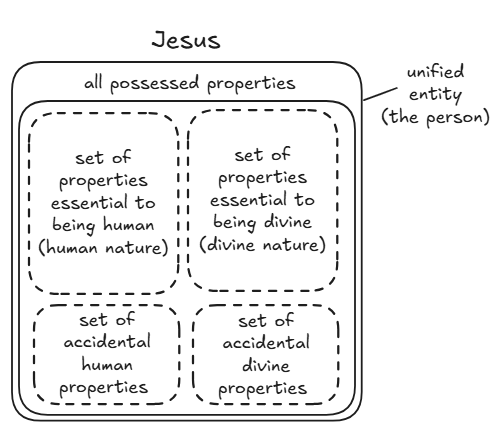
Evans doesn’t clearly identify that he is working within a metaphysical view that understands natures to be abstract. However, he notes that when Christ assumed a human nature he “acquired all the properties that are necessary to be human” but that this nature is “not an entity distinct from him.” 9
He adds that there are not two entities that exist in Jesus as natures. Rather that:
[Jesus in] his unified person has all the properties necessary for being divine in addition to all the properties necessary for being human.10
When pushed to clarify things by the other contributors, Evans adds to the description of his view that there is only one concrete entity. That is the person of Christ.
This is a problem with all views that make the human nature of Christ an entity distinct from the divine nature. On my view there is only one entity, the person of Christ, who has both a divine and human nature, understood as sets of properties. To be sure, Christ is a concrete entity and thus his human nature is concrete. But it is not an entity over and above his divine nature, but a set of properties added to the person who possessed that divine nature from all eternity. (emphasis added) 11
A separate paper, that was not written by Evans, explored the metaphysics of the incarnation and explains a metaphysic that holds to abstract natures.12
Abstractists conceive of the divine and the human ‘natures’ as sets of essential properties that Christ instantiates. On this view, to say that Christ has two natures is to say that he has two such sets of properties, and to say that he has one nature is to say that he has only one such set of [essential] properties. 13
When Evans says that “his human nature is concrete”, that seems best understood as the abstract set of human properties is instantiated in the concrete person Jesus.
The quotes from Evans essay, his response and this separate paper suggest Evans holds to an abstract nature consisting of a set of properties that are possessed by the property-bearer but is not itself a particular entity.
When we speak of Jesus in this model He is a single particular entity and the only entity that can bear properties. It is unclear, from Evans presentation, in what way the two sets of properties, the divine set and the human set, are held by the person of Christ. Are they to be understood as unmixed or should we understand them as combined into one larger set of possessed properties. This makes it unclear whether Evans kenotic model, as opposed to other kenotic models, risks being considered Eutychian.14 Eutychus suggested that in the Person of Christ the two natures became one nature, a view that was rejected in 451 at the Council of Chalcedon. It is hard not to see something similar in this model where each set of properties is now part of a single set of possessed properties.
Evans metaphysical moves are designed to preserve a more coherent definition of person, although Evens does clearly define this term. Rather we can deduce that from comments he makes challenging a Two Minds Christology. In that view there are two minds, a divine and a human one, in the single person Christ. 15 This seems similar to the conciliar assertion that Christ has two wills. The problem, as Evans sees it, is that anything with a mind and an ability to will is a person. Thus models that suggest two minds (or wills) present, or at least seem to present, Jesus as two persons.16 Evans would clearly reject Aquinas’ metaphysic that sought to evade the idea of two persons by asserting that “a complete substance subsisting of itself and separate from all else” is a requirement for being a person (see part 1).17
The Kenotic model
The passage in Philippians 2:6-11 is a foundational text for any kenotic model.18 When the Son, as the 2nd Person of the Trinity became man by assuming the set of essential human properties (a human nature) he relinquished some of His divine properties.19 This model readily explain how the 2nd Person of the Trinity could live as a human with all of the limitations that being human entails.
Which properties are relinquished?
Evans reminds readers that an entity can have both essential and accidental properties. The accidental properties would be those that are not necessary to possess in order to answer the question what type of entity is this. Accidental properties, because they are not essential, do not need to be possessed for the entity to still be considered a certain type. 20 For example having a human body is generally considered an essential property for being human. Having hair is not. Socrates is no less human because he is bald.
Evans will contend that Jesus, even having relinquished some divine properties, is always divine because He always possesses the essential properties of divinity. The properties that are relinquished are accidental properties of divinity. 21 Suggesting that any of the divine properties are accidental would be a controversial move in itself. But as we will see, Evans model states that Jesus gave up the omni-properties (omniscience, omnipotence and omnipresence) and asserts that these properties are non-essential for being divine. 22
The Kenotic model emphasizes that there is one unified Person. The model outlines three stages in the life of the Person Jesus.
- Pre-incarnate Jesus
- possesses all divine properties and no human properties
- Incarnate Jesus
- possesses all essential human properties, some accidental human properties and the essential divine properties
- relinquishes some non-essential divine properties
- Post-resurrection Jesus
- retains His humanity while regaining those divine properties that were relinquished 23
A kenotic model shows numerous changes occurring within the 2nd Person of the Trinity as well as temporal predications. These, as noted earlier, would be hard to reconcile with strong views of classical theism.
During the Incarnation it seems that we have contradictory properties possessed by the Person Jesus. For example Jesus both knows and does not know the time of His return. Or perhaps that Jesus can experience hunger but also cannot experience hunger.
Evans notes that the reduplicative strategy can be used to handle some incompatible properties by restricting or narrowing how the subject has one property and at the same time does not have that property. 24
- Jesus according to his humanity (human nature) can be hungry
- Jesus according to his divinity (divine nature) cannot be hungry
This is basically doing the same work as narrow scope negation that Pawl relies on. We can predicate contradictory properties to the Person Jesus because of his two natures. Jesus can be hungry because He has a nature that can hunger. And Jesus never hungers because He has a nature that can’t hunger. It is unclear which properties might be handled with the reduplicative strategy nor how that might work with abstract natures.
Evans argues that the omni-properties, among others, can’t be handled with a reduplicative strategy. 25 How could a human body be omnipresent when it is spatial-temporally restricted to being in one place on earth? How could a human mind both know all things and grow in wisdom? The primary way to deal with these challenges under the kenotic model is to suggest that Jesus exercised a self-limiting power and is no longer omnipresent or omniscient. The same could be said for omnipotence.26 When the Scriptures show Jesus as having supernatural knowledge and working miracles during His earthly ministry it is argued that these would flow from His reliance and relationship with the Father rather than His tapping into His own divine powers. 27
By self-limiting Himself, the kenotic model provides an explanation for how Jesus incarnate could have limited knowledge and be limited to being present in only one place such as in Jerusalem. Properties that would not be able to be explained via the reduplicative strategy.
What does relinquish mean?
In the kenotic model, the Person Jesus relinquishes His omni-properties. Most doctrines of God would assert that these properties are among the great making properties and are essential to being divine. But Evans argues that these are accidental properties. This is a move he is required to make in order to avoid having Jesus cease being divine.
Evans knows that the omni-properties are considered great-making properties and are thus widely considered as being essential for any being to be divine. However, Evans argues that a being with the great-making property of being able to self-limit properties that one possesses is greater than the being that does not have the property of being able to relinquish these properties.28
It is here that Loke presses Evans on which model of kenosis he adopts and presumes it is the ontological rather than the functional model. 29 These models were explored in part 2 and the key difference is whether Christ retains his divine properties but consciously chooses not to exercise them (functional) or whether he actually gives them up and cannot exercise them (ontological).
In his response Evans says that he is not “clear about the difference” between the two models and that he does not know how Christ relinquishes his properties.
He goes on to argue from a seemingly functional model that:
If Christ, in his pre-incarnate state, chose to become incarnate and as a part of this decision willed not to exercise certain powers during his earthly incarnation … , there is no possibility that those powers will be exercised during the incarnation. … Christ no longer has these powers available to him. He has bound himself by his irrevocable decision. … a power that cannot be exercised seems like a power that has been relinquished. 30
While Evans dismisses any notable difference in the kenotic models, it seems clear that a functional model allows for the omni-powers to be equally inaccessible as if they were “removed” but affirm that they are still possessed by the person. Thus the functional kenotic model would eliminate the need to “remove” properties that are widely held to be essential for being divine. The functional model still has the challenge of explaining how one person can be omnipresent while being in a spatial-temporally located human body but it does not have to argue that the omni-properties are accidental properties of divinity.
Overall, Evans essay presents a kenotic model composed of a loose set of claims that would require more precision for the reader to fully understand how he understands and presents the Person of Jesus metaphysically.
Just say no to Classical Theism
Pawl pushes back on Evans’ claim that kenotic Christology fits within a creedal orthodoxy. He notes, by way of an example, that Nicaea requires an affirmation “that the Son of God is [not] subject to change or alteration”, which he understands as requiring that one hold to strong classical theism. 31
Against Loke, he wrote:
Features such as immutability, impassibility, atemporality, and simplicity cannot fit with a parthood analysis … a person cannot both be unable to undergo change and also have a part that is changing
Against Evans he writes that “[r]elinquishing [properties] implies change” and thus challenges whether the kenotic model can be considered orthodox. 32
Evans affirms that God is unchangeable in His essence and pushes back on what counts as orthodoxy:
This strong doctrine of divine changelessness was indeed held by most theologians in the early church … Pawl seems to think that to qualify as orthodox a Christian must accept … all the views contained in “conciliar documents”. … If so, I think that there is something wrong with his conception of orthodoxy.33
- Hollingsworth, Mullins, The Incarnation Four Views, Wipf and Stock Publishers Kindle edition (p 175) ↩︎
- Ibid 175 ↩︎
- Ibid 177-178 ↩︎
- Ibid 176 ↩︎
- Ibid 195, 207, 231
Pawl argues Evans does not specify which councils and creedal statements he has in mind and that those that are presented is but a limited set that is not inclusive of all that the councils taught. Evans response points Pawl, and all readers, to Stephen Davis’ essay entitled “Is Kenosis Orthodox” for a more detailed treatment and set of arguments that he did not provide in his essay
Loke argues that Evans needs to clarify whether he is arguing for a ontological or functional kenotic view. I explore that in some detail in the main post ↩︎ - Ibid 218-219
Jedwab seems to struggle with Evans’ metaphysic on natures ↩︎ - Ibid 176 ↩︎
- Ibid 18 ↩︎
- Ibid 176 ↩︎
- Ibid 177 ↩︎
- Ibid 238 ↩︎
- Marmodoro, Anna and Hill, Jonathan, Modeling the Metaphysics of the Incarnation, Philosophy & Theology 20, 1-2)
(source: https://www.researchgate.net/publication/272762932_Modeling_the_Metaphysics_of_the_Incarnation) ↩︎ - Ibid 101 ↩︎
- Ibid 108 ↩︎
- The Incarnation Four Views (p 182) ↩︎
- Ibid 182 ↩︎
- Ibid 34 ↩︎
- Ibid 183 ↩︎
- Ibid 183-184 ↩︎
- Ibid 178 ↩︎
- Ibid 233-234 ↩︎
- Ibid 233-234 ↩︎
- Ibid 184 ↩︎
- Ibid 180 ↩︎
- Ibid 180-181 ↩︎
- Ibid 184-186 ↩︎
- Ibid 184-186 ↩︎
- Ibid 188-190 ↩︎
- Ibid 207 ↩︎
- Ibid 235-236 ↩︎
- Ibid 197, 138 ↩︎
- Ibid 196 ↩︎
- Ibid 231 ↩︎


Pingback: Blogging Thru The Incarnation Four Views: Divine Preconscious Model (Part 2) | Dead Heroes Don't Save
Pingback: Blogging Thru The Incarnation Four Views: Relative Identity Model (Part 4) | Dead Heroes Don't Save