Twas the dawn of Reformation (a poem/parody)

What happens when a history buff and theology geek can’t sleep around Christmas time?
How about a mash-up that goes something like this (updates in italics):

Reformers: Luther, Erasmus, and Zwingli

Reformers: Luther, Erasmus, and Zwingli

‘Twas the dawn of Reformation, all thro’ the land,
penance was sold for a Cathedral so grand.
The theses were hung on Wittenburg with great care,
In hopes that needed reform soon would be there.
Now, Martin Luther was torn with guilt you see,
the gospel of Romans was what set him free,
But the marketing plan used by one Tetzel,
tied up good news into a works based pretzel.

When all across Europe there arose such a clatter,
it was clear to see the gospel does matter.
Cajetan was sent to Ausburg in a flash,
to examine Luther who was acting quite rash.
Next up was Eck, the debate was quite a show,
to Papal authority Luther said no.
Then what in Martin’s inbox should now appear,
but a Bull from the Pope, you’re out now my dear.

Now, what next in history should happen , just wait
But the Diet of Worms to decide Luther’s fate.
More rapid than eagles his accusers came,
they questioned his writings and put him to shame.
Luther asked for more time and prayed thru the nite,
Before them he said – Here I Stand for what’s right.
Tho’ captive to God, he was hidden from view,
Tis’ dangerous to challenge the Pope’s purview.

Erasmus the scholar, who brought back the Greek,
A fight with Luther he did not want or seek.
For, the Catholic Church, both sought to restore,
But on this issue they created rancor.
Does anyone have the ability to choose,
or is it our God who determines you lose?
The Bondage of the Will or is it set free,
a doctrine on which we may never agree.

In Zurich, Zwingli joined Luther’s reform work,
After fighting in Marsburg, called him a jerk.
Despite much in common, one thing caus’d tension,
the presence of Christ, the point of dissention.
Now what do you believe and hold to be true?
These things Luther presents in Augsburg to you.
Translating the Bible so it can be read,
Luther helped many change to living from dead.

Now two more reformers entered the fray,
and sola scriptura was what they did say.
The faithful, Calvin said, only God can elect,
sorry if it was you He did not select.
But, Arminius did not see it as such,
instead he taught that coming to faith ‘went Dutch’.
Now, this doctrine they tried to settle in court,
and a TULIP was grown at the Council of Dort.

While in doctrine we don’t all see eye to eye,
In God and His Word, does authority lie.
Reformed and reforming by this we’re driven:
Telling all – by faith, salvation is given.
’cause Jesus exclaimed as He rose out of sight,
be My witness to all, thru My power and might.
And in all that we do may God get the glory,
as we live our lives based on this Christmas story.
The Antioch Incident (Two Views) part 2

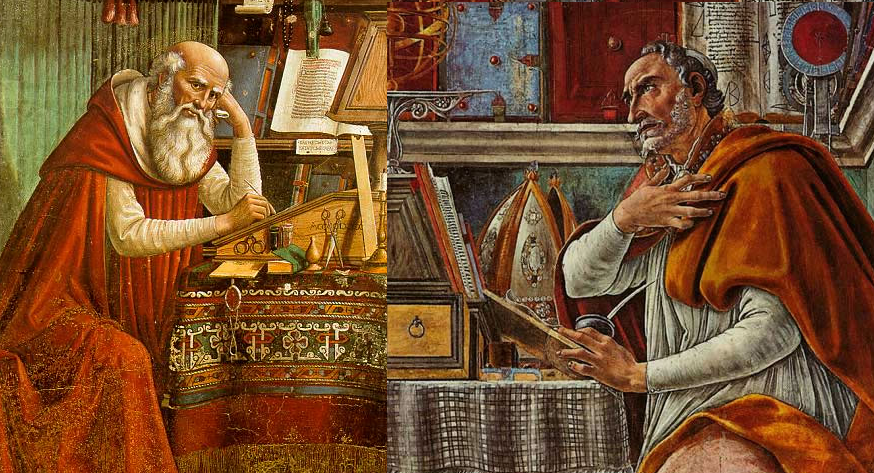
This is part 2 of a series of posts recreating the debate between Jerome and Augustine over the passage in Galatians 2:11-14. Think of it as the “cliff notes” to a series of letters written between them as a series of blog comments. I added some interaction with more recent debates to highlight how the issues we face today are not much different than those faced in the early centuries of Christianity. The comments are based on how I thought the theologians might respond to modern theological issues based on the point of view they expressed in their letters. You might want to start with part 1 and read Jerome’s blog post and the earlier comments.


Comment Section for the Antioch Incident


Augustine, Bishop of Hippo

Jerome, the high esteem that others hold you in is well deserved. Here in northern Africa we eagerly await your next set of translations of the Scriptures and ancient commentaries into the Latin. Thanks for updating everyone of your progress in your blog.I do hope you saw my comments regarding the use of the LXX that I left.

Regarding the events that took place in Antioch, you have appealed to the writings of those in the past and have asked if anyone holds to my opinion.The path you are taking us down is one well traveled. Like you Rob Bell, a popular writer, claims his views are orthodox appealing to the pool of diverse opinions that can be found among the ancient writers. He can even find many of the opinions he holds in Origen, yet that does not end the debate on “the fate of every person who ever lived”. Nor will it be the end to our debate.

I know that you hold Origen in high regard and where he holds to the truth we should accept him, but even you have had problems with some of his opinions on other matters. I only wish that you would apply your great learning and knowledge of this man and catalog his heresies for all to plainly see.

I, however, am not without support in the ancient writers. Continue reading

The Antioch Incident (Two Views)

There are many blogs that examine passages in Scripture that have what might be called a “folk theology” interpretation. These posts then try to set the record straight explaining what is a more probable interpretation. Some examples are Jeremiah 29:11, Matthew 18:20, 2 Tim 2:13, and the notion “all sins are equal in God’s eyes” or “one little lie will send you to Hell”.

A passage that is not considered very controversial today or likely to get a closer look is the description of the Antioch Incident. But for the early church the event was pondered over and hotly debated.

This event is recounted in the letter to the Galatians (2:11-14) and went something like this: Peter is visiting Antioch, perhaps to see first-hand how the gospel is spreading to the Gentiles (Acts 11:19-26). While he is there, Peter sits down to some bacon, lettuce, tomato sandwiches with some Gentile believers. While they are enjoying their meal some Jewish believers sent by James arrive in Antioch. Peter sees them, excuses himself from the table, and leaves the room. Returning with a kosher fish sandwich, he joins the new group of Jewish believers and enjoys catching up on the latest Jerusalem news. Soon the other Jewish believers are getting up from the Gentile table – even Barnabas – and sit down with Peter and the new arrivals. The Gentiles are wondering what is going on and whether they must follow the Mosaic Law too. Overhearing this Paul, who has been eating alone in the corner, stands up marches across the room and has some words with Peter. He calls him out for his hypocritical behavior, which is encouraging the Gentiles to observe the Law and distorts the gospel.

We may stop for a moment and wonder why Paul chose to include this event as part of his defense of the Gospel? Or why Peter was afraid of the “circumcision party”? We are prudent to walk away from the event humble and alert to how our actions can impact the gospel since ‘even Barnabas’ was compelled to follow actions that contradicted the truth of the gospel. But what was it that sparked debate in the early church? Continue reading