Irenaeus On Election and Free Will

This is a series that will be updated periodically that captures the early church views on free will and election. In part 1 we looked at some statements regarding Irenaeus’ views on free will and election. Some time ago we also examined the Rule of Faith (orthodoxy) held by Irenaus.
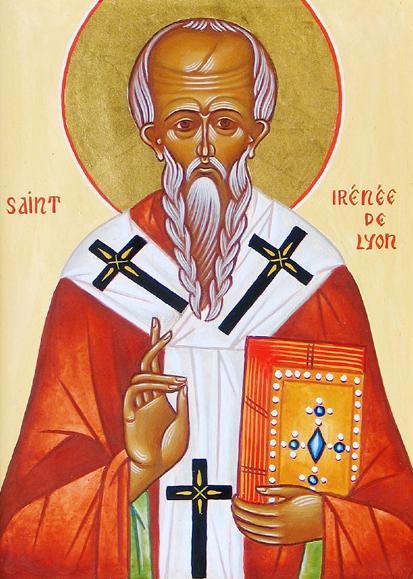
saint_irenaeus_oflyonsBefore looking at what else Irenaeus has to say, let’s take a look at what Charles Spurgeon has to say regarding this topic from his sermon titled “Election“. First he asserts that should one look through the doctrine of the ancients they would struggle to find those who did not hold to his views on election:

Were I a Pelagian, or a believer in the doctrine of free-will, I should have to walk for centuries all alone. Continue reading
Irenaeus on Free Will

Irenaeus

Irenaeus

Charles Spurgeon has written in his treatise “A Defense of Calvinism” that:

The old truth that Calvin preached, that Augustine preached, that Paul preached, is the truth that I must preach to-day, or else be false to my conscience and my God. … Calvinism is the gospel, and nothing else.

Augustine, the #1 theologian on Parchment and Pen, and his writings had tremendous influence on the Reformers including Martin Luther and John Calvin. The ideas expressed in his writings form the foundation for the tenets of Calvinism. The question often debated is whether the views of Augustine were held by the early theologians of the church prior to Augustine.

In “Calvinism in History“, Reformed theologian Loraine Boettner acknowledges that Augustine is responsible for formulating these views. Continue reading

Unrestricted Free Agents: Examining Libertarian Free Will

We are exploring different views on free will. In the first post we described a situation where a running back in the NFL has entered free agency. The player has 3 different offers. In this example we have avoided complicating the illustration by avoiding choices where a person is exercising saving faith or committing a sin. We already took a look at how a compatibilist might view this choice. Now we tackle the same scenario from a libertarian free will perspective.

Sam Harris, an atheist and determinist, calls the concept of free will an illusion. In his book Free Will he defines the type of free will that he argues does not exist:

The popular conception of free will seems to rest on two assumptions: (1) that each of us could have behaved differently that we did in the past, and (2) that we are the conscious source of most of our thoughts and actions in the present.

This is a reasonable definition of Libertarian Free Will (LFW). I would only make the second assumption more explicit than what is implied here. That in the present we have the actual ability to choose differently.

The choice according to Libertarian Free Will (unrestricted free agent):

Our running back has been presented with 3 different contract offers from Team A, B, and C. Continue reading