Bring Out Your Dead (A look at Death in Ephesians 2)

The passage in Ephesians 2 starts off highlighting our need for a Savior.

And although you were dead in your transgressions and sins, in which you formerly lived … and were by nature children of wrath … (Eph 2:1-3 NET)

Eric-Idle-Monty-Python-Holy-Grail-bring-out-deadPaul addresses the Ephesians as those who were dead. In doing so he leaves the reader hanging.

This chapter, as noted in the translation notes in the NET, starts off with an incomplete sentence. The participle finds its completion in verse 4 and 5 where we learn that we are “made alive together with Christ”.

What does Paul mean by the term “dead”?

Some possibilities include:

  • physical death
  • spiritual death
  • the natural inability to do good or respond to the gospel

Continue reading

Grace for All: The Wideness of God’s Mercy

Nothing in human history testifies to the wideness of God’s mercy or the breadth of his love like the atoning death of Christ.

So begins chapter 4 of Grace for All, in which we are presented with both an “exegetical” and a “systematic” investigation of the intent and extent of the atonement.

The essay was written by Robert Picirilli (link), the former Academic Dean of the Graduate School at Free Will Baptist Bible College. Picirilli has autho415xXkjORGLred numerous commentaries, including one on Romans from an Arminian perspective. He has also written the book Grace, Faith, Free Will (amazon), one of the best and most accessible books (IMO) on the Calvinism/Arminianism debate. Some of the points covered in this essay can also be found in a lecture Picirilli gave in 2002 (link).

What is the atonement? Noted Reformed pastor, John Piper, provides us with a great definition (link):

the work of God in Christ on the cross whereby he canceled the debt of our sin, appeased his holy wrath against us, and won for us all the benefits of salvation.

There would be little to debate on this important truth, so Picirilli focuses his essay on the question: what did God intend to achieve through the atoning, redemptive work of Jesus? Continue reading

The Good Electrician: An Illustrated look at Soteriology

Both Calvinists and Arminians hold that forgiveness of sins and eternal life come through faith in Jesus Christ. However they offer very different descriptions of how God’s grace works in salvation and what role a person plays in responding to the gospel.

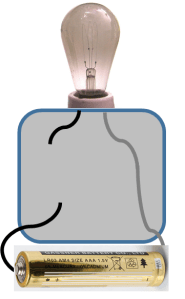
In order to illustrate these two contrasting views on salvation we can use an electrical circuit. In order for a light bulb to be lit the wires in the circuit must be connected and form a closed loop. This allows current to flow and the bulb to be lit. When the loop is broken there is no way that the light bulb can be turned on.

In this example the junction box, wires, and light bulb represent a person. When the light bulb is lit the person has exercised saving faith. When the light bulb is off the person is in a state of darkness and unbelief.

DHDS_UnWired

Both Calvinists and Arminians hold to the inability of man to respond to the gospel in his natural state. This can be illustrated by an electrical circuit in which the wires in the junction box are disconnected. Without a reconnecting of the wires the current cannot flow through the circuit and the light can not be turned on. There can be no positive response to the gospel. Continue reading