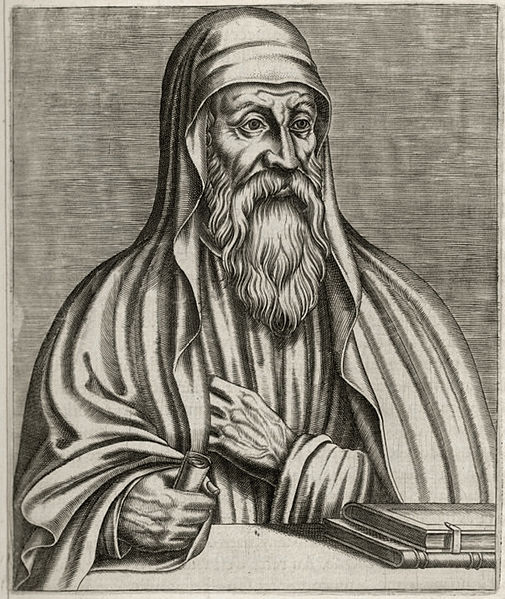
What is Orthodoxy? [Part 4] Is Origen Orthodox?

OrigenIn the book Love Wins, Rob Bell speculates on what happens in the after-life opening up the door on various ideas claiming in an interview with George Stephanopoulos of ABC News:

I think that the orthodox, historic, Christian tradition is this vast, diverse, conversation that’s been going on for thousands of years and I think Jesus can handle the discussion. It think he can handle the debate.

Based on these comments we have looked at the orthodox, historic, Christian tradition – or the Rule of Faith – in a series of posts exploring whether it is something that should be considered wide (vast/diverse) or narrow.

Now to this discussion I would like to look at Origen. Why? Because, Origen is considered one of the earliest writers who speculated on the after-life suggesting many ideas found in Love Wins. Origen (185-254) lived primarily in Alexandria, Egypt. His writings are later than the previous two apologists that we have examined and unlike Irenaeus and Tertullian, Origen is not writing against heresies. One might argue that rather he is creating them. In First Principles he is laying out a systematic theology of sorts.

Origen: On the After-Life

In this book Origen speculates on the after life. Before recording his ideas on this topic he writes:

But since the discourse has reminded us of the subjects of a future judgment and of retribution, and of the punishments of sinners, according to the threatenings of holy Scripture and the contents of the Church’s teaching—viz., that when the time of judgment comes, everlasting fire, and outer darkness, and a prison, and a furnace, and other punishments of like nature, have been prepared for sinners—let us see what our opinions on these points ought to be. [2.10.1]

From this two observations regarding the judgment and the punishment of sinners can be made – according to Origen:

  • they are according to Scripture.
  • they are according to the Church’s teaching.

Rather than jump into his opinions on the after-life, Origen next establishes that there is an after-life and a resurrection of the body:

there will be no absurdity in restating a few points from such works [other treaties he has composed], especially since some take offence at the creed of the Church, as if our belief in the resurrection were foolish, and altogether devoid of sense; and these are principally heretics, … [2.10.1]

From this two more observations can be – according to Origen:

  • a creed documenting the Church’s doctrine is in existence.
  • those who reject it are heretics.

Having established the resurrection of the dead and the immortality of the soul, Origen states that after we die God will raise out of up the natural body “a spiritual one capable of inheriting the heavens” for those that deserve it, while those that are “destined to everlasting fire or to severe punishments” are given a body that “cannot be corrupted or dissolved”. Based on this, Origen would certainly reject the annihilationist view of the after-life. Having established that the church teaches that there is an “everlasting fire”, he moves on to to “see what is the meaning of the threatening of eternal fire” [2.10.3].

Origen suggests that there are two possibilities [2.10.5]:

  1. psychological/emotional – the conscience torments the soul because it accuses/convicts the person of all the sin committed.
  2. physical – the pains of general punishment.

However it is his “opinion that another species of punishment may be understood to exist”. Here the pain is likened to the body being torn apart since the soul recognizes it is not connected to God and is in a disordered condition. This state when it has “been tested by the application of fire” will result in “restoration”. Here Origen is advocating the post-mortem evangelistic view.

He bases the restoration on:

  • “God our Physician, desiring to remove the defects of our souls”  will like a doctor take extreme measures to cure us and restore us. [2.10.6]
  • “Nothing is impossible to the Omnipotent, nor is anything incapable of restoration to its Creator” so the “destruction of the last enemy” is when the soul/body ceases to be an enemy and to be dead, but is rather restored. [3.6.5]

What should we make of these ideas in regard to orthodoxy?

Does that fact that Origen wrote out his ideas make them part of the historic, orthodox, Christian faith? Or are they one man’s ideas on what the after-life could be like. More importantly can the speculations withstand the teaching of the Scriptures and the church which even Origen acknowledged were to be the source of truth in his preface to First Principle:

Since many, however, of those who profess to believe in Christ differ from each other, not only in small and trifling matters, but also on subjects of the highest importance […] it seems on that account necessary first of all to fix a definite  limit and to lay down an unmistakable rule regarding each one of these [areas that are in disagreement].

seeing there are many who think they hold the opinions of Christ, and yet some of these think differently from their predecessors, yet as the teaching of the church, transmitted in orderly succession from the apostles, and remaining in the churches to the present day, is still preserved, that alone is to be accepted as truth which differs in no respect from ecclesiastical and apostolical tradition. [preface]

Then he goes on to list what he considers plain and explicit doctrine clearly communicated by the apostles. Here is how they line up with the Apostles’ Creed.

Apostle’s Creed De Principiis (Preface)
I believe in God the Father, Almighty, Maker of heaven and earth there is one God, who created and arranged all things, and who, when nothing existed, called all things into being […]
And in Jesus Christ, his only begotten Son, our Lord This just and good God, the Father of our Lord Jesus Christ […]
Who was conceived by the Holy Ghost, born of the Virgin Mary He in the last times, divesting Himself (of His glory), became a man, and was incarnate although God, and while made a man remained the God which He was; that He assumed a body like our own, differing in this respect only, that it was born of a virgin and of the Holy Spirity
Suffered under Pontius Pilate; was crucified, dead and buried […] that this Jesus Christ was truly born, and did truly suffer, and did not endure this death common (to man) in appearance only, but did truly die;
He descended into hell
The third day he rose again from the dead that He did truly rise from the dead; and that after His resurrection He conversed with His disciples,
He ascended into heaven, and sits at the right hand of God the Father Almighty and was taken up (into heaven).
From thence he shall come to judge the quick and the dead the apostolic teaching is that the soul, having a substance and life of its own, shall, after its departure from the world, be rewarded according to its deserts, being destined to obtain either an inheritance of eternal life and blessedness, if its actions shall have procured this for it, or to be delivered up to eternal fire and punishments
I believe in the Holy Ghost the apostles related that the Holy Spirit was associated in honour and dignity with the Father and the Son.
I believe in the holy catholic church: the communion of saints [clearly acknowledges the teaching of the Church as the basis of truth]
The forgiveness of sins
The resurrection of the body And the life everlasting. that there is a time of resurrection from the dead […]
Amen.

When Origen writes about his opinions on the after-life he shows that he is familiar with teachings that some will be raised to “eternal fire and punishments”. He then speculates that these punishments are restorative in nature. Even thought he attempts to support his ideas with Scripture he does not claim that these speculations are part of the Rule of Faith/creed. Therefore it is reasonable to conclude that even Origen would not have considered his ideas or conclusions regarding “restorative punishment” as orthodox but rather his explanation to things that were (in his view) outside of the clear and plain teachings of Jesus and the apostles.

Is orthodoxy narrow or wide?

Is Origen’s list of clear teachings a good basis for orthodoxy? Can they be supported with Scripture?

Is there anything you agree with or disagree with in his list?

Is Rob Bell a Universalist? (or what does Love Wins actually teach)

Rob Bell is the pastor of Mars Hill church in Grand Rapids, MI. He has written a book – “Love Wins – A Book About Heaven, Hell, and the Fate of Every Person Who Ever Lived” that has been a NY Times bestseller due in large part to the debate that ensued (most of it before the book came out) around whether Rob Bell is a universalist. The first to respond (to the promo video) was Justin Taylor and the Resurgence has a good overview (with links) of the early responses to the promo video and the book. Since then there has been a lively discussion on hell and Bell has been interviewed several times – with Lisa Miller of Newsweek, Martin Bashir of MSNBC, George Stephanopoulos of ABC News, Morning Joe of MSNBC, and Josh Loveless of Relevant Magazine. Bell has also been featured on the cover of Time Magazine and a site has been set up to track what is now known as Hell’s Gate.

Is Rob Bell a universalist? 

I guess to answer that question we first have to know what universalism is. In an interview with Lisa Miller, Bell was asked that question.

[Miller] Let’s get right to it. You have been accused in a lot of the coverage of your book of being a universalist. A universalist, in theological terms, means that everybody gets to go to heaven – everybody is allowed to go to heaven. That means Buddhists, Hindus – you can reinterpret my definition when I’m done – Buddhists, Hindus, Jews, Atheists, all get to go to heaven. Are you a universalist?

[Bell] No – if by universalist we mean there’s a giant cosmic arm that swoops everybody in at some point, whether you want to be there or not.  […] So, if by universalist we mean that love doesn’t win, and God sort of co-opts the human heart and says, “You’re coming here and you’re going to like it,” that violates the laws of love. Love is about freedom, it’s about choice. It’s about, “Do you want to be here?” Because that’s what would make it heaven.

The definition used by Miller and Bell generally agrees with the definitions on several other sites:

  • Christian Universalism denies pluralism and balder forms of universalism by contending that all can or will be saved, but only through the saving work of Jesus Christ. [Jesus Creed: Scott McKnight]
  • Yes, everyone will ultimately be saved. Historically known as “universalism,” this view exists in multiple forms, but in each the outcome is the same: Every human being whom God has created will finally come to enjoy the everlasting salvation into which Christians enter here and now. [the Gospel Coalition: Collin Hansen]
  • [Universalism] is the doctrine that states all people of all time will be saved by being reconciled to God and go to heaven, whether or not faith is professed in Jesus Christ in this life. [the Credo House]

Based on these definitions, the answer is no – Rob Bell is correct in claiming that he is not a universalist. That said, much of what he writes in Love Wins, can be seen as opening door wide on this view for others to accept – even if Bell does not.

At the center of the Christian tradition since the first church have been a number who insist that history is not tragic, hell is not forever, and love, in the end, wins and all will be reconciled to God. [page 109]

[Note: I have written a few posts regarding whether the orthodox, Christian tradition has such claims at its center for those interested.]

What does Love Wins actually teach regarding the after-life?

Before attempting to answer that, here is a chart that lists the major theological views of the after-life. Within each of these major views there are of course multiple variations, however I have tried to summarize them in general terms as I understand them.

pluralism All will be saved. All religions are equally valid and lead to heaven. Jesus is not (necessarily) the means of salvation.
universalism (christian)
All will be saved. Jesus is the means of salvation and everyone is saved through His sacrifice regardless of what they believe (or want). In this view there is no possibility for people to reject God.
inclusivism Jesus is the means of salvation but some (unevangelized, young children) will be saved through His sacrifice even if they have not heard or responded to the gospel message. In this view it is possible that some people will eternally reject God.
postmortem evangelism A form of exclusivism where Jesus is the means of salvation and a person must willingly choose to accept God’s gracious gift. If people do not accept the gift in their lifetime they will be given another chance to choose to accept Christ after they have died. In this view it is possible that some people will eternally reject God.
annilationism A form of exclusivism where Jesus is the means of salvation and a person must willingly choose to accept God’s gracious gift in this lifetime. Those who have not accepted Christ are thrown into hell at the judgment. They are destroyed in hell rather than being eternally tormented and punished in hell.
traditional view of hell A form of exclusivism where Jesus is the means of salvation and a person must willingly choose to accept God’s gracious gift in this lifetime. Those who have not accepted Christ are thrown into hell at the judgment. They suffer eternal torment and punishment in hell.

Determining which of these views Love Wins is affirming is a tough question to answer because Love Wins does not advocate or defend any position regarding the after-life. Instead it poses questions and possibilities and reports on what others ask or claim. Rob Bell seems much more interested in generating discussion and stirring up debate than settling any theological questions. Referring to the traditional view of hell (page 110), Bell claims:

Not all Christians have believed this, and you don’t have to believe it to be a Christian. The Christian faith is big enough, wide enough, and generous enough to handle that vast a range of perspectives.

In fact on page 115, Bell asserts that we can’t know which perspective or view is right:

Will everybody be saved, or will some perish apart from God forever because of their choices? Those are questions, or more accurately, those are tensions we are free to leave fully intact. We don’t need to resolve them or answer them because we can’t …

That said there are four strong points that the book does make regarding the after-life:

  • God is love and love involves the freedom given to us to choose or reject God. Our fate in the after-life is based on this choice.
  • God is not limited to giving us a choice only in this lifetime but can provide one or more chances after death (postmortem evangelism).
  • God is not limited to someone hearing the gospel and choosing only in this lifetime but can accept a person’s implicit acceptance of Jesus because they responded to what they had available (inclusivism).
  • There is a strong reaction against (if not a denial of) the traditional view of hell.

On love, hell, and choices Love Wins does make some clear assertions (points I agree with):

Love demands freedom. It always has, and it always will. We are free to resist, reject, and rebel against God’s ways for us. We can have all the hell we want. [page 113]

That’s how love works. It can’t be forced, manipulated, or coerced. … God says yes, we can have what we want because love wins. [page 119]

It is based on these statements (and similar ones in interviews) that I don’t think Rob Bell is a christian universalist (even if he leaves that door open for others).

The rejection of the traditional view of hell in Love Wins is based on the provocative questions more than any clear statements. Here is a sampling:

Can God do this or even allow this [send millions of people to spend eternity in anguish], and still claim to be a loving God? Does God punish people for thousands of years with infinite, eternal torment for things they did in their few finite years of life? This doesn’t just raise disturbing questions about God; it raises disturbing questions about the beliefs themselves. [page 2]

Will all people be saved, or will God not get what God wants? [page 98]

Is God our friend, our provider, our protector, our father – or if God the kind of judge who may in the end declare that we deserve to spend forever separated from our Father? [page 102]

Telling a story about a God who inflicts unrelenting punishment on people because they didn’t do or say or believe the correct things in a brief window of time called life isn’t a very good story. [page 110]

After reading through this that there is not much room for the traditional view of hell. And one could certainly see universalism in some of these statements.

The postmortem evangelism view is explored in Love Wins. However, the view is presented through what others ask or others claimed – opening up the possibility for the view without advocating for it directly.

And then there are others who can live with two destinations, two realities after death, but insist that there must be some kind of “second chance” for those who don’t believe in Jesus in this lifetime. […]  And then there are others who ask, if you get another chance after you die, why limit that chance to a one-off immediately after death? […] At the heart of this perspective is the belief that, given enough time, everybody will turn to God and find themselves in the joy and peace of God’s presence.  [page 106-107]

The inclusivism view is explored in Love Wins. Based on the texts in Exodus 17 and 1 Cor 10, Bell draws the conclusion that since Jesus was the rock Moses struck and He was not identified then the possibility exists that others can come to Jesus without identifying Him or placing faith in Him directly too:

 People come to Jesus in all sorts of ways. […] Sometimes people use his name; other times they don’t.  [page 158]

 [Jesus said] “I am the way and the truth and the life. No one comes to the Father except through me”

This is a wide and expansive a claim as a person can make.

What he doesn’t say is how, or when, or in what manner the mechanism functions that gets people to God through him. He doesn’t even state that those coming to the Father through him will even know that they are exclusively coming through him. He simply claims that whatever God is doing in the world to know and redeem and love and restore the world is happening through him.

And so the passage is exclusive, deeply so, insisting on Jesus alone as the way to God. But it is an exclusivity on the other side on inclusivity. [page 154-155]

And this may be the biggest problem in the book – one is left with a muddled and incoherent gospel message. But more on that later.

This quote from the Relevant Magazine interview may explain why it is hard to label Love Wins (or Rob Bell) with any particular view – he does not have one:

Serious, faithful, devout followers of Jesus have wrestled with these questions and have entered into the speculation and have all sorts of ways they thought about this and talked about this. I’m not interested in dying on any one of those hills, I’m interested in dying on the hill that says, “There’s lots of hills, and there’s lots of space here.” That’s what interesting to me.

So while Bell is saying there are a lot of hills, he seems to be far more open to the hills of universalism then he is to the traditional view on hell.

Have you read the book? What do you think, is Bell a universalist?

What view of the after-life does Love Wins teach? 

What is Orthodox?

Rob Bell in the preface to Love Wins claims to be swimming in the wide, diverse pool of historic, orthodox Christian faith.

But what is historic, orthodox Christian faith?  Is it wide and diverse? How wide and diverse is it? Who gets to decide?

In Scott McKnight’s article What Love Wins Tells Us About Christians  he lists ten lessons that we can take away from the debate over Love Wins that erupted in the blog-o-sphere. Lesson #10 asks the following:

Tenth, what is evangelicalism and what is orthodoxy? I heard Rob Bell say in an interview that he is evangelical and orthodox to the bone. What do these terms mean? (emphasis in original)

If people holding to different viewpoints and theological systems are going to communicate and use terms like orthodox then it is important that we have a working definition that we can agree upon. The goal of this post is to think through what the term orthodox means. Generally, orthodox refers to the “right beliefs”. Summarizing dictionary.com it is “pertaining or conforming to approved doctrine”.

Scott McKnight’s tenth takeaway continues by defining orthodoxy as follows:

And what does “orthodoxy” mean? Ask the best church historians and theologians and they will point you to the classic creeds, from Nicea on, and that means orthodoxy defines and articulates the Trinity. An orthodox person is someone who believes those creedal formulations. But I’m encountering a generation of young thinkers who really don’t care what these terms mean.

G. K. Chesterton (1908) seems to agree writing that “[w]hen the word ‘orthodoxy’ is used [in the book of the same title] it means the Apostles’ Creed, as understood by everybody calling himself Christian until a very short time ago and the general historic conduct of those who held such a creed.”

C. Michael Patton explores 6 different approaches to orthodoxy found in the church today. Patton assesses two views of orthodoxy as credible and defines them as follows (I recommend reading the whole post):

[Paleo-orthodoxy:] the Christian faith can be found in the consensual beliefs of the church. …  consensual faith can be found in the first five centuries of the Christian church.

[Progressive Orthodoxy:] seeks the consensus of the Church throughout time for the core essential theological issues, finding most of these in the early church expressed in the ecumenical councils. But it also believes that our understanding of these issues can and may mature and reform both through articulation and added perspective.

In another post on essentials Patton proposes separating orthodoxy along historic and denominational lines. The historic orthodox faith would be a set of doctrine that would (or should) be agreed upon by all denominations and which has been held throughout the history of the church. Patton cites the Vincentian Canon found in  the Commonitory (434 AD) – “that which has been believed everywhere, always and by all” – as the principle behind historic orthodoxy.

But are we really to look to the historic church and the creeds and writings to define orthodoxy? Shouldn’t we just rely on Scripture?

Before answering that question consider what Irenaeus wrote in “Against Heresies” (180 AD) regarding the purpose of orthodoxy (Book 1 Chapter 10):

As I have already observed, the Church, having received this preaching and this faith, although scattered throughout the whole world, yet, as if occupying but one house, carefully preserves it. She also believes these points [of doctrine] just as if she had but one soul, and one and the same heart, and she proclaims them, and teaches them, and hands them down, with perfect harmony, as if she possessed only one mouth.

And also what Augustine wrote in a treatise called On the Creed (around 393). In it he explains the importance and purpose of orthodoxy (which he calls the “rule of faith”) :

Receive, my children, the Rule of Faith, which is called the Symbol (or Creed). …  These words which ye have heard are in the Divine Scriptures scattered up and down: but thence gathered and reduced into one, that the memory of slow persons might not be distressed; that every person may be able to say, able to hold, what he believes.

Orthodoxy then seems to center on those doctrines which are held in the early creeds and councils of the church. It comprises those essential beliefs that unified the church, that people were willing to die for, and made the teachings of Scripture more easily remembered.  Orthodoxy, therefore, is not taking historic Christianity over and above the teaching of Scripture. It is capturing the essential doctrines of the faith throughout the history of the church that are clearly taught in the Scriptures.  These rules of the faith are part of what was passed on to us and which  Jude urges us to contend for (Jude 1:3). As does Paul (2 Tim 2:2; 1 Core 11:2; 1 Thess 2:15; 3:6). When orthodoxy goes beyond the Scriptures we would certainly be right to reject it. Of course determining which creeds (Apostle, Nicene, or Athanasian) and which councils are to be used to define orthodoxy certainly muddy up the water a bit (more on this in later posts). However rather than a wide and diverse pool – the purpose of orthodoxy seeks to define a clear set of basic doctrine that is narrow and establishes the essentials. Orthodoxy is the bumper guards in the bowling alley of theology. It is the narrow and uniform body of water that is safe to swim in.  It is there to protect us from straying outside of the truth.

How do you define orthodoxy?

Is it a narrow (defining the basic Christian doctrine) or wide (encompassing all the varying and often speculative teachings found in church history) pool?