I find your definition of faith disturbing

Believe in the Lord Jesus, and you will be saved. – Acts 16:31

A friend recently gave me a copy of Grace, Salvation & Discipleship by Charles C. Bing to review. The author, a strong advocate of the Free Grace movement, wrote this book to defend the idea that the term disciple is not a synonym for a Christian (or believer).

A Christian is someone who believes in Jesus Christ as the Son of God who died for sins, rose again, and guarantees eternal salvation. … A disciple is someone committed to following Jesus Christ and learning from Him.

The Grace Evangelical Society, a ministry dedicated to advancing Free Grace teaching, declares that its “aim is to promote the clear proclamation of God’s free salvation through faith alone in Christ, which is properly correlated with and distinguished from issues relating to discipleship.” Bing is a frequent contributor to their journal (link).

The first part of the book, Bing explores the importance of good Bible interpretation. He also defines various terms where he feels there has been confusion across various theological circles. Most of the book is dedicated to exploring the passages dealing with salvation and discipleship with the goal of presenting the Free Grace understanding of each.

I don’t intend to blog through the entire book, but will be writing on various topics that are dealt with. In this post we will examine how we are to define faith, as this is one of the terms tackled in the book Grace, Salvation & Discipleship (GSD).
Continue reading

Why could God not have made men such that they always freely choose the good?

Why is there so much evil and suffering in the world if the Judaeo-Christian God exists? This question presents us with the challenge known as the logical problem of evil. The solution to this problem, Scripturally and logically, is the high value placed on significantly free (ie libertarian free will (LFW)) people (see post).

Irenaeus

Irenaeus

A common challenge to the free will defense (FWD) is that God could create a world in which significantly free people never “go bad”.  The FWD, as posited by philosopher Alvin Plantinga, however, rests on the idea that creating people with LFW makes such a world impossible (quotes).

God can create free creatures, but He can’t cause or determine them to do only what is right. For if He does so, then they aren’t significantly free after all. … He can’t give these creatures the freedom to perform evil and at the same time prevent them from doing so.

C.S. Lewis would agree with Plantinga, a world in which people are significantly free yet never do anything but good is not possible, even for an omnipotent God. Continue reading

The Law of Undulation and the Pursuit of Novelty

As we read the letters written to Wormwood, we find Screwtape amazed at how little his nephew knows about tempting. Particularly shocking is an ignorance of the law of undulation and how best to make use of it when attempting to discourage people and encourage them to sin.

The only constant is change. And change is the principle that lies behind the law of undulation.

[people’s] bodies, passions, and imaginations are in continual change, for to be in time means to change. Their nearest approach to constancy, therefore, is undulation – the repeated return to a level from which repeatedly fall back, a series of troughs and peaks.

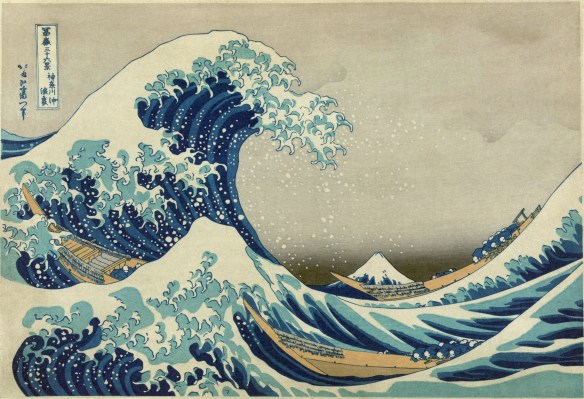
The word undulation describes a wave-like motion. When this idea is applied to people, as it is by Screwtape, it explains the following phenomenon.

to be in time means to chang

If you had watched your patient carefully you would have seen this undulation in every department of his life – his interest in his work, his affection for his friends, his physical appetites, all go up and down. As long as he lives on earth periods of emotional and bodily richness and liveliness will alternate with periods of numbness and poverty.

Wormwood is reminded that people can be as ignorant of this principle as he is, therefore one of his primary goals is to never let his patient “suspect the law of undulation”.
Great_Wave_off_Kanagawa2

The challenge for the tempters is, working against this natural flow, to lead a person into thinking that permanence is the normal state of things. Once this is accomplished it works to their advantage in many ways. Continue reading