Blessed are those who Hunger for a Markan Sandwich

This post is part of a series on the Gospel of Mark based on classes I am teaching.Bite of Sandwich

Mark, the writer of this gospel we are studying is helping us understand who Jesus is. Throughout the narrative he uses a literary technique called the “Markan Sandwich”. This technique involves starting a story that pulls the reader in, then switches to another story line before concluding the first story line. This is similar to how a movie tells concurrent story lines shifting from one character’s situation then panning out and dropping us into the events being tackled by another character. What makes this technique a “sandwich” is after the author finishes telling us the middle story the shift in the narrative moves immediately back to the story that was started and left unfinished.

One of the most obvious and identified “sandwiches” in the Markan narrative occurs in chapter 5. It looks like this: Continue reading
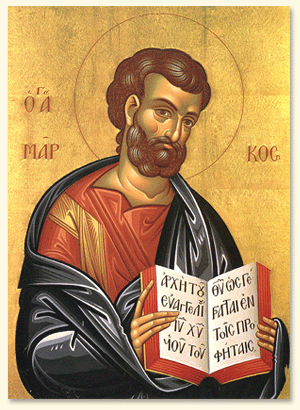
What is Mark’s Good News?

The beginning of the gospel of Jesus Christ, the Son of God.

Mark

Mark

So begins the Gospel according to Mark. We might have different ideas about what the term “gospel” means, but for a first century reader the “good news” (from the Greek εὐαγγέλιον) would bring to mind the ideas of a ruler and/or a great victory. [1]

A popular example that captures these Roman ideas from the same time period (9 BC) is the Priene Inscription. It is an engraved stone created in the city of Priene in Asia Minor to celebrate the birth of Emperor Augustus. It is variously translated, but the Greek word for gospel appears twice (noted in bold).[2] Continue reading

Who wrote the Gospel of Mark (Part V)

Modified from original published on January 22, 2010

I do from time to time read some of what Bart Ehrman writes as I enjoy studying early church history. His latest book “Jesus Interrupted” is on the list. I have not read this entire book but have read some of it in the book store and online.

In chapter 4, Dr. Ehrman claims that the Gospels were not written by eyewitnesses because the disciples of Jesus could not read or write.

From the Gospels we learn that the disciples of Jesus, like him, were lower-class peasants from rural Galilee. … We have some information about what it meant to be a lower-class peasant in rural areas of Palestine in the first century. One thing it meant is that you were almost certainly illiterate. Jesus himself was highly exceptional, in that he could evidently read (Luke 4:16-20), but there is nothing to indicate that he could write. In antiquity these were two separate skills, and many people who could read were unable to write.
Continue reading