Blogging thru On the Incarnation: Athanasius’ Teleological Argument (part 5)

This is part 5 of the series blogging through the book On the Incarnation by Athanasius. You might want to start with part 1 and work your way through the series.

In this post we are going to jump right in, picking up where we left off in part 4. We will be looking at the second major argument Athanasius presents in Against the Gentiles related to how creation points to a Creator. And yes, we will eventually get back to On the Incarnation.

Why do we find a Universe that has Order and Harmony?

In the second major argument advanced by Athanasius, we find him making a teleological argument. A teleological argument is one that makes an appeal to what is known of the universe and then moves to argue that it shows evidence of design and purpose. It then asserts that this is evidence for a Designer.

The Fine-Tuning Argument

A popular and modern version of a teleological argument would be the fine tuning argument.

The laws of physics, the shape of the universe and the values of numerous constants appear to be so finely tuned that a slight change in any one of them could radically change how the universe looks and whether it could support life.1 These observations leave physicists, and all of us, to grapple with whether our universe was designed to support life or whether it was something else that brought about the circumstances in which we find ourselves.
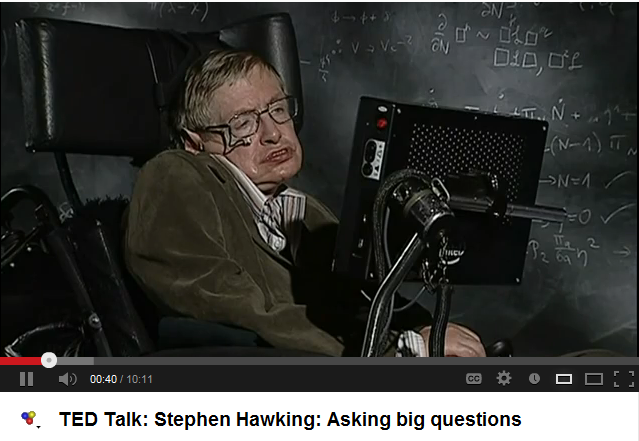
In A Brief History of Time, the famous physicist Stephen Hawking writes:

The laws of science, as we know them at present, contain many fundamental numbers, like the size of the electric charge of the electron and the ratio of the masses of the proton and the electron. We cannot, at the moment at least, predict the values of these numbers from theory – we have to find them by observation. It may be that one day we shall discover a complete unified theory that predicts them all, but it is also possible that some or all of them vary from universe to universe or within a single universe. The remarkable fact is that the values of these numbers seem to have been very finely adjusted to make possible the development of life. … it seems clear that there are relatively few ranges of values for the numbers that would allow the development of any form of intelligent life. Most sets of values would give rise to universes, that, although they might be very beautiful, would contain no one able to wonder at that beauty. One can take this either as evidence of a divine purpose in Creation and the choice of the laws of science or as support for the strong anthropic principle. (emphasis added) 2

Continue reading

Blogging thru On the Incarnation: Athanasius’ Cosmology (part 4)

This is part 4 of the series blogging through the book On the Incarnation by Athanasius. You might want to start with part 1 and work your way through the series.

On Feb 14, 1990, Voyager 1 sent back its famous image of the “pale blue dot”, capturing how large and vast the universe is. This was taken some 3.7 billion miles from the sun as the probe left our solar system. 1 However, the idea that the universe was larger than our solar system, something we take for granted as a well established fact, was still a debated idea until Jan 1, 1925.2

When we affirm that the heavens declare the glory of God, we have a very different mental model and understanding of these heavens than Athanasius and his contemporaries did living in the fourth century. However, that doesn’t mean that in each age the creation doesn’t “make known, and witness to, the Father of the Word, Who is the Lord and Maker of these [things]” 3

In noting that “it is first necessary to speak about the creation of the universe and its Maker”, Athanasius quickly affirms creation ex nihilo, an act performed by the Father through the Word.

God is not weak, but from nothing and having absolutely no existence God brought the universe into being through the Word 3

On the Incarnation chap 3

In On the Incarnation, Athanasius explores creation as it relates to the incarnation and the cross. A topic that we will explore later in this series. In Against the Gentiles the emphasis is on how creation declares a Creator. It is in this earlier work that we get a brief description of how Athanasius understands the universe. That will be the focus on this particular entry in the blogging series.

For Athanasius, as noted already, the model of the universe was very different from what we know today. It would be incredibly smaller, at least from our point of view. In a prior series we explored ancient cosmology and the major characteristics from the point of view of a person living in the fourth century5

Continue reading

Blogging thru On the Incarnation: Good is, Evil is not (part 3)

This is part 3 of the series blogging through the book On the Incarnation by Athanasius. You might want to start with part 1 and work your way through the series.

Having established the proper state of mankind, Athanasius traces the origin and history of evil all the way to its worse form, which for him is idolatry. Don’t worry, we won’t get too bogged down in all of the arguments or the refutations that Athanasius offers against idols.

In Against the Gentiles, he starts off chapter 2 saying:

In the beginning wickedness did not exist. 1

With these words Athanasius takes us back to the Genesis account and creation.

In the early part of On the Incarnation, Athanasius will tell us that it will “be necessary to speak about the creation of the universe” in order to understand why Christ came in bodily form. In that work he will examine more closely the Fall and its impacts. Here, in Against the Gentiles, he delves into how man left the proper state and brought about evil with broader brush strokes.

But men later on began to contrive [wickedness] and to elaborate it to their own hurt. Whence also they devised the invention of idols, treating what was not as though it were. 

Describing God as “good and exceedingly noble”, Athanasius will later say (in chapter 4):

Continue reading