To Be or Not to Be Part 3: Can God kill the Soul?

In part one we explored the concepts of existence and identity. That was followed, in part 2, by a look at the major influences that lead to the idea that the soul is immortal. This entry will explore alternative understandings of the soul for consideration.

In the last post we saw that, despite different underlying philosophical foundations, Augustine and Aquinas affirm that the person is a composite of body and soul. They also both affirm that the soul, an incorporeal intellect and the principle of life, is naturally immortal (or incorruptible). In a moment we will see that both theologians will be careful to ground the existence of the soul in God and His will rather then in itself. In doing so, we might, with a degree of irony, call both Augustine and Aquinas advocates of a conditional immortality.

The punishment of the damned will never come to an end
Before one scoffs at that and considers it a foolish claim, let me make it abundantly clear that both of these theologians affirm that the wicked will suffer eternal conscious torment (ECT).

pain can exist only
in a living subject 1
– Augustine

Augustine notes that in his day there is debate about the fate of the wicked. He spends the greater part of Book XXI of The City of God making the case that “the soul [of the wicked] will neither be able to enjoy God and live, nor to die and escape the pains of the body.” 2

… to say in one and the same sense, life eternal shall be endless, punishment eternal shall come to an end, is the height of absurdity. Wherefore, as the eternal life of the saints shall be endless, so too the eternal punishment of those who are doomed to it shall have no end.3
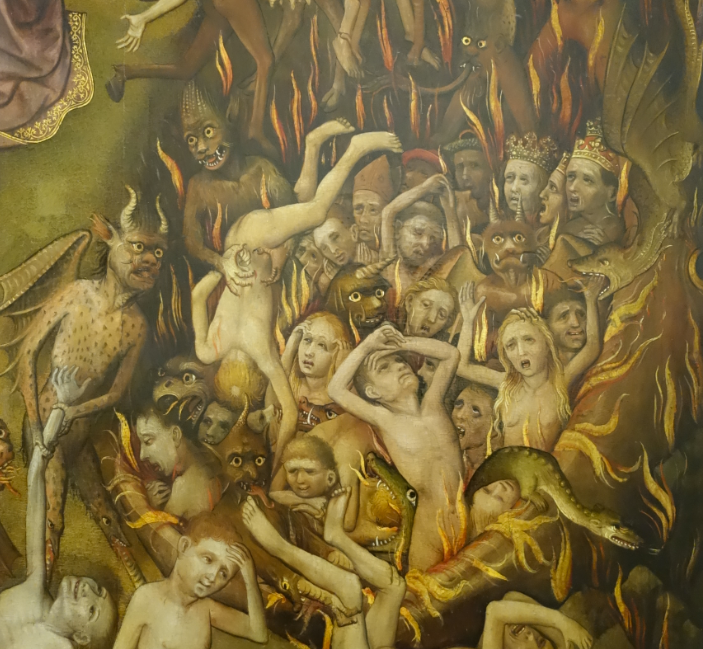
In the supplement to the Summa Aquinas argues “the damned can prefer ‘not to be’ according to their deliberate reason” which would be to have “relief from a painful life”.4 However “it is inadmissible that the punishment of the damned will ever come to an end.” 5

The disposition of hell will be such as to be adapted to the utmost unhappiness of the damned. Wherefore accordingly both light and darkness are there, in so far as they are most conducive to the unhappiness of the damned. 6

Having established that Augustine and Aquinas were deeply committed to ECT, why might we consider them advocates of conditional immortality?

Continue reading

To Be or Not to Be: What is Existence?

When Kirk Cameron recently noted that he favored conditional immortality (CI), also known as annihilationism, over eternal conscious torment (ECT) it created a series or reactions and responses across various platforms. This prompted me to take a deeper look at the fate of those who die without Christ. Among the numerous rebuttals that were offered two major themes emerged that are worth exploring.

  • What do we mean by the terms existence, life and death?
  • What claims might we make about the soul?

As we delve into these topics we will find that the concept of identity is also important.

Augustine famously quips that he understands “time” until he is asked to explain it.1 That sentiment is just as true when we attempt to define each of the concepts outlined above with any precision. Aristotle starts off his work De Anime (On the Soul) noting that having certainty about the soul is one of the hardest things possible.2 We would be wise to admit that certainty on much of these topics “lies beyond [our] powers” and that there is “darkness in our understanding”. As we pursue these topics my aim, like Augustine, is to do so with a sense of offering the “service of my thinking and my [keyboard]” such that it is “stirring up love for [God] in myself, and in those who read this.” 3

What is existence?
When we say that something exists or has existence, what do we mean. We may start with the idea that some entity is instantiated in reality or actuality. This entity has being as opposed to non-being or nothing. In saying an entity exists we are saying that it is instead of that it is not. The notion of existence is related to the identity of the entity, or the description of what it is (its essential properties). How these things are related to each other is something that has been widely debated by philosophers for millennia.4

Continue reading

Justin Martyr the Calvinist? (part 5)

Summary

This post was not an attempt to examine the Reformed doctrines of grace in detail, nor to argue for or against them. It was written to share some research that was done examining whether the early church held these ideas. Ultimately this research and these posts form a rebuttal to those Reformed teachers that assert that the early church held to the Reformed doctrines of grace prior to Augustine.  In order to narrow the scope of this research, I focused on the quotes used to prove that Justin Martyr was a proto-Calvinist.

There is no problem with Reformed teachers that want to argue for their doctrines using their interpretations of Scripture and/or making a philosophical argument. In making this case, there can reject the teachings in the early church, arguing that the early theologians prior to Augustine were wrong because they incorrectly held that foresight, foreknowledge and freewill are compatible or that synergism is a basis for boasting.

However, it is rather troubling for these teachers to claim, using vague, spurious,  and misleading citations, that the early patristic sources affirmed TULIP and determinism. These claims have to ignore the context of the passages as well as clearer statements made by these writers in an attempt to make them out to be something that they are not. As Cottrell said: this is “extremely poor scholarship”. With a little research it should be clear that Justin, rather than being a confused or contradictory theologian, held to a view of soteriology that denied the very ideas these scholars boldly claim that he held.

I hope that this exercise will encourage readers to take the advice of McMahon and consult the primary sources. In doing so, they will find that the quotes taken from writings of the early church do not support the argument that the early church affirmed the Reformed doctrines of grace, but instead rejected them.

Contra Charles Spurgeon, who would write in his sermon Election (link), that Calvinism is the ancient faith,

It is no novelty, then, that I am preaching; no new doctrine. I love to proclaim these strong old doctrines, which are called by nickname Calvinism, but which are surely and verily the revealed truth of God as it is in Christ Jesus. By this truth I make a pilgrimage into the past, and as I go, I see father after father, confessor after confessor, martyr after martyr, standing up to shake hands with me. Were I a Pelagian, or a believer in the doctrine of free-will, I should have to walk for centuries all alone.

we will find that it is a synergistic understanding of faith and salvation that echoes throughout the centuries.

[<< Prev]