Justin Martyr the Calvinist?

Regular readers of this blog will know I am an advocate of the Vincentian Canon. This principle, advocated by Vincent of Lérins, during the early to mid fifth century, in the Commonitorium, was given to help readers determine the “truth of [the universal] faith from the falsehood of heretical pravity.”

That principle is:

all possible care must be taken, that we hold that faith which has been believed everywhere, always, by all. (chapter 2)
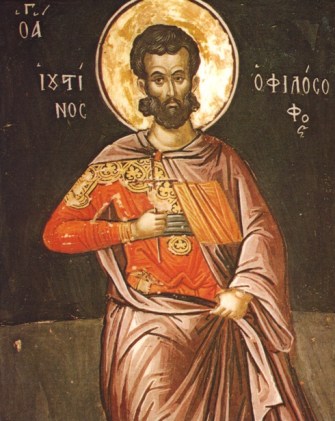
Saint_Justin_Martyr_by_Theophanes_the_Cretan

Justin the Philosopher by Theophanes the Cretan [Public domain], via Wikimedia Commons

The word “faith” has a range of meanings. Here it is taken to mean the doctrine and practices of the church, rather than the loyal trust in God made by an individual. Vincent goes on, in chapter 31, to write:

what has been handed down from antiquity should be retained, what has been newly devised, rejected with disdain

Based on this principle, a solid reason for rejecting the Reformed teachings on the doctrines of grace; as captured in the acrostic TULIP, the Westminster Confession of Faith, and the Canons of Dort; is their novelty. These doctrines, based on extant writings, are not held by theologians prior to Augustine.
Continue reading

Reading History: Justin Martyr answers Why the Cross?

Around 150 years before Athanasius wrote On the Incarnation, Justin Martyr wrote Dialogue with Trypho. As a Christian philosopher, Justin explored the case for Christ through a conversation with a Jewish seeker named Trypho. As the conversation unfolds the need for the cross is affirmed.

The rest of this post contains excerpts from chapters 89-95 from CCEL.


Then Trypho remarked, “Be assured that all our nation waits for Christ; and we admit that all the Scriptures which you have quoted refer to Him. … But whether Christ should be so shamefully crucified, this we are in doubt about. For whosoever is crucified is said in the law to be accursed, so that I am exceedingly incredulous on this point. It is quite clear, indeed, that the Scriptures announce that Christ had to suffer; but we wish to learn if you can prove it to us whether it was by the suffering cursed in the law.”

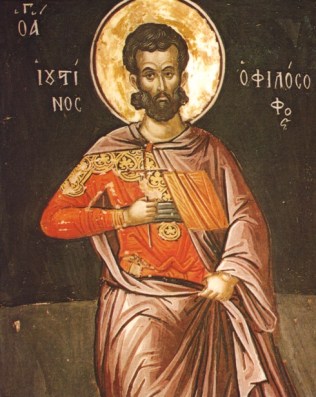
Saint_Justin_Martyr_by_Theophanes_the_Cretan

Justin the Philosopher by Theophanes the Cretan [Public domain], via Wikimedia Commons

I replied to him, “If Christ was not to suffer, and the prophets had not foretold that He would be led to death on account of the sins of the people, and be dishonoured and scourged, and reckoned among the transgressors, and as a sheep be led to the slaughter, whose generation, the prophet says, no man can declare, then you would have good cause to wonder.

But if these are to be characteristic of Him and mark Him out to all, how is it possible for us to do anything else than believe in Him most confidently? And will not as many as have understood the writings of the prophets, whenever they hear merely that He was crucified, say that this is He and no other?” Continue reading

Justin Martyr: What we do in life echoes in eternity

As we approach the 500th anniversary of the Reformation, we are looking at some of the people that have stood out in the history of the church. This past Sunday we focused on Justin Martyr.

Justin was probably a Roman Gentile, born early in the second century in the city of Flavia Neapolis located in Samaria. What we know of him comes primarily from his extant works or statements about him in Eusebius’ Ecclesiastical History

Justin was especially prominent in those days. In the guise of a philosopher he preached the divine word, and contended for the faith in his writings. (Eccl Hist 4.11)

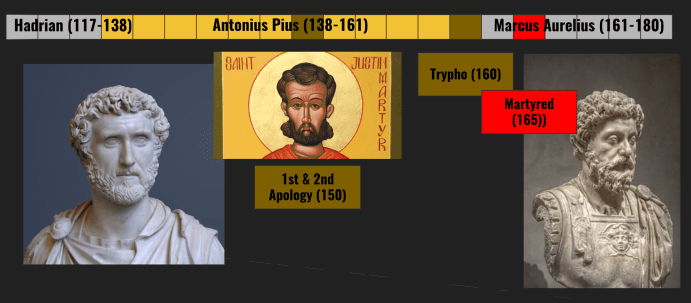
Justin lived in the early 2nd century, spending most of his life under the reign of the Roman Emperors Hadrian and Antonius Pius.

JustinMartyrWorld

Living in the early 2nd century, and traveling broadly as he studied philosophy, Justin would have learned about Christianity from people who were potentially taught by the apostles. Given his travels, he also would have a good understanding of the doctrines held across numerous locations. Thus, in Justin’s writings we find important descriptions of the practices and doctrines of the early church.

There are three extant works that are generally accepted as being written by him.

  • First Apology, addressed to Antonius Pius, and generally dated between 150 and 157
  • Second Apology, often considered as part of the First Apology
  • Dialogue with Trypho, which defends Jesus as Messiah to those who are Jewish. It is usually dated around 160.

Continue reading