Lessons from the Warrior Dash

This past weekend I ran in a race called the Warrior Dash. This crazy race – billed as a “mud-crawling, fire leaping, extreme run” is a challenging 3.5 mile course filled with obstacles. Obstacles which include barricades to be leaped over and crawled under, tires and trashed cars to be traversed, and “swimming” through water while “leaping” over logs. And mud did I mention mud. That is part of the deal but the rain that morning made sure that there was plenty of it as the entire course was muddy and slippery.
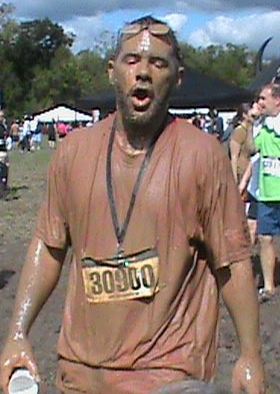
My family and I got to the site early and met up with my brother in law, his family, and one of his coworkers. As it got closer to our start time and we got in line the nervous energy and anticipation was growing. After some good old fashion Brave Heart screams and chants of “bring it on” instigated by the DJ the big flames finally shot out of the top of the starting gate and we are off.

The first mile or so was obstacle free – except for the muddy course so we were able to settle into a runner’s rhythm. We were also excited about getting to the first obstacle. That excitement quickly waned after managing to gut it through that obstacle – which was a series of several alternating items to be traversed – first over a waist-high barrier then crawling under a knee-high cross beam.   I was totally winded. And we had barely started. Then doubt started to creep in and all I could hear was – “Mike, there is no way are you going to make it”. Starved of O2 I quickly caught my breath and started to press on. I had to go catch up with my brother in law. Once we changed our pace a bit we were able to settle in and tackle the next series of obstacles.

One of the later obstacles is a tall wooden barricade that must be climbed. It is probably 10-12 feet tall. And while it has a rope and some wooden studs to help the runner along the way to the top, it is also wet and muddy and therefore slippery. It doesn’t take to long to learn that this obstacle – like most in this event – is best tackled by hitting it hard and not slowing down or stopping once you get started. Even if your muscles are aching and you just want to catch your breath. Because slowing down and stopping reduces momentum and then fatigue and gravity start to really take over. And once that happens it takes a lot more work to get to the top.

Reflecting on the fun (does that make me crazy) of the event later, it became clear why running as an athlete is such a good illustration of living out the Christian life used in Scripture (particularly by Paul).

image from Warrior Dash Facebook page

Life is dirty and full of obstacles…

To live out a life that would imitate Jesus the following principles are mentioned when an illustration based on running a race is used (1 Cor 9:24-26; 2 Tim 2:1-7, 4:7-8; Heb 12:1-3):

  • train with goals in mind
  • learn to control the body
  • compete according to the rules
  • fight the good fight
  • run with endurance
  • remove entanglements so you are not slowed down

The Christian life lived well takes work just like running well in an event like the Warrior Dash.

When I decided to run this event with my brother in law I knew I had to start training and build into my weekly routine time to run, lift weights, and go to kickboxing class. However training is not easy. It involves hard work, sweat, and aching muscles so after the initial excitement passes the excuses follow (there is plenty of time before the race) as does loss of motivation (I don’t feel like working out tonight) that leads to skipped workouts.  And then there are the other demands (good and bad) on our time. However when one stops training – even for a short amount of time – it is amazing how quick we lose all that hard earned endurance and strength. All readers over 40 know that seems to be at ratio of losing 1 week of gained strength/endurance for each day we take off.  And skipping training makes the goal of surviving the Warrior Dash and getting one of those cool medals that says “I survived” that much harder. So we can pay now or pay more later.

Whether it is slowing down in training or slowing down on that large wall obstacle the result is the same. When we stop we start losing ground – on getting up the wall or getting stronger and fitter. And in life this principle applies with similar results. When we stop moving forward in the Christian life we tend to fall into our natural tendencies. We start loving others less and giving less and then we really start to slip into selfish desires and worldliness starts to take over. There is no effort involved here and we don’t have to think about falling back into them. It just happens because we stopped moving forward.

The idea of continual training, learning, and growing is a repeated theme. The Thessalonian church was noted amongst the churches for their love to others and yet they were told to keep growing in love (1 Thes 4:10). The apostle Peter urged people to increase in qualities such as faith, self-control, endurance, and love so that they would be effective and fruitful Christians (2 Pet 1:8).  And the apostle Paul, echoing themes of running and training, urged all Christians to imitate him. They are to strain forward and press on to the goal of winning the prize just as he does  (Phil 3:12-16). These themes all contain the idea that moving forward is necessary, and it takes work. It also implies that when we stop growing we tend to fall back not remain where we are. Even Paul was worried about being disqualified from earning the prize if he did not train (1 Cor 9:27).

That is why Paul reminds his readers that they are are to “put off the old man” and to “put on the new man” (Col 3:9-10). This was similar to the guidance given to the church in Ephesus (Eph 4:22-24). The verbs used for laying aside and putting on in these passages are in the middle voice. This indicates that we must be an active part of the exchange between the old and the new man. It also indicates that this was not a completed action when we trusted in Christ (Eph 1:13). It requires hard work and dedication.

What are the old man and the new man that Paul refers to?

These men (old and new) that Paul describes are of course not actual people but rather metaphors for our attitudes and practices. The old man is described by Paul as one whose mind is set on the earth and whose attitudes and actions are defined as evil and deserving of God’s wrath (Col 3:2,5-9). The old man is deceived by futile thinking, ignorance, and a hard heart that results in sin and a life apart from God (Eph 4:17-19, 22). The new man is contrasted with the old man and is therefore its opposite.

When we slow down and stop pursuing growth in Christian qualities it is really easy to let ourselves go and find that the “old man clothes” are fit well and are really comfortable.

What practical actions can we do to put on the new man?

First, we must realize that the clothes of the new man are not something that we can create or buy. These clothes are created by God and given to us (Col 3:10; Eph 4:24) when we are in Christ. The old man can only be called a former way of life and be put aside after we have learned the truth in Christ and have received Him (Col 3:7-8, Eph 4:20-22) because it requires a total transformation of who we are from the inside out.

Second, we must establish the right goals to pursue. As this is already long post, I’ll keep this simple – Love God and Love Others.

Third, we must understand that it is a choice that we must make. To take off the old and put on the new. Just like it is a choice to train and prepare for a race and to run with endurance. It is a choice to fight against the sinful desires that will tempt us and hinder us from our goals. Even when don’t want to push on or we lose motivation or we don’t want to get dirty. We must press on. When we don’t want to fight the temptation and just give in. We must fight the good fight. The “putting on” is is not drumming up false feelings and the “taking off” is not getting rid of feelings that exist in us and we wished did not. It is willing to push past them, fight on, and do the right thing.

I do not mean that anyone can decide this moment that he will never feel it anymore. That is not how things happen. I mean that every time it bobs its head up, day after day, year after year, all our lives long, we must hit it on the head. It is hard work, but the attempt is not impossible. – C.S. Lewis (Mere Christianity)

Life is dirty and full of obstacles…

So establish the right goals, stay focused on these goals, don’t quit, and hit each obstacle as it comes.

Oh, and don’t forget to have fun along the way!

Where’s the Beef?

Back in 1984, Wendy’s challenged their competitors with the famous question – “where’s the beef?”. It featured a little old woman examining her burger and asking the question to her two friends.

The question became a cultural catchphrase used to challenge the substance and validity of the claims others make.

Too bad that feisty woman was not one of the Hebrews encamped around Mt. Sinai after they had been delivered from Egypt. In this post we will look at a moment in the history of Israel where they failed to ask that question.

Setting the context a bit the Hebrews had been enslaved in Egypt for some 400 years. However, after these long bitter years their God has just rescued them in dramatic fashion. The people sitting in the camp were all witnesses to the 10 plagues that fell on the nation of Egypt before the Pharaoh let them finally leave the country. And they all stood at the banks of the Red Sea and trembled in fear as the Egyptian army, sent to chase them down, had them boxed in and was ready to destroy them. And they all rejoiced as they saw God (in the form of a pillar of cloud) stand between them and the army protecting them from certain slaughter and then deliver them through the parting of the Red Sea.

These Hebrews who now sit in the wilderness at the foot of Mt. Sinai are traveling to the land promised to Abraham (the father of their nation). In the last few days they have been offered a set of laws (Exodus 20-23). These laws are offered to them by God in the form of a covenant where He would be their protector and bless them if they obeyed the laws, but punish and remove His protection if they disobeyed. The people readily accepted these conditions and entered into the covenant confirming it with a blood oath (Exodus 24).

It is at this point that they find themselves at the bottom of Mt. Sinai waiting for their leader Moses who has gone back up the mountain. While he is receiving instructions on how to build the ark and tabernacle they are growing tired of waiting.

1When the people saw that Moses delayed to come down from the mountain, the people gathered themselves together to Aaron and said to him, “Up, make us gods who shall go before us. As for this Moses, the man who brought us up out of the land of Egypt, we do not know what has become of him.” 2So Aaron said to them, “Take off the rings of gold that are in the ears of your wives, your sons, and your daughters, and bring them to me.” 3So all the people took off the rings of gold that were in their ears and brought them to Aaron. 4 And he received the gold from their hand and fashioned it with a graving tool and made a golden calf. And they said, “These are your gods, O Israel, who brought you up out of the land of Egypt!” 5When Aaron saw this, he built an altar before it. And Aaron made proclamation and said, “Tomorrow shall be a feast to the LORD.” 6And they rose up early the next day and offered burnt offerings and brought peace offerings. And the people sat down to eat and drink and rose up to play. (Exodus 32:1-6 ESV)

Why did the Hebrews choose to invent a new god (which they had just agreed not to do)? Why did they accept and worship a statue of gold over the God that actually delivered them?  Especially a god that they watched be fashioned from gold. Gold that moments ago was being worn as jewelry that they had owned and donated for the cause. And how could they actually think that this god delivered them from bondage and brought them out of Egypt when it did not even exist until after they were enjoying their freedom?

Where’s the Beef?

There was less beef in this god then the hamburger in the Wendy’s commercial so why were the Hebrews so quick to accept and worship the golden calf? There are many reasons why the Hebrews may have chosen to define their own god that day that could be explored. After all these were a tired and scared group of people. They had no home land as of yet. They are in the wilderness and currently without their leader Moses. And as for idols – well all the other nations are doing it. But, I think that at the core the main reason was this golden calf god was a lot less demanding than the real thing. This chunk of gold was not going to be making any rules on how to live that would have to be obeyed. Instead the Hebrews could go eat and drink and play. Why ask questions when you can “have it your way”.

Today we would laugh at such a scene. Yet people do the same thing when they form their religious or spiritual views based on accepting things based on personal preference and subjectivity – a topic explored in a prior post Burger King theology. Can one really mix and match various spiritual ideas blending them together based on preference and actually believe that it is true? We may not worship a golden calf, but people aren’t any different when they think of Jesus as only a good teacher or a spiritual adviser who will guide us to enlightenment. The idea that Jesus was a good teacher is based  on such teachings as “don’t judge, lest ye be judged”, “treat others the way you want to be treated”, and the call to “love others” and care for the poor. But where do we find these teachings? While there are some extant references to Jesus’ teaching outside the Bible, most of Jesus’ teachings are contained in the New Testament. And most who would claim that Jesus is a good teacher would readily admit that they rely on the New Testament to know what he taught.

But here are some of the other claims that Jesus makes:

  • son your sins are forgiven (Mk 2:5)
  • Truly, truly, I say to you, unless one is born again he cannot see the kingdom of God … whoever believes in the Son has eternal life; whoever does not obey the Son shall not see life, but the wrath of God remains on him. (John 3:3, 36)
  • it is not I alone who judge, but I and the Father who sent me … (John 8:16)
  • I and the Father are one … I am the Son of God (John 10:30, 36)

What is interesting about these claims is that the Pharisees and people at that time challenged Jesus:

  • no one can forgive sins except God (Mk 2:7)
  • how can these things be? (John 3:9)
  • who is your father, who are you? (John 8:19, 25)
  • you, being a man, make yourself God (John 10:33)

Wonder where those same people willing to ask “where’s the beef” types of questions were when the golden calf was being offered as god?

Questions are not bad. We need to be able to examine our beliefs. But how can we accept teachings from the Sermon on the Mount and reject Jesus’ other teachings or His death and resurrection when they are in the same book? On what basis should we take one teaching of say the Gospel of Mark or John as authentic and reject another teaching as “inaccurate” ? What confidence can anyone have that they picked the right sections as accurate?

The real question is when one approaches spiritual truth or the identify of Jesus this way how is this any different than the Hebrews who sought a golden calf?

Sounds a lot more like Burger King Theology than the Wendy’s version and where’s the beef, in that?

Burger King Theology

The “have it your way” meme has hit religion according to a recent article in USAToday. The quote that sums it all up is here:

“We are a designer society. We want everything customized to our personal needs — our clothing, our food, our education,” he says. Now it’s our religion.  … Barna laments, “People say, ‘I believe in God. I believe the Bible is a good book. And then I believe whatever I want.'”

Nadine Epstein, editor and publisher of Moment magazine is quoted:

It’s incredibly exciting. We live in an era where you pick and choose the part of the religion that makes sense to you. And you can connect through culture and history in a meaningful way without necessarily religiously practicing,”

I guess this should not be too surprising given our postmodern culture which is enamored with subjectivity and relative truth and which views Oprah as its spiritual adviser. Back in 2008, USA Today reported essentially the same thing:

Religion today in the USA is a salad bar where people heap on upbeat beliefs they like and often leave the veggies — like strict doctrines — behind.

Going on to add:

The impact of Oprah is seen throughout this survey. She uses the language of Bible and Christian traditions and yet includes other traditions to create a hodgepodge personalized faith.

How does Oprah view spirituality –  according to a USA Today article reporting on her appearance on the Piers Morgan show:

In Oprah-vision: We’re all good, we should not judge each other and morality is relative. This is no Jesus-centered, born into sin and in need of salvation God who both loves and judges.

Her message of hope is to believe in yourself, redeem yourself. Very popular but not very Christian.

In that same article a partial transcript reveals:

Oprah: There couldn’t possibly be only one way with millions of people in the world!

When asked how she reconciled her spiritual teachings with Christian beliefs, Oprah essentially replied – I have an open mind.

I reconciled it because I was able to open my mind about the absolute indescribable hugeness of that which we call God,” Oprah said. “I took God out of the box because I grew up in the Baptist church and there were rules and belief systems and doctrine.

“What I believe is that Jesus came to show us Christ-consciousness. Jesus came to show us the way of the heart … Jesus came to say ‘Look, I’m going to live in the human body and I’m going to show you how it’s done. These are some principles and some laws that you can use to live by to know that way’. . . Even as a Christian, I don’t believe that Jesus came to start Christianity.”

Unfortunately an open mind did not include and open Bible.

This “salad bar” view of religion has its supporters even in the evangelical realm. Rob Bell, author of Love Wins wrote in his previous best seller Velvet Elvis that Christianity was like a trampoline and doctrines were the springs.

The springs are statements and beliefs about our faith that help give words to the depth that we are experiencing in our jumping.

Offering up the possibility that the Trinity, virgin birth, and other holdings in Christianity could be questioned and even removed.

We don’t need all the springs to jump. While I understand and respect his view that we need to be able to question our beliefs. Test them and evaluate them. There is a fine line big difference between subjectively dropping springs we don’t like and changing springs based on logical reasoning and a study of the Scriptures.

I guess Solomon was right – there really is nothing new under the sun. This has played out before:

In those days there was no king in Israel. Everyone did what was right in his own eyes. (Judges 17:6 ;21:25)

Why is Oprah’s view of spirituality so popular and why does removing the springs we don’t like so popular? I think it is because it is “politically correct”, its “open to anything”, its warm and fuzzy and feeds the “have it your way” culture we live in.

What do you think truth should be based on?

[Continue reading: Where’s the Beef]