Blogging thru On the Incarnation: Who is Athanasius? (part 1)

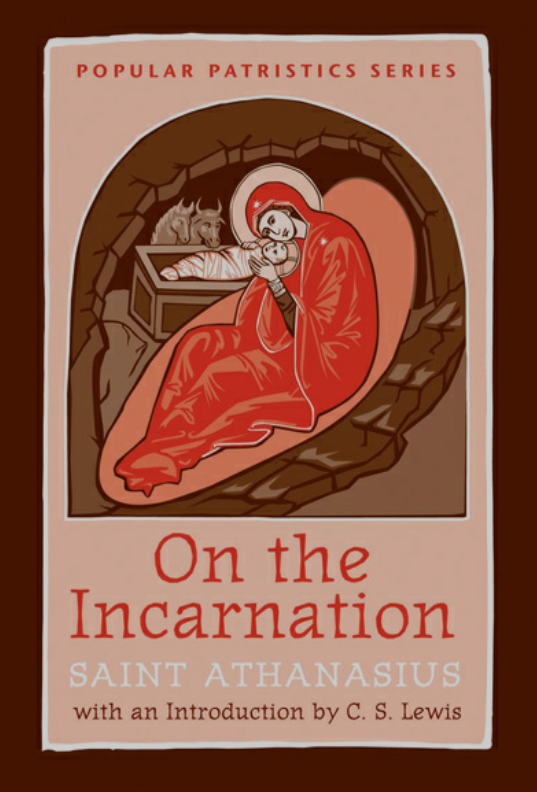
With Christmas coming, I decided to take C.S. Lewis’ advice and read an old book, tackling On the Incarnation by Athanasius during Advent. Up to now I’ve only read excerpts from this work (post), but I plan on reading and blogging through the entire book. I will be using the translation published as part of the Popular Patristics Series. This edition is translated by John Behr and contains the famous preface by C.S. Lewis (see blog post on that here).

Every age has its own outlook. It is specially good at seeing certain truths and specially liable to make certain mistakes. We all, therefore, need the books that will correct the characteristic mistakes of our own period. And that means the old books.

Preface by C.S. Lewis

On the Incarnation

On the Incarnation is considered an apology (or defense) of the cross and is the sequel to an earlier work entitled Against the Gentiles. 1 The dating for On the Incarnation is debated, with some favoring an early date prior to the Council of Nicaea, citing the lack of mentioning Arius. 2 Others suggest it was probably written sometime after the council, given that the author would have been writing at a very young age if it was earlier.3 These provide a range of time for the composition that would fall somewhere between 318 and 337 AD.

that you may be able to know the cause of the manifestation in the body of such and so great Paternal Word, … that, being by nature bodiless and existing as the Word, by the love for humankind and goodness of his own Father he appeared to us in a human body for our salvation.

On the INCARNATION 1

Who was Athanasius?

Athanasius contra mundum

Continue reading

The Lord Has Not Given You a Heart to Know (Part 3)

I recommend starting with part 1 if you have not read that already…

We started what has turned into a mini-series of posts by reading Deuteronomy 29:4 and asking three questions.

  • What is it that God is not giving the Israelites an ability to understand, perceive and discern?
  • Is this something the Israelites are only able to understand if God gives them an ability to perceive it?
  • What is the historical context of the day on which this is spoken and what has occurred before the statement is made?

Focusing on the immediate context, as well as the overall context of Deuteronomy, we found the historical context. Moses is addressing the Israelites as they are gathered at Moab. The Israelites are about to enter the Promised Land and Moses is transferring his leadership to Joshua. Given the phrase “to this day”, we concluded that it was reasonable to assume that the Lord has not given the Israelites an ability to understand, perceive nor discern something throughout the entire Exodus.

The immediate context, also answered the question that the something that the Israelites were unable to understand, perceive nor discern was all of the Lord’s activities, the signs and wonders, during the Exodus and the wilderness wandering. These activities were given to both teach the Israelites so that they would know the Lord and to test them.

Continue reading

The Lord Has Not Given You a Heart to Know (Part 2)

I recommend starting with part 1 if you have not read that already…

The intent of the exhortation in Deuteronomy 29 looks to remind the Israelites that there current track record in knowing and trusting the Lord isn’t very good. Any reasonable Israelite at the gathering would know this to be true.

Here is a cursory and non-exhaustive look at their recent history of the people Moses has been leading since the Exodus.

  • Complained that they would be die at the hands of the Egyptian army (Exodus 14:10-12)
  • Complained that they would die of starvation (Exodus 16:1-3)
  • Complained that they would die of thirst (Exodus 17:1-3)
  • Asked for the golden calf because 40 days was to long to wait for Moses (Exodus 32:1-6)
  • Complained about the food they received (Numbers 11:1-9)
  • Complained that they would be die at the hands of the armies in Canaan (Numbers 14:1-3)
  • Complained about the food they received (Numbers 21:4-5)

A worthwhile application is to ask ourselves, do we tend to ignore what God has promised and what He has done and focus on what can go wrong?

The complaints and fears highlighted in these passages highlight the fact that this group of people has shown limited to no trust that God was going to watch over them as they made their way out of Egypt and towards Canaan.

The Israelites are a rebellious people

Prior to gathering at Moab, the Lord assessed the people of Israel and concluded that they are an obstinate and stiff-necked people. The evaluation that was made after the people asked Aaron to make the Golden Calf was particularly severe. As the people reject God’s provision, the Lord is described as being ready to give up on the people that have left Egypt. He tells Moses that He is going to destroy them all and start over forming the nation through Moses.

Then the Lord said to Moses, “I have seen this people. Look what a stiff-necked people they are! So now, leave me alone so that my anger can burn against them and I can destroy them, and I will make from you a great nation.”

Exodus 32:9-10 (NET)
Continue reading