The Third Peacock and Theodicy

In The Third Peacock, Robert Farrar Capon presents the reader with an interesting exploration of the problem of evil in the face of a good God (theodicy).
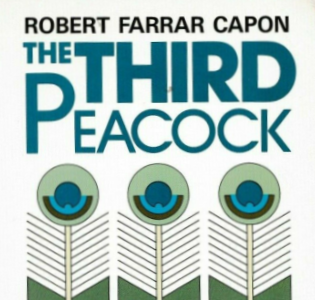
Capon writes with an easy prose that sounds more like the conversation one would have while sitting and enjoying a beer together (or whatever your drink of choice might be). He dispenses with theological jargon, offering instead a plain spoken, no holds barred assessment of the rough and tumble world we live in. How can this world possibly align with a good God? The reader may not agree with everything that is written, I didn’t, but this book does offer some insights for anyone that asks questions – either silently or aloud – about why there is so much suffering, both moral and natural, in creation.

I should warn you that this post is part book review and part blogging through a book. It summarizes many of the main points made in the book and thus contains spoilers.

The book opens with the sentence – “Let me tell you why God made the world.” By the middle of the next page we find the Trinity drinking wine, telling jokes and throwing olives at each other. With this analogy, which even Capon admits is crass, the author seeks to present the reader with the theology of delight. This attempts to overturn ideas of God as a cosmic kill-joy or stern judge. Perhaps it could serve as a rebuttal to the servant in Matthew 25 who sees God as overly harsh. The theology of delight offers up creation as one big party in which God took, and continues to take, great delight in what He has created.

Continue reading
Twas a Tale of Two Falls

A theological poem using the rhyme scheme known as anapaestic tetrameter found in Twas the Night Before Christmas.

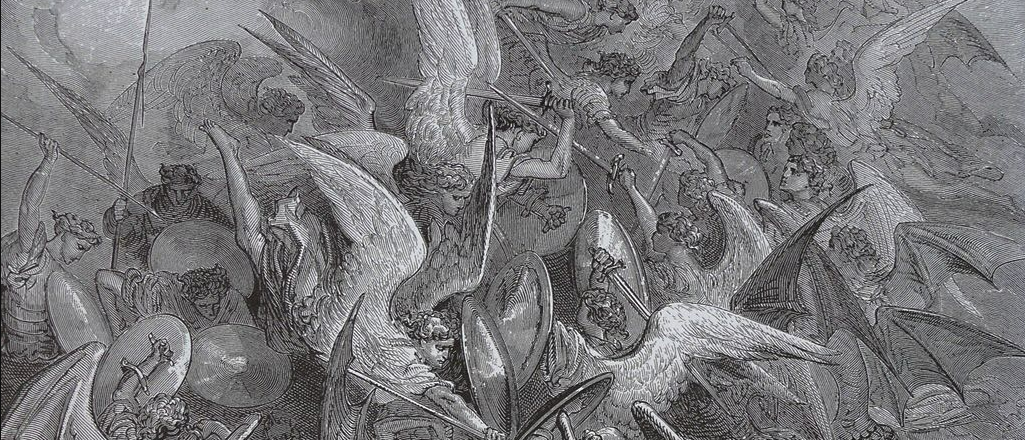
Illustration for John Milton’s “Paradise Lost“ by Gustave Doré

Twas before the beginning when God formed a plan
to create heavens and earth and even a man.
Before earth’s big debut, there was a prior start.
The angels were created and given a part.
Praising the Ancient One in His glorious light. 
The winged creatures serve Him all day, there’s never night.

But wait. How can we know the order of these things?
Can angels rejoice before they’re made by the King?
For eternity has no before or after.
It’s one endless now without former or latter.
Now, if time is the space that’s between two events, 
then to order them ask: when did the clock commence?
Before earth and sky are spoken into being,
what else can give things chronological meaning?

Let’s go back to the start before our inception 
when angels were pure and were without deception.

Continue reading

Justin Martyr the Calvinist? (part 5)

Summary

This post was not an attempt to examine the Reformed doctrines of grace in detail, nor to argue for or against them. It was written to share some research that was done examining whether the early church held these ideas. Ultimately this research and these posts form a rebuttal to those Reformed teachers that assert that the early church held to the Reformed doctrines of grace prior to Augustine.  In order to narrow the scope of this research, I focused on the quotes used to prove that Justin Martyr was a proto-Calvinist.

There is no problem with Reformed teachers that want to argue for their doctrines using their interpretations of Scripture and/or making a philosophical argument. In making this case, there can reject the teachings in the early church, arguing that the early theologians prior to Augustine were wrong because they incorrectly held that foresight, foreknowledge and freewill are compatible or that synergism is a basis for boasting.

However, it is rather troubling for these teachers to claim, using vague, spurious,  and misleading citations, that the early patristic sources affirmed TULIP and determinism. These claims have to ignore the context of the passages as well as clearer statements made by these writers in an attempt to make them out to be something that they are not. As Cottrell said: this is “extremely poor scholarship”. With a little research it should be clear that Justin, rather than being a confused or contradictory theologian, held to a view of soteriology that denied the very ideas these scholars boldly claim that he held.

I hope that this exercise will encourage readers to take the advice of McMahon and consult the primary sources. In doing so, they will find that the quotes taken from writings of the early church do not support the argument that the early church affirmed the Reformed doctrines of grace, but instead rejected them.

Contra Charles Spurgeon, who would write in his sermon Election (link), that Calvinism is the ancient faith,

It is no novelty, then, that I am preaching; no new doctrine. I love to proclaim these strong old doctrines, which are called by nickname Calvinism, but which are surely and verily the revealed truth of God as it is in Christ Jesus. By this truth I make a pilgrimage into the past, and as I go, I see father after father, confessor after confessor, martyr after martyr, standing up to shake hands with me. Were I a Pelagian, or a believer in the doctrine of free-will, I should have to walk for centuries all alone.

we will find that it is a synergistic understanding of faith and salvation that echoes throughout the centuries.

[<< Prev]