Reason Rally or Atheist Assembly?

Today on the National Mall in Washington DC, people will gather together at an event called the Reason Rally. What is the purpose of the gathering? According to the web site it is a “coming out of the closet” for secularists. Here is how the Washington Post is describing it:

Reason Rally will show that all the cool people are atheists now and that the days of consent by silence are over. It’s an appeal to millions of hidden atheists to come out of their closets and join the fun.

One of the speakers, is Richard Dawkins, who poses the question who is against reason?

How have we come to the point where reason needs a rally to defend it? To base your life on reason means to base it on evidence and logic. Evidence is the only way we know to discover what’s true about the real world. Logic is how we deduce the consequences that follow from evidence. Who could be against either?

Sadly, Dawkins concludes that anyone who is not a secularist is against reason, logic, and evidence. He lauds science and reason comparing the building of planes, rockets, Mars rovers, the ability to cure diseases,  and the fact that the Earth spins to other things “we know”. Things like the age of the universe, the age of the earth, and the fact that we all evolved from other species.

This is not something new, Dawkins is known for this famous (or is it infamous) quote:

It is absolutely safe to say that if you meet somebody who claims not to believe in evolution, that person is ignorant, stupid or insane (or wicked, but I’d rather not consider that).

He, by his own count says 4x in the article that the “Reason Rally is not for you” if you have not outgrown the supernatural.

Tom Gilson over at Thinking Christian wrote the following:

The new atheists–participants in the contemporary anti-religion movement led by Richard Dawkins, Sam Harris, the late Christopher Hitchens, among others–are working overtime to tell the world that reason favors atheism, and atheism alone.

In this article and in this blog entry, he demonstrates where Dawkins fails to apply the reason he is rallying for.

Unfortunately, the notion that anyone who is religious must be against reason is ridiculous. Questioning the conclusions of science in areas like evolution is not rejecting reason or hiding from evidence. It is however recognizing that some things are probable and can’t be known with absolute certainty.

One of my favorite bloggers and theologians, C. Michael Patton has written on the idea of our need for certainty in a provocative entry “Why I am not completely sure Christianity is true”:

We don’t want probability! People can poke holes in that. We want absolute certainty. We want to be indubitable!” Indubitability ultimately equates to infallible knowledge—knowledge that can’t be wrong.

The science of aerodynamics can be proven with absolute certainty. I happen to live near an airport and see the evidence flying overhead every day. As we look overhead at these engineering marvels it is easy to think that science can prove anything in a similar manner. If scientists can build that plane then they can prove things like evolution too. However, this is committing the fallacy of faulty generalization.

  • Science has proven flight is possible by building a plane.
  • Science proposes that all living things evolved.
  • Therefore all living things have evolved because science proves things.

Enns and other theologians have assumed this as a starting point as they grapple with the impacts to theology. But that depends on what we mean by “know” and “prove”. In evaluating Enns claims, I have written about the difference between science that deals with the present, like putting rockets on the moon, and science that deals with the past and events that are a singularity, like the beginning of the universe.

We must all wrestle with the evidences we have available to answer these types of questions regarding what it is true. That even includes our own belief in God as Creator and in Jesus’ death and resurrection. Belief or faith by definition requires trusting something that can’t be proven certain, but does not mean that we are forced to take a “blind leap” that throws reason to the wind.

Christianity is a rational faith based on the historic reality of God interacting with His creation by sending His Son into the world to conquer death and save sinners during the first century. Can we know this with absolute certainty? No.  But having examined the evidence I have come to the logical conclusion that it is probable that Christianity is true.

And, if the Reason Rally is a coming out party for atheists to assert how cool they are then,Dawkins is right it is not for me. But then this event is not really a rally for reason, it is just an assembly of atheists.

a man under authority (being Elite part 3)

What is an elite Christian? If you are reading this post check out part 1 which lays out the main idea. In part 2 we looked at the Canaanite woman who was recognized for her great faith. Today we examine the centurion who was also noted for his great faith.

When he had entered Capernaum, a centurion came forward to him, appealing to him, “Lord, my servant is lying paralyzed at home, suffering terribly.” And he said to him, “I will come and heal him.” (Matt 8:5-7 ESV)

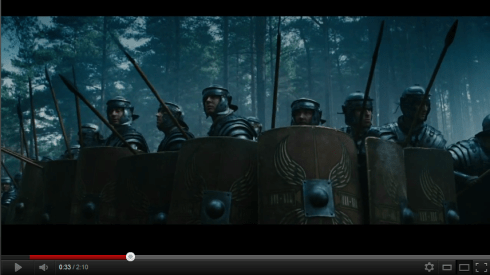
As we engage in this story we must remember that the man who approaches Jesus was a warrior in the army of Rome.

He is a leader responsible for around 80 men, called a century. His century would be one of six that comprised a larger combat unit called a cohort. This is similar to the way the military divides men into platoons, companies, and battalions today. As a centurion this man has lead troops into battle. And he has charged the enemy lines and faced his enemy face to face in combat. He has likely killed many people during these battles. The centurion is a tough and strong individual who has earned the right to lead.

Not every man was fit for service in the Roman army. According to Book 1 of “De Re Militaria” (On Military Matters), dating to the 4th century, the new recruit was evaluated before being accepted as a Roman soldier:

The recruit, however, should not receive the military mark as soon as enlisted. He must first be tried if fit for service; whether he has sufficient activity and strength; if he has capacity to learn his duty; and whether he has the proper degree of military courage. For many, though promising enough in appearance, are found very unfit upon trial. These are to be rejected and replaced by better men; for it is not numbers, but bravery which carries the day.

And from Book II of the same work, fewer still would be fit to serve as a centurion. This person was one who excelled in the art of combat, discipline, and self-control:

The centurion in the infantry is chosen for his size, strength and dexterity in throwing his missile weapons and for his skill in the use of his sword and shield; in short for his expertness in all the exercises. He is to be vigilant, temperate, active and readier to execute the orders he receives than to talk; Strict in exercising and keeping up proper discipline among his soldiers, in obliging them to appear clean and well-dressed and to have their arms constantly rubbed and bright.

This man has likely formed a strong relationship with his servant, having relied on each other through many trying times. Showing both compassion and humility he realizes his friend needs more help then he can provide, so the centurion approaches Jesus. Recognizing the man’s faith and humility, Jesus is ready to heal the centurion’s servant by offering to go to his house.

Who is serving who?

Most people like when people drop everything to take care of their request. They would respond “great, Lord, let’s go”. That’s what I would have done. I would have been so focused on getting what I wanted that I would grab Jesus by the arm and start heading toward home. But the centurion is not like most people.

… the centurion replied, “Lord, I am not worthy to have you come under my roof, but only say the word, and my servant will be healed. For I too am a man under authority, with soldiers under me. And I say to one, ‘Go,’ and he goes, and to another, ‘Come,’ and he comes, and to my servant, ‘Do this,’ and he does it.”

This warrior must have known that Jesus was sent from God and able to heal otherwise he would not have sought Him out. But he also understands that anyone who can heal a broken body and restore a person back to health is someone with authority. He reasons that if an officer in the Roman army can issue commands to the soldiers under him with the full expectation that they will be carried out then Jesus can issue the command for the healing and it will be accomplished.

And anyone with authority over the physical world and diseases has authority over him and deserves to be served and obeyed. Not serve him. Just as John the Baptist knew that he was unworthy to untie the sandals of the Messiah, the centurion puts it all together and humbly realizes that he is not worthy of having Jesus come to his home.
And that is what I would have missed. In my pride I would not have recognized how unworthy I really was in the presence of Jesus. I would have expected Jesus to come follow me to my house. I expect Jesus to fulfill my requests. Now, the account doesn’t tell us what Jesus and his disciples were doing, but whatever it was, the centurion had just interrupted them. Had I been there I would have put Jesus “in a box” and expected Him to do what He has always done and heal through physical contact. Jesus would have come and altered His plans and come to heal my friend. But I would have missed out on truly understanding the power and authority of Jesus.

When Jesus heard this, he marveled and said to those who followed him, “Truly, I tell you, with no one in Israel have I found such faith. I tell you, many will come from east and west and recline at table with Abraham, Isaac, and Jacob in the kingdom of heaven, while the sons of the kingdom will be thrown into the outer darkness. In that place there will be weeping and gnashing of teeth.” And to the centurion Jesus said, “Go; let it be done for you as you have believed.” And the servant was healed at that very moment.

Take me to your leader

Most people like to be in authority rather than under authority. But the centurion is not like most people and Jesus is amazed at his response. To be under authority requires humility and the recognition that another has control and power over you.

Paul, writing his last (extant) letter to Timothy before his pending execution reminds us that serving Jesus takes hard work:

Take your share of suffering as a good soldier of Christ Jesus. No one in military service gets entangled in matters of everyday life; otherwise he will not please the one who recruited him.  (NET 2 Tim 2:3-4)

He compares serving Jesus to being a soldier who was to work hard and focus on his training so that he might be prepared to fight and engage in battle. His focus must be on obeying the one who is in command. Without a good leader to train and exercise his men they are unprepared and on the battle field they are more vulnerable. Without the trust and respect for the leader and his authority the soldiers will be disorganized and defeated when the enemy advances.

Jesus said, “no one can serve two masters, for either he will hate the one and love the other, or he will be devoted to the one and despise the other.”  He also said “all authority in heaven and on earth has been given to me”. If we are going to be elite we are going to have to be like the centurion who was humble enough to accept the authority of Jesus.

Why is Creation complaining?

This post was originally published on November 24, 2009 – the 150th anniversary of Origin of the Species. Wrestling with origins is likely something people will do until the return of Jesus, however the discussion over historical Adam seems to have created more interest in this topic so thought I would repost.


Darwin’s Origin of Species was published 150 years ago today sparking debate over the origins of man. So I thought it fitting to post some thoughts on origins today. Darwin himself seems to have struggled with the First Cause

But I may say that the impossibility of conceiving that this grand and wondrous universe, with our conscious selves, arose through chance, seems to me the chief argument for the existence of God; but whether this is an argument of real value, I have never been able to decide.

Life and Letters Vol. 1 (page 306-307)

He goes on to say in later reflections…

“Another source of conviction in the existence of God, connected with the reason, and not with the feelings, impresses me as having much more weight. This follows from the extreme difficulty or rather impossibility of conceiving this immense and wonderful universe, including man with his capacity of looking far backwards and far into futurity, as the result of blind chance or necessity. When thus reflecting I feel compelled to look to a First Cause having an intelligent mind in some degree analogous to that of man; and I deserve to be called a Theist. This conclusion was strong in my mind about the time, as far as I can remember, when I wrote the ‘Origin of Species;’ and it is since that time that it has very gradually, with many fluctuations, become weaker. But then arises the doubt, can the mind of man, which has, as I fully believe, been developed from a mind as low as that possessed by the lowest animals, be trusted when it draws such grand conclusions?
I cannot pretend to throw the least light on such abstruse problems. The mystery of the beginning of all things is insoluble by us; and I for one must be content to remain an Agnostic.

Life and Letters Vol. 1 (page 312-313)

One of my favorite theology blogs has recently [it was recent in 2009] analyzed the various views one might have relating to creation and evolution. [but their is this recent post on that topic] has As I reflect on these options as well as what Darwin has written I turn to Romans 8 and have to wonder what creation is groaning about if chance and natural selection are the basis of our origins.

For the creation waits with eager longing for the revealing of the sons of God. For the creation was subjected to futility, not willingly, but because of him who subjected it, in hope that the creation itself will be set free from its bondage to corruption and obtain the freedom of the glory of the children of God. For we know that the whole creation has been groaning together in the pains of childbirth until now. And not only the creation, but we ourselves, who have the firstfruits of the Spirit, groan inwardly as we wait eagerly for adoption as sons, the redemption of our bodies. For in this hope we were saved. Now hope that is seen is not hope. For who hopes for what he sees? 25 But if we hope for what we do not see, we wait for it with patience. (Romans 8:19-25 ESV)

For if God did use evolution (macro/common descent) and natural selection to create man then what was creation subjected to and when?

It would seem that subjection to bondage and corruption would require a state of creation that existed prior to its being subjected. And that state must be something different than what exists today. But in theistic evolutionary views the earth is required to be essentially the same for the 4.5 billion years (give or take) of its existence because the “7 days” of creation in Genesis 1 are where the work of natural selection processes were at work culminating in the evolution of man.

But if that is the case then what freedom and state is creation aspiring too? What does that look like? And what affect does this have on our own hope in the future since our hope and that of creation seem to be intertwined with restoration at Jesus return?