The Third Peacock and Theodicy

In The Third Peacock, Robert Farrar Capon presents the reader with an interesting exploration of the problem of evil in the face of a good God (theodicy).
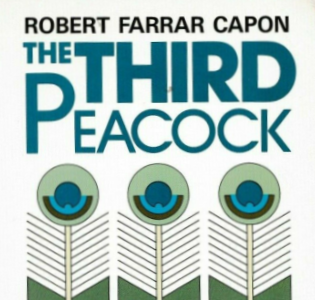
Capon writes with an easy prose that sounds more like the conversation one would have while sitting and enjoying a beer together (or whatever your drink of choice might be). He dispenses with theological jargon, offering instead a plain spoken, no holds barred assessment of the rough and tumble world we live in. How can this world possibly align with a good God? The reader may not agree with everything that is written, I didn’t, but this book does offer some insights for anyone that asks questions – either silently or aloud – about why there is so much suffering, both moral and natural, in creation.

I should warn you that this post is part book review and part blogging through a book. It summarizes many of the main points made in the book and thus contains spoilers.

The book opens with the sentence – “Let me tell you why God made the world.” By the middle of the next page we find the Trinity drinking wine, telling jokes and throwing olives at each other. With this analogy, which even Capon admits is crass, the author seeks to present the reader with the theology of delight. This attempts to overturn ideas of God as a cosmic kill-joy or stern judge. Perhaps it could serve as a rebuttal to the servant in Matthew 25 who sees God as overly harsh. The theology of delight offers up creation as one big party in which God took, and continues to take, great delight in what He has created.

Continue reading →

Reading History: John of Damascus answers Why the Cross?

As we continue our Easter related posts, we are going to look at John of Damascus’ reflections on the cross in his work Orthodox Faith. An eighth century theologian, John is best known for defending the veneration of icons and imagery when this issue was causing major divisions (link). Though intermixed with a defense of venerating the symbol of the cross (mostly removed from this post), John’s writing shows how central the cross is to orthodox Christianity.

The rest of this post contains excerpts from Book 4 chapter 11 (CCEL).


John_Damascus_(arabic_icon).gifEvery action, therefore, and performance of miracles by Christ are most great and divine and marvellous: but the most marvellous of all is His precious Cross. Continue reading →

Reading History: Justin Martyr answers Why the Cross?

Around 150 years before Athanasius wrote On the Incarnation, Justin Martyr wrote Dialogue with Trypho. As a Christian philosopher, Justin explored the case for Christ through a conversation with a Jewish seeker named Trypho. As the conversation unfolds the need for the cross is affirmed.

The rest of this post contains excerpts from chapters 89-95 from CCEL.


Then Trypho remarked, “Be assured that all our nation waits for Christ; and we admit that all the Scriptures which you have quoted refer to Him. … But whether Christ should be so shamefully crucified, this we are in doubt about. For whosoever is crucified is said in the law to be accursed, so that I am exceedingly incredulous on this point. It is quite clear, indeed, that the Scriptures announce that Christ had to suffer; but we wish to learn if you can prove it to us whether it was by the suffering cursed in the law.”

Saint_Justin_Martyr_by_Theophanes_the_Cretan

Justin the Philosopher by Theophanes the Cretan [Public domain], via Wikimedia Commons

I replied to him, “If Christ was not to suffer, and the prophets had not foretold that He would be led to death on account of the sins of the people, and be dishonoured and scourged, and reckoned among the transgressors, and as a sheep be led to the slaughter, whose generation, the prophet says, no man can declare, then you would have good cause to wonder.

But if these are to be characteristic of Him and mark Him out to all, how is it possible for us to do anything else than believe in Him most confidently? And will not as many as have understood the writings of the prophets, whenever they hear merely that He was crucified, say that this is He and no other?” Continue reading →